

8
J. A. (:ULLAND AND J. E. CARROZ
I
I
I
I
I
I
I
I
-+
c L
-
9 2 0 -
I
increasing (Wimpenny, 1053). Convincing proof that this decline, and
the decline in stocks of other valuable species, was due to fishing was
provided by the severe restrictions on fishing during the two world
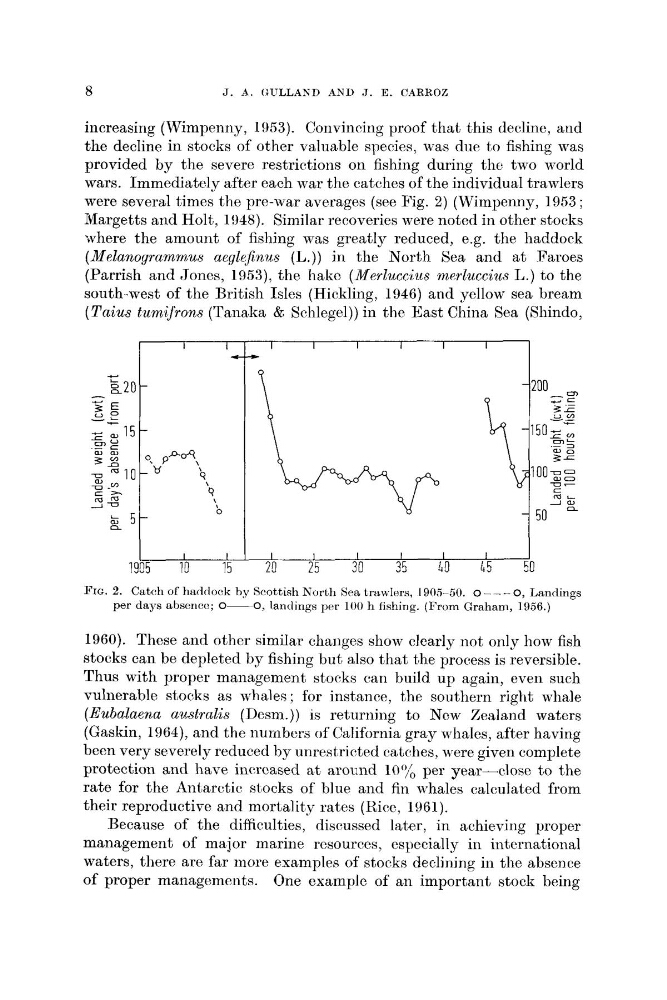
wars. Immediately after each war the catches of the individual trawlers
were several times the pre-war avesages (see Fig. 2) (Wimpenny, 1953 ;
Margetts and Holt, 1948). Similar recoveries were noted in other stocks
where the amount of fishing was greatly reduced, e.g. the haddock
(Melanogrammus aegle,finus (L.)) in the North Sea and a t Faroes
(Parrish and Jones, 1953), the hake (Merluccius mqrluccizcs L.) to the
south-west of the British Isles (Hickling, 1946) and yellow sea bream
(Taius tumifrons (Tanaka & Schlegel)) in the East China Sea (Shindo,
- m
200
c
2; -
-
r: g 1 5 -
3s
-a - 1 0 -
G -m
3 4 2
b 5 -
'sc m a )
c x
a
1960). These and other similar changes show clearly not only how fish
stocks can be depleted by fishing but also that the process is reversible.
Thus with proper management stocaks can build up again, even such
vulnerable stocks as whales ; for instance, the southern right whale
(Eubalaena australis (Desm.)) is returning to Ncw Zealand waters
(Gaskin, 1964), and the numbers of California gray whales, after having
been very severely reduced by unrestricted catches, were given complete
protection and have incrcased at around 10% per year-close to the
rate for the Antarctic stocks of blue and fin whales calculated from
their reproductive and mortality rates (Rice, 1961).
Because of the difficulties, discwssed later, in achieving proper
management of major mariiie resources, especially in international
waters, there are far more examples of stocks declining in the absence
of proper managements. One example of an important stock being
c c
9 P-4,
tr
c
m L
A a J
Q\
0
- 5 0
a
?,
I
I
I
I
I
1
J. A. (:ULLAND AND J. E. CARROZ
I
I
I
I
I
I
I
I
-+
c L
-
9 2 0 -
I
increasing (Wimpenny, 1053). Convincing proof that this decline, and
the decline in stocks of other valuable species, was due to fishing was
provided by the severe restrictions on fishing during the two world
wars. Immediately after each war the catches of the individual trawlers
were several times the pre-war avesages (see Fig. 2) (Wimpenny, 1953 ;
Margetts and Holt, 1948). Similar recoveries were noted in other stocks
where the amount of fishing was greatly reduced, e.g. the haddock
(Melanogrammus aegle,finus (L.)) in the North Sea and a t Faroes
(Parrish and Jones, 1953), the hake (Merluccius mqrluccizcs L.) to the
south-west of the British Isles (Hickling, 1946) and yellow sea bream
(Taius tumifrons (Tanaka & Schlegel)) in the East China Sea (Shindo,
- m
200
c
2; -
-
r: g 1 5 -
3s
-a - 1 0 -
G -m
3 4 2
b 5 -
'sc m a )
c x
a
1960). These and other similar changes show clearly not only how fish
stocks can be depleted by fishing but also that the process is reversible.
Thus with proper management stocaks can build up again, even such
vulnerable stocks as whales ; for instance, the southern right whale
(Eubalaena australis (Desm.)) is returning to Ncw Zealand waters
(Gaskin, 1964), and the numbers of California gray whales, after having
been very severely reduced by unrestricted catches, were given complete
protection and have incrcased at around 10% per year-close to the
rate for the Antarctic stocks of blue and fin whales calculated from
their reproductive and mortality rates (Rice, 1961).
Because of the difficulties, discwssed later, in achieving proper
management of major mariiie resources, especially in international
waters, there are far more examples of stocks declining in the absence
of proper managements. One example of an important stock being
c c
9 P-4,
tr
c
m L
A a J
Q\
0
- 5 0
a
?,
I
I
I
I
I
1