

172
WILLIAM MACNAE
a metre or so wide. This is an area of very high tides (33 m). The
burrows extend seawards clustered round the bases of the trees and
bushes almost to the lowermost levels of the bruguiera forests. The
burrows of Sesarma meinerti and of 8. smithii may be hooded and those
of the latter turreted.
I n Malaysia many of the sesarmas make turreted burrows pressed
up against the boles of the trees, others produce hooded burrows but
which species was responsible for any of these could not be determined.
Sesarmine burrows are circular in cross-section, surrounded by pellets
of sand or of mud and the size and form of these pellets is probably
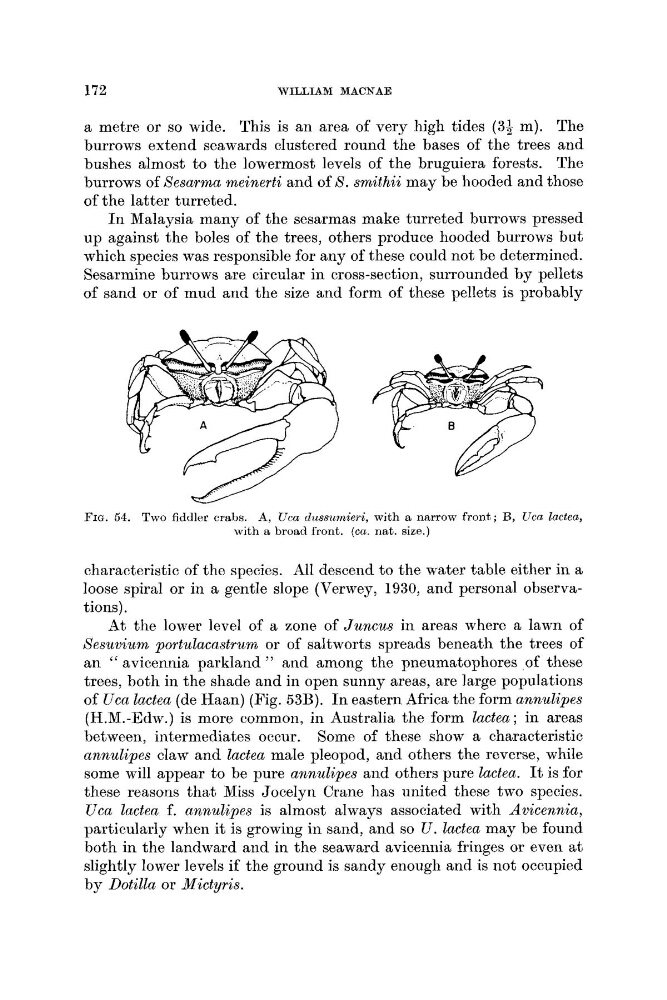
FIG. 54. Two fiddler crabs. A, Ura clzcssumieri, with a narrow front; B, Uca lactea,
with a broad front. (ca. nat. size.)
characteristic of the species. All descend to the water table either in a
loose spiral or in a gentle slope (Verwey, 1930, and personal observations).
At the lower level of a zone of Juncus in areas where a lawn of
Xesuvium portulacastrum or of saltworts spreads beneath the trees of
an ‘‘ avicennia parkland ” and among the pneumatophores of these
trees, both in the shade and in open sunny areas, are large populations
of Uca lactea (de Haan) (Fig. 53B). I n eastern Africa the form annulipes
(H.M.-Edw.) is more common, in Australia the form lactea; in areas
between, intermediates occur. Some of these show a characteristic
annulipes claw and lactea male pleopod, and others the reverse, while
some will appear to be pure annulipes and others pure lactea. It is for
these reasons that Miss Jocelyn Crane has united these two species.
Uca lactea f. annulipes is almost always associated with Avicennia,
particularly when it is growing in sand, and so U . lactea may be found
both in the landward and in the seaward avicennia fringes or even a t
slightly lower levels if the ground is sandy enough and is not occupied
by Dotilla or Mictyris.
WILLIAM MACNAE
a metre or so wide. This is an area of very high tides (33 m). The
burrows extend seawards clustered round the bases of the trees and
bushes almost to the lowermost levels of the bruguiera forests. The
burrows of Sesarma meinerti and of 8. smithii may be hooded and those
of the latter turreted.
I n Malaysia many of the sesarmas make turreted burrows pressed
up against the boles of the trees, others produce hooded burrows but
which species was responsible for any of these could not be determined.
Sesarmine burrows are circular in cross-section, surrounded by pellets
of sand or of mud and the size and form of these pellets is probably
FIG. 54. Two fiddler crabs. A, Ura clzcssumieri, with a narrow front; B, Uca lactea,
with a broad front. (ca. nat. size.)
characteristic of the species. All descend to the water table either in a
loose spiral or in a gentle slope (Verwey, 1930, and personal observations).
At the lower level of a zone of Juncus in areas where a lawn of
Xesuvium portulacastrum or of saltworts spreads beneath the trees of
an ‘‘ avicennia parkland ” and among the pneumatophores of these
trees, both in the shade and in open sunny areas, are large populations
of Uca lactea (de Haan) (Fig. 53B). I n eastern Africa the form annulipes
(H.M.-Edw.) is more common, in Australia the form lactea; in areas
between, intermediates occur. Some of these show a characteristic
annulipes claw and lactea male pleopod, and others the reverse, while
some will appear to be pure annulipes and others pure lactea. It is for
these reasons that Miss Jocelyn Crane has united these two species.
Uca lactea f. annulipes is almost always associated with Avicennia,
particularly when it is growing in sand, and so U . lactea may be found
both in the landward and in the seaward avicennia fringes or even a t
slightly lower levels if the ground is sandy enough and is not occupied
by Dotilla or Mictyris.