

120
WILLIAM MACNAE
At the Bako National Park the mangal in the small estuary of the
Sungei Lakei besar, a stream which drains virgin forest on a Tertiary
sandstone, had also developed .in sand and showed a similar pattern
of those mangroves which prefer well-drained soils ; these included
Xonneratia alba, Rhizophora apiculata, Ceriops tagal, Excoecaria agallocha
and Osbornia octodonta F.v.M. mostly in mixed stands with little
tendency to zonation.
The mangrove forests associated with the low-wooded-island reefs
of the Great Barrier Reef system also depart from the norm. At Low
Isles (Big. 29), while the upper part of the mangrove zonation is almost
normal, the seaward fringe is peculiar (T. A. Stephenson et al., 1931 ;
W. Stephenson et al., 1958; Macnae, 1966). The landward fringe is
very narrow but contains trees such as Osbornia octodonta, Pemphis
acidula L., Excoecaria agallocha, Avicennia marina, Aegialitis annulata
R. Br. and others. The seaward fringe extends below the level of the
water table-if not below mean sea-level-and in a shallow lagoon
some 20 cm deep a t low water of springs one finds well-grown trees of
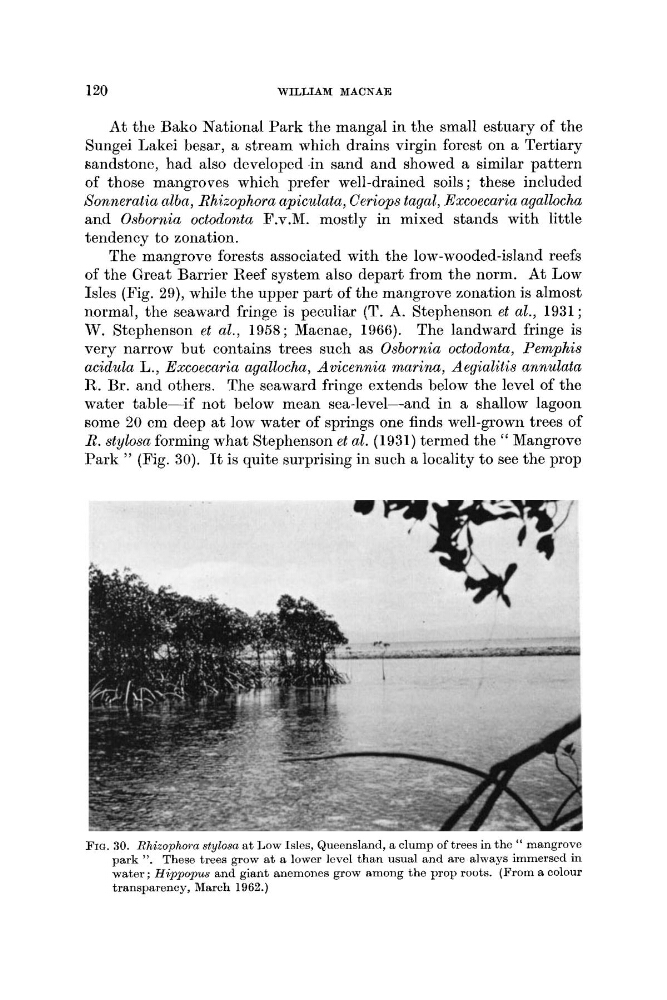
R. stylosa forming what Stephenson et al. (1931) termed the " Mangrove
Park " (Big. 30). It is quite surprising in such a locality to see the prop
FIG. 30. Rhizopho~a stylosa a t Low Isles, Queensland, a clump of trees in the " mangrove
park ". These trces grow a t a lower level than usual and are always immersed in
water; Hippopus and giant anemones grow among the prop roots. (From a colour
transparency, March 1962.)
WILLIAM MACNAE
At the Bako National Park the mangal in the small estuary of the
Sungei Lakei besar, a stream which drains virgin forest on a Tertiary
sandstone, had also developed .in sand and showed a similar pattern
of those mangroves which prefer well-drained soils ; these included
Xonneratia alba, Rhizophora apiculata, Ceriops tagal, Excoecaria agallocha
and Osbornia octodonta F.v.M. mostly in mixed stands with little
tendency to zonation.
The mangrove forests associated with the low-wooded-island reefs
of the Great Barrier Reef system also depart from the norm. At Low
Isles (Big. 29), while the upper part of the mangrove zonation is almost
normal, the seaward fringe is peculiar (T. A. Stephenson et al., 1931 ;
W. Stephenson et al., 1958; Macnae, 1966). The landward fringe is
very narrow but contains trees such as Osbornia octodonta, Pemphis
acidula L., Excoecaria agallocha, Avicennia marina, Aegialitis annulata
R. Br. and others. The seaward fringe extends below the level of the
water table-if not below mean sea-level-and in a shallow lagoon
some 20 cm deep a t low water of springs one finds well-grown trees of
R. stylosa forming what Stephenson et al. (1931) termed the " Mangrove
Park " (Big. 30). It is quite surprising in such a locality to see the prop
FIG. 30. Rhizopho~a stylosa a t Low Isles, Queensland, a clump of trees in the " mangrove
park ". These trces grow a t a lower level than usual and are always immersed in
water; Hippopus and giant anemones grow among the prop roots. (From a colour
transparency, March 1962.)