

10s
WILLIAM MACNAE
support a ‘‘ herb-layer ” of the fern Acrostichunz speciosunz which tends
to be restricted to the mounds cast up by Thalassina anomala (Fig. 5 2 ,
p. 170) ; the lower lcvels of the soil surface arc bare or colonized by mats
of algae, mostly blue-green.
D. Zones of rhixophora forests
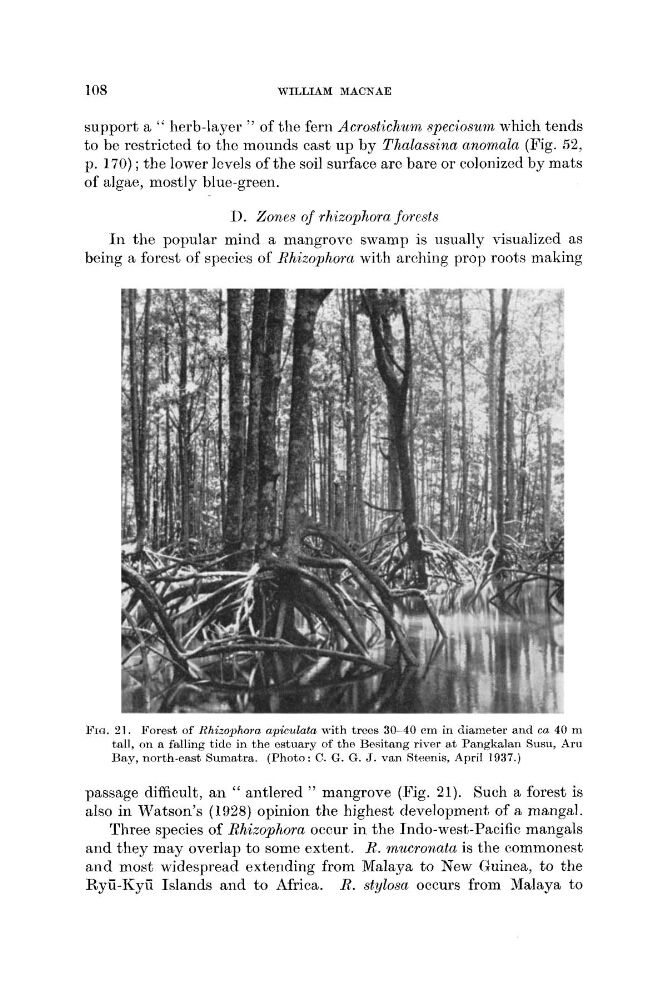
I n the popular mind a mangrove swamp is usually visualized as
being a forest of species of Rhizophora with arching prop roots making
FIG. 21. Forest of Rhizophora upiculuta with trees 30-40 cm in diameter and ca 40 m
tall, on a falling tide in the estuary of the Besitang river a t Pangkalan Gusu, Aru
Bay, north-east Sumatra. (Photo : C. G. G. J. van Gteenis, April 1937.)
passage difficult, an “ antlered ” mangrove (Fig. 21). Such a forest is
also in Watson’s (1928) opinion the highest development of a mangal.
Three species of Rhixophora occur in the Indo-west-Pacific mangals
and they may overlap to some extent. R. mucronata is the commonest
and most widespread extending from Malaya to New Guinea, to the
Ryii-Kyii Islands and to Africa. R. stylosa occurs from Malaya to
WILLIAM MACNAE
support a ‘‘ herb-layer ” of the fern Acrostichunz speciosunz which tends
to be restricted to the mounds cast up by Thalassina anomala (Fig. 5 2 ,
p. 170) ; the lower lcvels of the soil surface arc bare or colonized by mats
of algae, mostly blue-green.
D. Zones of rhixophora forests
I n the popular mind a mangrove swamp is usually visualized as
being a forest of species of Rhizophora with arching prop roots making
FIG. 21. Forest of Rhizophora upiculuta with trees 30-40 cm in diameter and ca 40 m
tall, on a falling tide in the estuary of the Besitang river a t Pangkalan Gusu, Aru
Bay, north-east Sumatra. (Photo : C. G. G. J. van Gteenis, April 1937.)
passage difficult, an “ antlered ” mangrove (Fig. 21). Such a forest is
also in Watson’s (1928) opinion the highest development of a mangal.
Three species of Rhixophora occur in the Indo-west-Pacific mangals
and they may overlap to some extent. R. mucronata is the commonest
and most widespread extending from Malaya to New Guinea, to the
Ryii-Kyii Islands and to Africa. R. stylosa occurs from Malaya to