

FATJNA AND FLORA O F MANGROVE SWAMPS
103
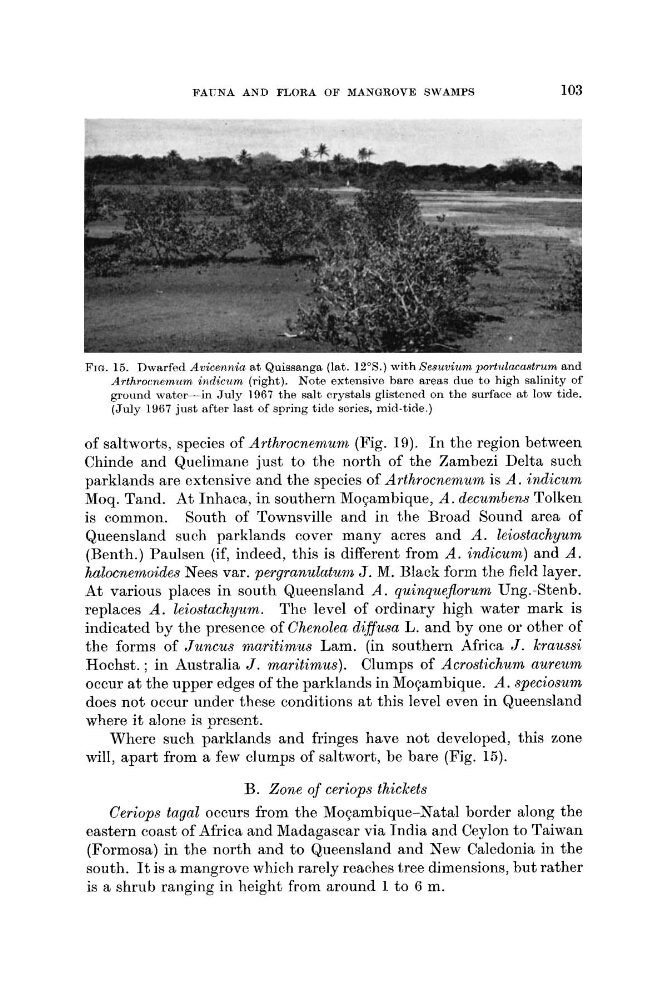
FIG. 15. Dwarfed Auicennia at Quissanga (lat. 12°K) with Sesuvium portulacastrum and
Arthrornemum indicum (right). Note extensive bare areas due to high salinity of
ground water-in July 1967 the salt crystals glistened on the surface a t low tide.
(July 1967 just after last of spring tide series, mid-tide.)
of saltworts, species of Arthrocnemum (Fig. 19). In the region between
Chinde and Quelimane just to the north of the Zambezi Delta such
parklands are extensive and the species of Arthrocnemum is A . indicum
Moq. Tand. At Inhaca, in southern Moqambique, A . decumbens Tolken
is common. South of Townsville and in the Broad Sound area of
Queensland such parklands cover many acres and A . leiostachyum
(Benth.) Paulsen (if, indeed, this is different from A . indicum) and A .
hnlocnemoides Nees var. pergranulntu~ J. M. Black form the field layer.
At various places in south Queensland A. quinquejlorum Ung.-Stenb.
replaces A. leiostachyum. The level of ordinary high water mark is
indicated by the presence of Chenolea diflusa L. and by one or other of
the forms of Juncus maritimus Lam. (in southern Africa J . kraussi
Hochst. ; in Australia J . maritimus). Clumps of Acrostichum aureum
occur at the upper edges of the parklands in Mogambique. A. speciosum
does not occur under these conditions at this level even in Queensland
where it alone is present.
Where such parklands and fringes have not developed, this zone
will, apart from a few clumps of saltwort, be bare (Fig. 15).
B. Zone of ceriops thickets
Ceriops tagal occurs from the Moqambique-Natal border along the
eastern coast of Africa and Madagascar via India and Ceylon to Taiwan
(Formosa) in the north and to Queensland and New Caledonia in the
south. It is a mangrove which rarely reaches tree dimensions, but rather
is a shrub ranging in height from around 1 to 6 m.
103
FIG. 15. Dwarfed Auicennia at Quissanga (lat. 12°K) with Sesuvium portulacastrum and
Arthrornemum indicum (right). Note extensive bare areas due to high salinity of
ground water-in July 1967 the salt crystals glistened on the surface a t low tide.
(July 1967 just after last of spring tide series, mid-tide.)
of saltworts, species of Arthrocnemum (Fig. 19). In the region between
Chinde and Quelimane just to the north of the Zambezi Delta such
parklands are extensive and the species of Arthrocnemum is A . indicum
Moq. Tand. At Inhaca, in southern Moqambique, A . decumbens Tolken
is common. South of Townsville and in the Broad Sound area of
Queensland such parklands cover many acres and A . leiostachyum
(Benth.) Paulsen (if, indeed, this is different from A . indicum) and A .
hnlocnemoides Nees var. pergranulntu~ J. M. Black form the field layer.
At various places in south Queensland A. quinquejlorum Ung.-Stenb.
replaces A. leiostachyum. The level of ordinary high water mark is
indicated by the presence of Chenolea diflusa L. and by one or other of
the forms of Juncus maritimus Lam. (in southern Africa J . kraussi
Hochst. ; in Australia J . maritimus). Clumps of Acrostichum aureum
occur at the upper edges of the parklands in Mogambique. A. speciosum
does not occur under these conditions at this level even in Queensland
where it alone is present.
Where such parklands and fringes have not developed, this zone
will, apart from a few clumps of saltwort, be bare (Fig. 15).
B. Zone of ceriops thickets
Ceriops tagal occurs from the Moqambique-Natal border along the
eastern coast of Africa and Madagascar via India and Ceylon to Taiwan
(Formosa) in the north and to Queensland and New Caledonia in the
south. It is a mangrove which rarely reaches tree dimensions, but rather
is a shrub ranging in height from around 1 to 6 m.