

4. ANALYSIS O F FACTORS INVOLVED IN SYMBIOSIS
67
studied both metacercarial recovery rates and host responses. It was
determined t h a t the nature of the outer metacercarial cyst wall, which
actually represents host tissues responding t o the presence of the
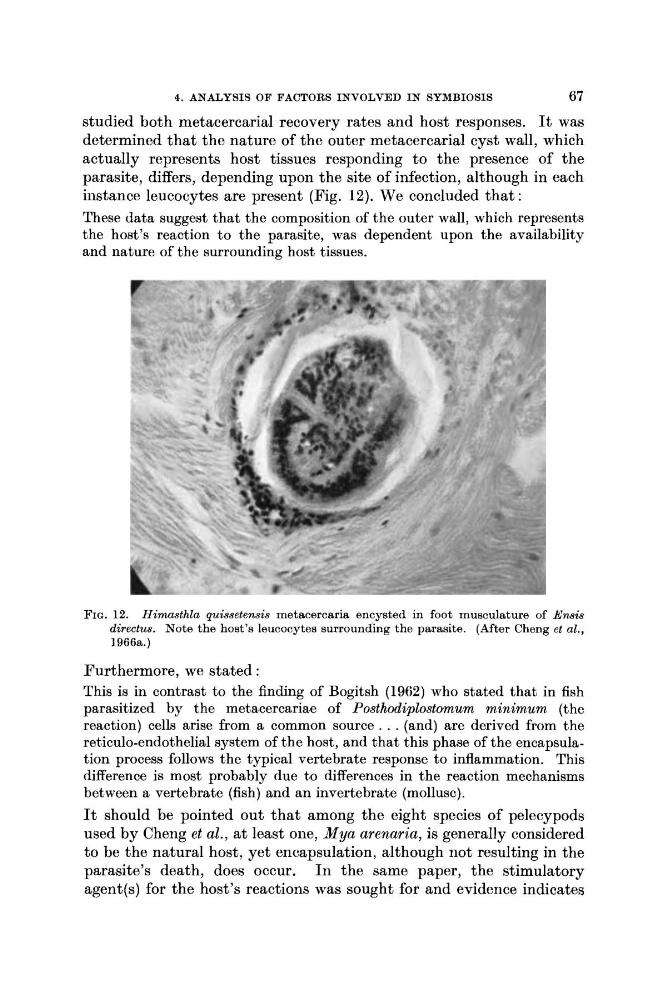
parasite, differs, depending upon the site of infection, although in each
instance leucocytes are present (Fig. 12). We concluded t h a t :
These data suggest that the composition of the outer wall, which represents
the host’s reaction to the parasite, was dependent upon the availability
and nature of the surrounding host tissues.
FIG. 12. Uimasthla quissetensis metacercaria encysted in foot musculature of Ensis
directus. Note the host’s leucocytes surrounding the parasite. (After Cheng et al.,
1966a.)
Furthermore, we stated :
This is in contrast to the finding of Bogitsh (1962) who stated that in fish
parasitized by the metacercariae of Posthodiplostomum minimum (the
reaction) cells arise from a common source. . . (and) are derived from the
reticulo-endothelial system of the host, and that this phase of the encapsulation process follows the typical vertebrate response to inflammation. This
difference is most probably due to differences in the reaction mechanisms
between a vertebrate (fish) and an invertebrate (mollusc).
It should be pointed out t h a t among the eight species of pelecypods
used by Cheng et al., at least one, M y a arenaria, is generally considered
t o be the natural host, yet encapsulation, although not resulting in the
parasite’s death, does occur. In the same paper, the stimulatory
agent(s) for the host’s reactions was sought for and evidence indicates
67
studied both metacercarial recovery rates and host responses. It was
determined t h a t the nature of the outer metacercarial cyst wall, which
actually represents host tissues responding t o the presence of the
parasite, differs, depending upon the site of infection, although in each
instance leucocytes are present (Fig. 12). We concluded t h a t :
These data suggest that the composition of the outer wall, which represents
the host’s reaction to the parasite, was dependent upon the availability
and nature of the surrounding host tissues.
FIG. 12. Uimasthla quissetensis metacercaria encysted in foot musculature of Ensis
directus. Note the host’s leucocytes surrounding the parasite. (After Cheng et al.,
1966a.)
Furthermore, we stated :
This is in contrast to the finding of Bogitsh (1962) who stated that in fish
parasitized by the metacercariae of Posthodiplostomum minimum (the
reaction) cells arise from a common source. . . (and) are derived from the
reticulo-endothelial system of the host, and that this phase of the encapsulation process follows the typical vertebrate response to inflammation. This
difference is most probably due to differences in the reaction mechanisms
between a vertebrate (fish) and an invertebrate (mollusc).
It should be pointed out t h a t among the eight species of pelecypods
used by Cheng et al., at least one, M y a arenaria, is generally considered
t o be the natural host, yet encapsulation, although not resulting in the
parasite’s death, does occur. In the same paper, the stimulatory
agent(s) for the host’s reactions was sought for and evidence indicates