

64
MARINE MOLLUSCS AS HOSTS FOR SYMBIOSES
Little is known about environmental parameters which influence
molluscan phagocytic activity. As Stauber (1950) has pointed out, it
is to be expected that in molluscs (he referred specifically to the oyster,
but the same undoubtedly holds true for all molluscs), which are
poikilothermic animals, the degree of activity of phagocytes would be
affected by temperature changes. I n his experiments with India ink
cited above, he demonstrated that a t temperatures ranging from 12 to
2 1"C, ink-laden phagocytes were observed migrating across epithelial
layers after 8 days. With the temperature maintained as 21"C, Tripp
(1958a) has shown that phagocytes enclosing introduced erythrocytes
migrated through epithelia in 2 days. It is thus evident that temperature could influence the rate of phagocytosis and discharge ; however,
critical studies, utilizing identical introduced material, should be
conducted to study the influence of various environmental parameters.
b. Encapsulation
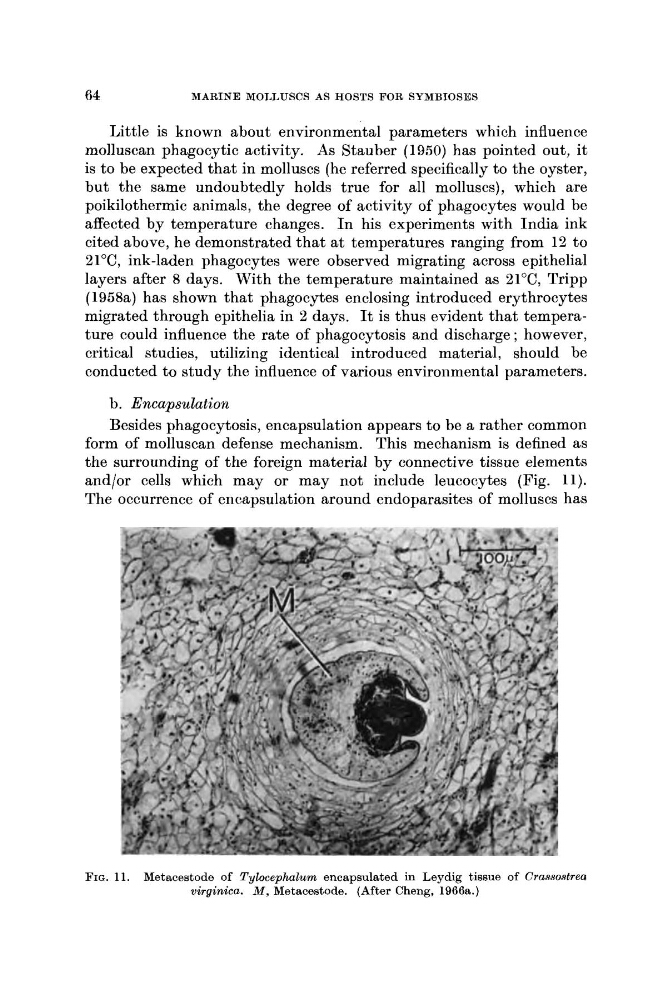
Besides phagocytosis, encapsulation appears to be a rather common
form of molluscan defense mechanism. This mechanism is defined as
the surrounding of the foreign material by connective tissue elements
and/or cells which may or may not include leucocytes (Fig. 11).
The occurrence of encapsulation around endoparasites of molluscs has
FIG. 11. Metacestode of Tylocephalurn encapsulated in Leydig tissue of Grassostreci
wirginica. M , Metacestode. (After Cheng, 1966a.)
MARINE MOLLUSCS AS HOSTS FOR SYMBIOSES
Little is known about environmental parameters which influence
molluscan phagocytic activity. As Stauber (1950) has pointed out, it
is to be expected that in molluscs (he referred specifically to the oyster,
but the same undoubtedly holds true for all molluscs), which are
poikilothermic animals, the degree of activity of phagocytes would be
affected by temperature changes. I n his experiments with India ink
cited above, he demonstrated that a t temperatures ranging from 12 to
2 1"C, ink-laden phagocytes were observed migrating across epithelial
layers after 8 days. With the temperature maintained as 21"C, Tripp
(1958a) has shown that phagocytes enclosing introduced erythrocytes
migrated through epithelia in 2 days. It is thus evident that temperature could influence the rate of phagocytosis and discharge ; however,
critical studies, utilizing identical introduced material, should be
conducted to study the influence of various environmental parameters.
b. Encapsulation
Besides phagocytosis, encapsulation appears to be a rather common
form of molluscan defense mechanism. This mechanism is defined as
the surrounding of the foreign material by connective tissue elements
and/or cells which may or may not include leucocytes (Fig. 11).
The occurrence of encapsulation around endoparasites of molluscs has
FIG. 11. Metacestode of Tylocephalurn encapsulated in Leydig tissue of Grassostreci
wirginica. M , Metacestode. (After Cheng, 1966a.)