

44
MARINE MOLLUSCS AS HOSTS FOR SYMBIOSES
process. If the invasive stage of this crab is placed in an aquarium with
several species of pelecypods, it chooses Crassostrea virginica. No
experimental evidence is yet available that would indica
chemotaxis, or a combination of both, although according to Johnson
(1952), who employed a Y-tube apparatus, no attraction was found to
exist between Pinnotheres ostreum and Crassostrea virginica. Similarly,
Johnson has reported the absence of attraction between the commensal
crabs Polyonynx macrocheles and Pinnixa chaetopterana and their
host, the marine annelid Chaetopterus variopedatus. On the other hand,
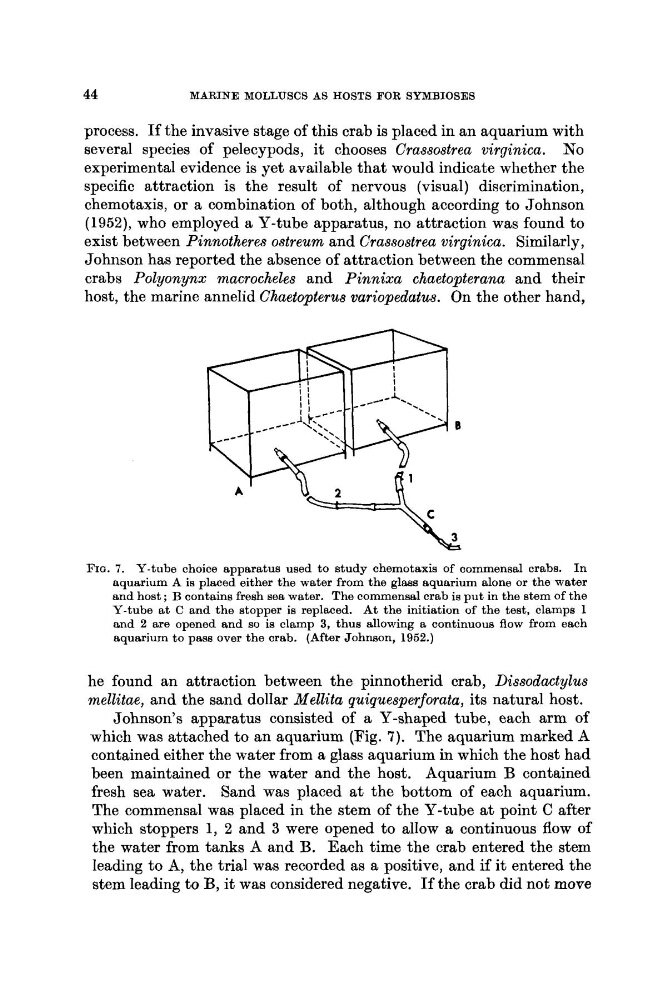
FIQ. 7. Y-tube choice apparatus used to study chemotaxis of commensal crabs. I n
aquarium A is placed either the water from the glass aquarium alone or the water
and host ; B contains fresh sea water. The commensal crab is put in the stem of the
Y-tube a t C and the stopper is replaced. At the initiation of the test, clamps 1
and 2 are opened and so is clamp 3, thus allowing a continuous flow from each
aquarium to pass over the crab. (After Johnson, 1952.)
he found an attraction between the pinnotherid crab, Dissodactylus
mellitae, and the sand dollar Mellita quiquesperforata, its natural host.
Johnson’s apparatus consisted of a Y-shaped tube, each arm of
which was attached to an aquarium (Fig. 7). The aquarium marked A
contained either the water from a glass aquarium in which the host had
been maintained or the water and the host. Aquarium B contained
fresh sea water. Sand was placed at the bottom of each aquarium.
The commensal was placed in the stem of the Y-tube at point C after
which stoppers 1, 2 and 3 were opened to allow a continuous flow of
the water from tanks A and B. Each time the crab entered the stem
leading to A, the trial was recorded as a positive, and if it entered the
stem leading to B, it was considered negative. If the crab did not move
MARINE MOLLUSCS AS HOSTS FOR SYMBIOSES
process. If the invasive stage of this crab is placed in an aquarium with
several species of pelecypods, it chooses Crassostrea virginica. No
experimental evidence is yet available that would indica
chemotaxis, or a combination of both, although according to Johnson
(1952), who employed a Y-tube apparatus, no attraction was found to
exist between Pinnotheres ostreum and Crassostrea virginica. Similarly,
Johnson has reported the absence of attraction between the commensal
crabs Polyonynx macrocheles and Pinnixa chaetopterana and their
host, the marine annelid Chaetopterus variopedatus. On the other hand,
FIQ. 7. Y-tube choice apparatus used to study chemotaxis of commensal crabs. I n
aquarium A is placed either the water from the glass aquarium alone or the water
and host ; B contains fresh sea water. The commensal crab is put in the stem of the
Y-tube a t C and the stopper is replaced. At the initiation of the test, clamps 1
and 2 are opened and so is clamp 3, thus allowing a continuous flow from each
aquarium to pass over the crab. (After Johnson, 1952.)
he found an attraction between the pinnotherid crab, Dissodactylus
mellitae, and the sand dollar Mellita quiquesperforata, its natural host.
Johnson’s apparatus consisted of a Y-shaped tube, each arm of
which was attached to an aquarium (Fig. 7). The aquarium marked A
contained either the water from a glass aquarium in which the host had
been maintained or the water and the host. Aquarium B contained
fresh sea water. Sand was placed at the bottom of each aquarium.
The commensal was placed in the stem of the Y-tube at point C after
which stoppers 1, 2 and 3 were opened to allow a continuous flow of
the water from tanks A and B. Each time the crab entered the stem
leading to A, the trial was recorded as a positive, and if it entered the
stem leading to B, it was considered negative. If the crab did not move