

4. ANALYSIS OF FACTORS INVOLVED I N SYMBIOSIS
33
free-living flatworms and called it “ circus movement ”. According to
these investigators, the “circus movement” is a consequence of a
“ chemo-tropo-tactic ” type of response. It appears to reflect the
response of only one of a pair of bilateral receptors, causing a complete
turning towards a favorable stimulus or away from an unfavorable one.
In addition to utilizing the behavior patterns described above,
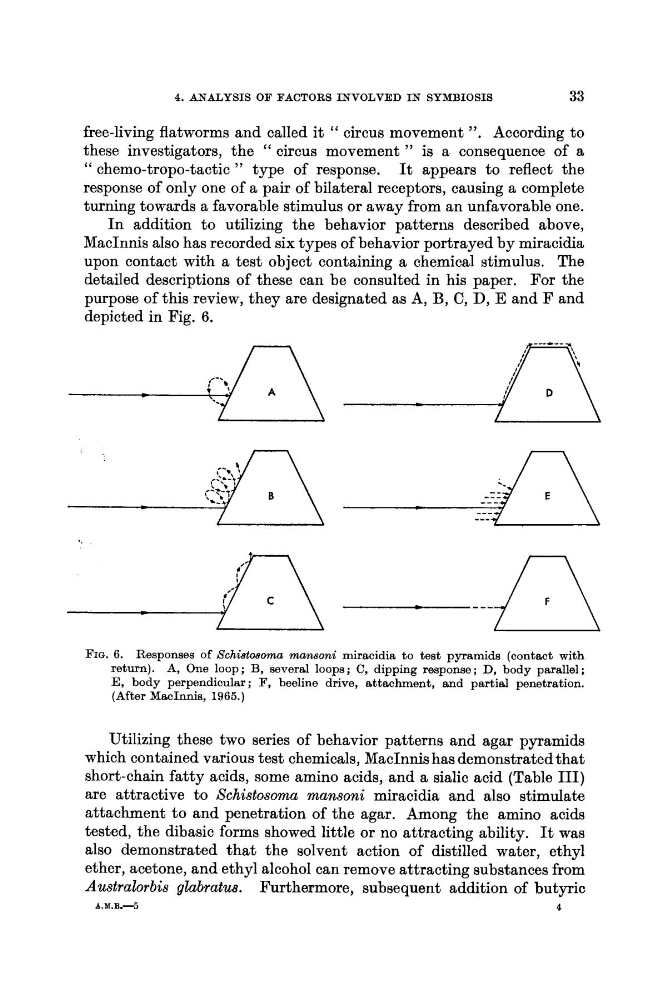
MacInnis also has recorded six types of behavior portrayed by miracidia
upon contact with a test object containing a chemical stimulus. The
detailed descriptions of these can be consulted in his paper. For the
purpose of this review, they are designated as A, B, C, D, E and F and
depicted in Fig. 6.
FIG. 6. Responses of Schistosoma mansoni miracidia to test pyramids (contact with
return). A, One loop; B, several loops; C, dipping response; D, body parallel;
E, body perpendicular ; F, beeline drive, attachment, and partial penetration.
(After MacInnis, 1965.)
Utilizing these two series of behavior patterns and agar pyramids
which contained various test chemicals, MacInnis has demonstrated that
short-chain fatty acids, some amino acids, and a sialic acid (Table 111)
are attractive to Schistosoma mansoni miracidia and also stimulate
attachment to and penetration of the agar. Among the amino acids
tested, the dibasic forms showed little or no attracting ability. It was
also demonstrated that the solvent action of distilled water, ethyl
ether, acetone, and ethyl alcohol can remove attracting substances from
Australorbis glabratus. Furthermore, subsequent addition of butyric
A.M.B.-5
4
33
free-living flatworms and called it “ circus movement ”. According to
these investigators, the “circus movement” is a consequence of a
“ chemo-tropo-tactic ” type of response. It appears to reflect the
response of only one of a pair of bilateral receptors, causing a complete
turning towards a favorable stimulus or away from an unfavorable one.
In addition to utilizing the behavior patterns described above,
MacInnis also has recorded six types of behavior portrayed by miracidia
upon contact with a test object containing a chemical stimulus. The
detailed descriptions of these can be consulted in his paper. For the
purpose of this review, they are designated as A, B, C, D, E and F and
depicted in Fig. 6.
FIG. 6. Responses of Schistosoma mansoni miracidia to test pyramids (contact with
return). A, One loop; B, several loops; C, dipping response; D, body parallel;
E, body perpendicular ; F, beeline drive, attachment, and partial penetration.
(After MacInnis, 1965.)
Utilizing these two series of behavior patterns and agar pyramids
which contained various test chemicals, MacInnis has demonstrated that
short-chain fatty acids, some amino acids, and a sialic acid (Table 111)
are attractive to Schistosoma mansoni miracidia and also stimulate
attachment to and penetration of the agar. Among the amino acids
tested, the dibasic forms showed little or no attracting ability. It was
also demonstrated that the solvent action of distilled water, ethyl
ether, acetone, and ethyl alcohol can remove attracting substances from
Australorbis glabratus. Furthermore, subsequent addition of butyric
A.M.B.-5
4