

4. ANALYSIS OF FACTORS INVOLVED I N SYMBIOSIS
29
associated with the crushed snails due to increased turbidity caused
by released respiratory pigments. Control experiments with four sham
snails revealed no statistically significant difference in miracidial
distribution. Thus, Etges and Decker have quite convincingly dernonstrated chemotactic attraction of miracidia to their normal host,
although these workers expressed their uncertainty as to whether such
a stimulus is operative under natural conditions. They further maintained that both light and gravity are far more powerful influences in
determining the orientation of Sch.istosoma rnansoni miracidia than the
molluscan host’s chemotactic attraction. S. mansoni miracidia are
known to be negatively geotactic in addition to being positively
phototactic.
The fact that Etges and Decker have found that crushed snails
attracted miracidia 1 h after the death of the snails is of interest since
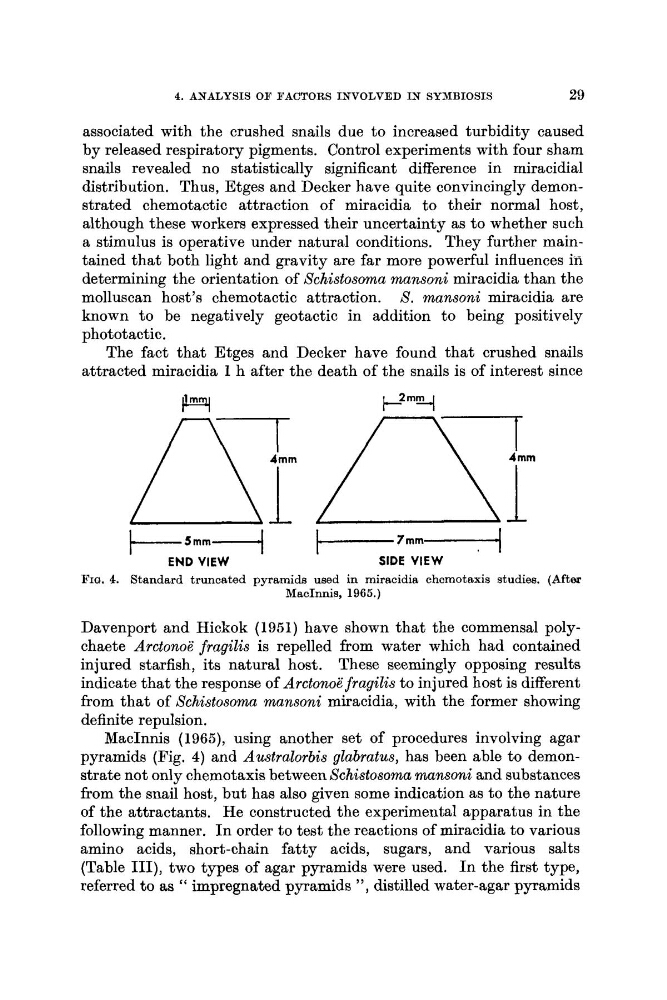
END VIEW
SIDE VIEW
FIG. 4. Standard truncated pyramids used in miracidia chemotaxis studies. (After
Machnis, 1965.)
Davenport and Hickok (1951) have shown that the commensal polychaete Arctonoe fragilis is repelled from water which had contained
injured starfish, its natural host. These seemingly opposing results
indicate that the response of Arctonoe fragilis to injured host is different
from that of Schistosoma mansoni miracidia, with the former showing
definite repulsion.
MacInnis (1965), using another set of procedures involving agar
pyramids (Fig. 4) and Australorbis glabratus, has been able to demonstrate not only chemotaxis between Schistosoma mansoni and substances
from the snail host, but has also given some indication as to the nature
of the attractants. He constructed the experimental apparatus in the
following manner. In order to test the reactions of miracidia to various
amino acids, short-chain fatty acids, sugars, and various salts
(Table 111), two types of agar pyramids were used. In the first type,
referred to as “ impregnated pyramids ”, distilled water-agar pyramids
29
associated with the crushed snails due to increased turbidity caused
by released respiratory pigments. Control experiments with four sham
snails revealed no statistically significant difference in miracidial
distribution. Thus, Etges and Decker have quite convincingly dernonstrated chemotactic attraction of miracidia to their normal host,
although these workers expressed their uncertainty as to whether such
a stimulus is operative under natural conditions. They further maintained that both light and gravity are far more powerful influences in
determining the orientation of Sch.istosoma rnansoni miracidia than the
molluscan host’s chemotactic attraction. S. mansoni miracidia are
known to be negatively geotactic in addition to being positively
phototactic.
The fact that Etges and Decker have found that crushed snails
attracted miracidia 1 h after the death of the snails is of interest since
END VIEW
SIDE VIEW
FIG. 4. Standard truncated pyramids used in miracidia chemotaxis studies. (After
Machnis, 1965.)
Davenport and Hickok (1951) have shown that the commensal polychaete Arctonoe fragilis is repelled from water which had contained
injured starfish, its natural host. These seemingly opposing results
indicate that the response of Arctonoe fragilis to injured host is different
from that of Schistosoma mansoni miracidia, with the former showing
definite repulsion.
MacInnis (1965), using another set of procedures involving agar
pyramids (Fig. 4) and Australorbis glabratus, has been able to demonstrate not only chemotaxis between Schistosoma mansoni and substances
from the snail host, but has also given some indication as to the nature
of the attractants. He constructed the experimental apparatus in the
following manner. In order to test the reactions of miracidia to various
amino acids, short-chain fatty acids, sugars, and various salts
(Table 111), two types of agar pyramids were used. In the first type,
referred to as “ impregnated pyramids ”, distilled water-agar pyramids