

26
MARINE MOLLUSUS AS HOSTS FOR SYMBIOSES
led to another series of experiments during which the extract from a
snail was added to a dish with a known number of miracidia before a
healthy snail was placed therein. It was found that in such a preparation
the number of miracidia which aggregated around the snail is markedly
reduced when compared with control snail and miracidia preparations
to which no snail extract had been added. Comparable evidences
were again reported by Kloetzel (1960). His studies certainly give
strong support to the belief that some degree of chemical attraction
exists between Austrabrbis glabratus and Schistosoma mansoni miracidia
although the attraction appears to be effective only over short distances.
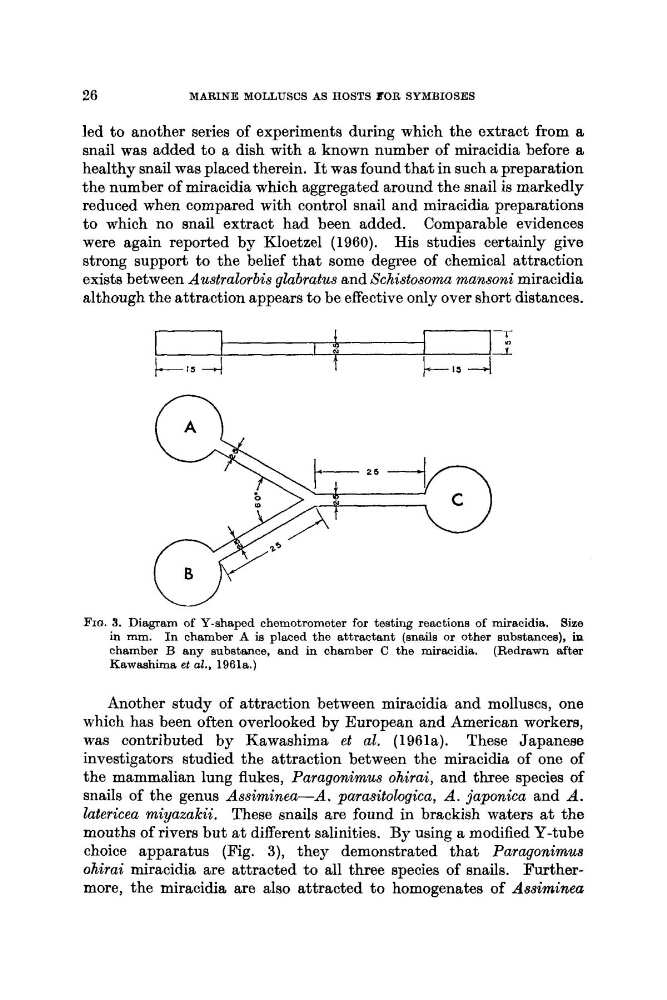
FIG. 3. Diagram of Y-shaped chemotrometer for testing reactions of miracidia. Size
In chamber A is placed the attractant (snails or other substances), in
(Redrawn after
in mm.
chamber B any substance, and in chamber C the miracidia.
Kawashima et al., 1961a.)
Another study of attraction between miracidia and molluscs, one
which has been often overlooked by European and American workers,
was contributed by Kawashima et al. (1961a). These Japanese
investigators studied the attraction between the miracidia of one of
the mammalian lung flukes, Paragonimus ohirai, and three species of
snails of the genus Assiminea-A . parasitologica, A. japonica and A .
latericea miyazakii. These snails are found in brackish waters at the
mouths of rivers but at different salinities. By using a modified Y-tube
choice apparatus (Fig. 3), they demonstrated that Paragonimus
ohirai miracidia are attracted to all three species of snails. Furthermore, the miracidia are also attracted to homogenates of Assiminea
MARINE MOLLUSUS AS HOSTS FOR SYMBIOSES
led to another series of experiments during which the extract from a
snail was added to a dish with a known number of miracidia before a
healthy snail was placed therein. It was found that in such a preparation
the number of miracidia which aggregated around the snail is markedly
reduced when compared with control snail and miracidia preparations
to which no snail extract had been added. Comparable evidences
were again reported by Kloetzel (1960). His studies certainly give
strong support to the belief that some degree of chemical attraction
exists between Austrabrbis glabratus and Schistosoma mansoni miracidia
although the attraction appears to be effective only over short distances.
FIG. 3. Diagram of Y-shaped chemotrometer for testing reactions of miracidia. Size
In chamber A is placed the attractant (snails or other substances), in
(Redrawn after
in mm.
chamber B any substance, and in chamber C the miracidia.
Kawashima et al., 1961a.)
Another study of attraction between miracidia and molluscs, one
which has been often overlooked by European and American workers,
was contributed by Kawashima et al. (1961a). These Japanese
investigators studied the attraction between the miracidia of one of
the mammalian lung flukes, Paragonimus ohirai, and three species of
snails of the genus Assiminea-A . parasitologica, A. japonica and A .
latericea miyazakii. These snails are found in brackish waters at the
mouths of rivers but at different salinities. By using a modified Y-tube
choice apparatus (Fig. 3), they demonstrated that Paragonimus
ohirai miracidia are attracted to all three species of snails. Furthermore, the miracidia are also attracted to homogenates of Assiminea