

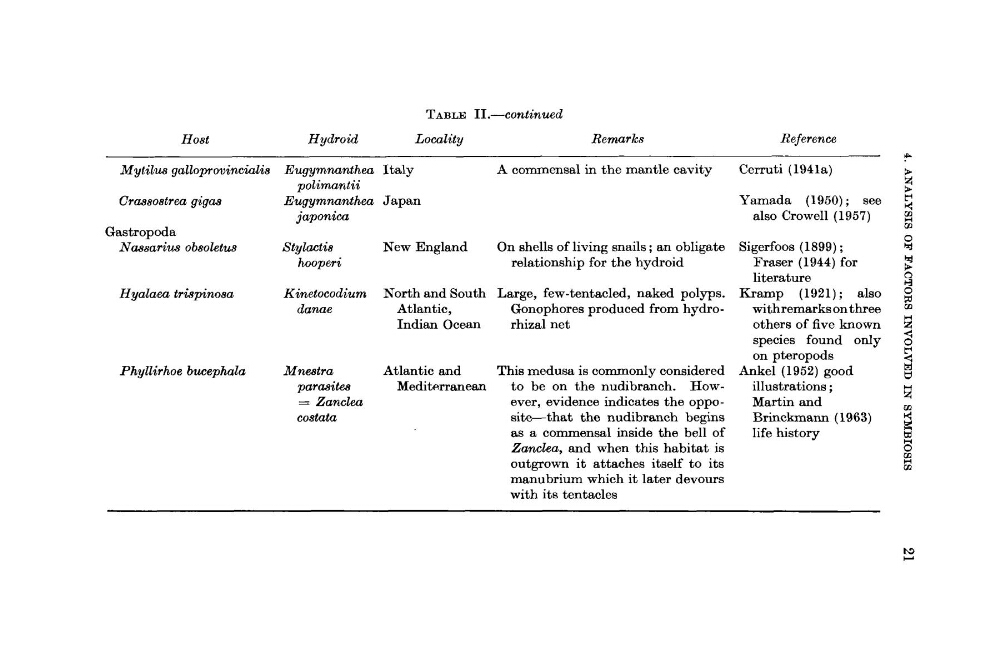
TABLE 11.-continued
Host
Hydroid
Locality
Remarks
Reference
Mytilus galloprovincialis Eugymnanthea ltaly
A commensal in the mantle cavity
Crassostrea gigas
Eugymnanthea Japan
polimantii
japonica
Gastropoda
Naasarius obsoletus
Stylactis
New England
On shells of living snails ; an obligate
hooperi
relationship for the hydroid
Hyalaea trispinosa
Kinetocodium North and South Large, few-tentacled, naked polyps.
d a m e
Atlantic,
Gonophores produced from hydroIndian Ocean
rhizal net
Phyllirhoe bucephala
Mnmtra
Atlantic and
This medusa is commonly considered
parasites
Mediterranean
to be on the nudibranch. How= Zanclea
ever, evidence indicates the oppocoslata
site-that the nudibranch begins
as a commensal inside the bell of
Zanclea, and when this habitat is
outgrown it attaches itself to its
manubrium which it later devours
with its tentacles
P
Cerruti (1941a)
Yamada (1950); see
5
also Crowell (1957)
w
0
Ei
m
Sigerfoos (1899) ;
w
Fraser (1944) for
w
! i
literature
e
&
(1921); also
withremarksonthree
others of five known
2
species found only
2
on pteropods
Ankel (1952) good
illustrations ;
Martin and
Brinckmann (1963)
life hist'ory
Q
E
w
Fn
L
!
0
m
Host
Hydroid
Locality
Remarks
Reference
Mytilus galloprovincialis Eugymnanthea ltaly
A commensal in the mantle cavity
Crassostrea gigas
Eugymnanthea Japan
polimantii
japonica
Gastropoda
Naasarius obsoletus
Stylactis
New England
On shells of living snails ; an obligate
hooperi
relationship for the hydroid
Hyalaea trispinosa
Kinetocodium North and South Large, few-tentacled, naked polyps.
d a m e
Atlantic,
Gonophores produced from hydroIndian Ocean
rhizal net
Phyllirhoe bucephala
Mnmtra
Atlantic and
This medusa is commonly considered
parasites
Mediterranean
to be on the nudibranch. How= Zanclea
ever, evidence indicates the oppocoslata
site-that the nudibranch begins
as a commensal inside the bell of
Zanclea, and when this habitat is
outgrown it attaches itself to its
manubrium which it later devours
with its tentacles
P
Cerruti (1941a)
Yamada (1950); see
5
also Crowell (1957)
w
0
Ei
m
Sigerfoos (1899) ;
w
Fraser (1944) for
w
! i
literature
e
&
(1921); also
withremarksonthree
others of five known
2
species found only
2
on pteropods
Ankel (1952) good
illustrations ;
Martin and
Brinckmann (1963)
life hist'ory
Q
E
w
Fn
L
!
0
m