

322
MARINE MOLLUSCS AS HOSTS FOR SYMBIOSES
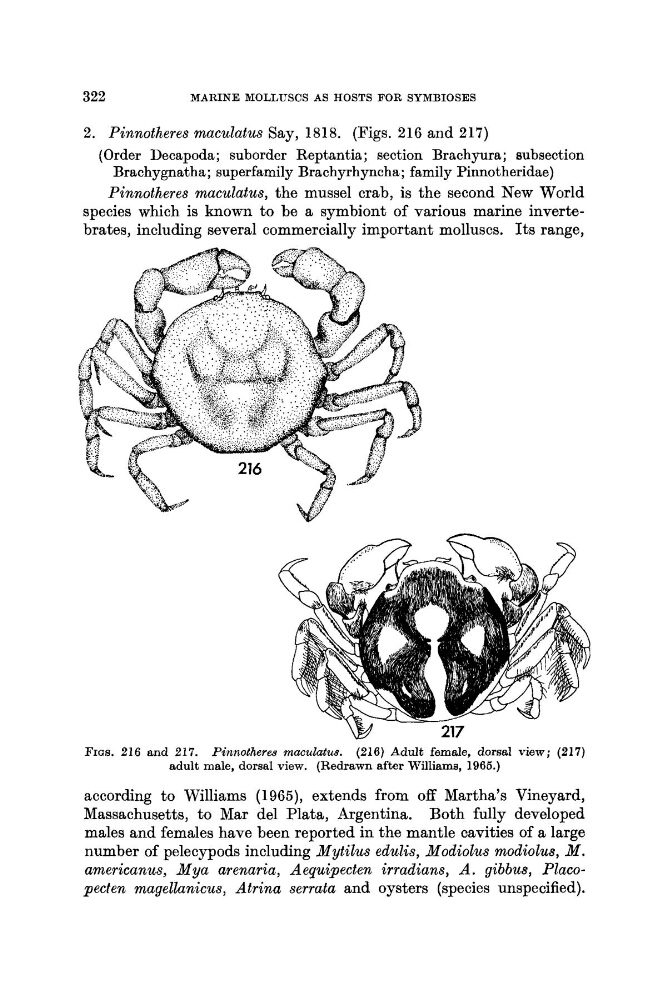
2. Pinnotheres maculatus Say, 1818. (Figs. 216 and 217)
(Order Decapoda; suborder Reptantia; section Brachyura; subsection
Brachygnatha; superfamily Brachyrhyncha ; family Pinnotheridae)
Pinnotheres maculatus, the mussel crab, is the second New World
species which is known to be a symbiont of various marine invertebrates, including several commercially important molluscs. Its range,
FIQS. 216 and 217. Pinnotheres maculatus. (216) Adult female, dorsal view; (217)
adult male, dorsal view. (Redrawn after Williams, 1965.)
according to Williams (1965), extends from off Martha’s Vineyard,
Massachusetts, to Mar del Plata, Argentina. Both fully developed
males and females have been reported in the mantle cavities of a large
number of pelecypods including Mytilus edulis, Modiolus modiolus, M .
americanus, Mya arenaria, Aequipecten irradians, A. gibbus, Placopecfen magellanicus, Atrina serrata and oysters (species unspecified).
MARINE MOLLUSCS AS HOSTS FOR SYMBIOSES
2. Pinnotheres maculatus Say, 1818. (Figs. 216 and 217)
(Order Decapoda; suborder Reptantia; section Brachyura; subsection
Brachygnatha; superfamily Brachyrhyncha ; family Pinnotheridae)
Pinnotheres maculatus, the mussel crab, is the second New World
species which is known to be a symbiont of various marine invertebrates, including several commercially important molluscs. Its range,
FIQS. 216 and 217. Pinnotheres maculatus. (216) Adult female, dorsal view; (217)
adult male, dorsal view. (Redrawn after Williams, 1965.)
according to Williams (1965), extends from off Martha’s Vineyard,
Massachusetts, to Mar del Plata, Argentina. Both fully developed
males and females have been reported in the mantle cavities of a large
number of pelecypods including Mytilus edulis, Modiolus modiolus, M .
americanus, Mya arenaria, Aequipecten irradians, A. gibbus, Placopecfen magellanicus, Atrina serrata and oysters (species unspecified).