

302
MARINE MOLLUSCS AS HOSTS FOR SYMBIOSES
limited commercial importance, information on their copepods wilI
not be reviewed in this paper. However, since these pelecypods are of
potential commercial importance, these parasites are briefly mentioned
a t this point.
Humes and Cressey have described Conchyliurus torosus from
Mactra glabrato from Pointe-Noire, Congo ; C. lobatus from Cardita ajar
dredged near Freetown, Sierra Leone ; Conchyliurus sp. from Cardium
ringens dredged in the harbor of Accra, Ghana ; Myocheres scobina from
Tellina nymphalis buried in the muddy sand a t Loango, 19 km north
of Pointe-Noire, Congo ; and M . dentata from Macoma cumana dredged
from mud in the bay of Accra, Ghana.
8. Ostrincola gracilis Wilson, 1944. (Figs. 199 and 200)
(Order Cyclopoida; family Ergasilidae)
Adults of Ostrincola gracilis were originally described by Wilson
(1944) from specimens removed from the mantle cavity of Crassostrea
virginica taken at Beaufort, North Carolina, and deposited in the U.S.
National Museum. This species was redescribed by Humes (1953)
based on specimens from the mantle cavity of C. virginica, Modiolus
demissus gmnisissiwzus, Brachidontes recurvus (= Mytilus recurvus) and
Mercenaria mercenaria collected fsom the Barataria Bay region of
Louisiana.
Description. Adult female (Fig. 199) colorless except for dark
reddish-black median eye and brownish intestine : total length (from
anterior end to tip of caudal ramus) averages 1-083 mm, greatest width
0.274 mm ; abdomen three-segmented ; minute spines on ventral surfaces
of genital segment and abdomen, dorsal surfaces without spines ;
caudal ramus bears three terminal setae and three along outer edge ;
first antenna of seven segments and several aesthetes, arrangement of
setae on distal segment suggests a subdivision but there is no articulation ; second antenna with notch-like interruption on inner margin of
claw; mouth parts greatly reduced; first, second, third, and fourth
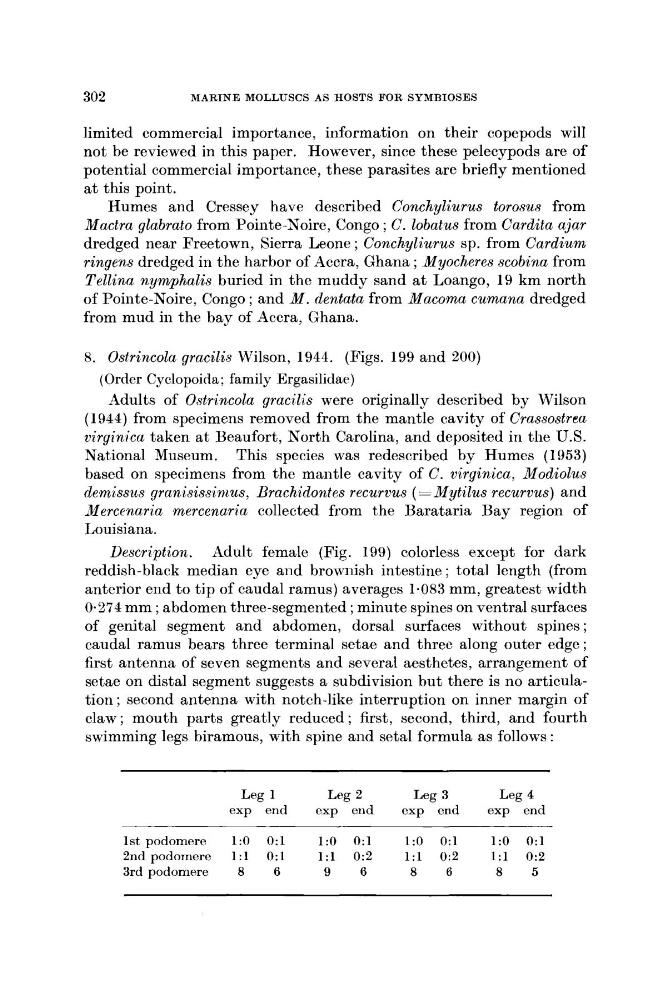
swimming legs biramous, with spine and setal formula as follows :
Leg 1
Leg 2
Leg 3
Leg 4
exp end
exp end
exp end
exp end
1st podomere
1:0 0:l
1:0 0:l
1:0 0:1
1:0 0:l
2ndpodomere
1 : l 0:l
1 : l 0:2
1:1 0:2
1 : l 0:2
3rdpodomere
8
6
9
6
8
6
8
5
MARINE MOLLUSCS AS HOSTS FOR SYMBIOSES
limited commercial importance, information on their copepods wilI
not be reviewed in this paper. However, since these pelecypods are of
potential commercial importance, these parasites are briefly mentioned
a t this point.
Humes and Cressey have described Conchyliurus torosus from
Mactra glabrato from Pointe-Noire, Congo ; C. lobatus from Cardita ajar
dredged near Freetown, Sierra Leone ; Conchyliurus sp. from Cardium
ringens dredged in the harbor of Accra, Ghana ; Myocheres scobina from
Tellina nymphalis buried in the muddy sand a t Loango, 19 km north
of Pointe-Noire, Congo ; and M . dentata from Macoma cumana dredged
from mud in the bay of Accra, Ghana.
8. Ostrincola gracilis Wilson, 1944. (Figs. 199 and 200)
(Order Cyclopoida; family Ergasilidae)
Adults of Ostrincola gracilis were originally described by Wilson
(1944) from specimens removed from the mantle cavity of Crassostrea
virginica taken at Beaufort, North Carolina, and deposited in the U.S.
National Museum. This species was redescribed by Humes (1953)
based on specimens from the mantle cavity of C. virginica, Modiolus
demissus gmnisissiwzus, Brachidontes recurvus (= Mytilus recurvus) and
Mercenaria mercenaria collected fsom the Barataria Bay region of
Louisiana.
Description. Adult female (Fig. 199) colorless except for dark
reddish-black median eye and brownish intestine : total length (from
anterior end to tip of caudal ramus) averages 1-083 mm, greatest width
0.274 mm ; abdomen three-segmented ; minute spines on ventral surfaces
of genital segment and abdomen, dorsal surfaces without spines ;
caudal ramus bears three terminal setae and three along outer edge ;
first antenna of seven segments and several aesthetes, arrangement of
setae on distal segment suggests a subdivision but there is no articulation ; second antenna with notch-like interruption on inner margin of
claw; mouth parts greatly reduced; first, second, third, and fourth
swimming legs biramous, with spine and setal formula as follows :
Leg 1
Leg 2
Leg 3
Leg 4
exp end
exp end
exp end
exp end
1st podomere
1:0 0:l
1:0 0:l
1:0 0:1
1:0 0:l
2ndpodomere
1 : l 0:l
1 : l 0:2
1:1 0:2
1 : l 0:2
3rdpodomere
8
6
9
6
8
6
8
5