

8. THE PHYLUM MOLLUSCA
279
as the outside surfaces of oyster shells, attract or retain more snails than
smooth surfaces, such as the inside surfaces of oyster shells.” That
the attraction of oysters for 0. impressa is by its soft tissues also has
been demonstrated by Hopkins. He has found that once the soft
tissues of an oyster are removed, the snails attached to the exterior
fall off and replacements are not attracted.
Although Allen’s results indicate that 0. impressa is not hostspecific, one observation did suggest that it may demonstrate a certain
degree of preference. She has found that this gastropod will not feed
on Triphora nigrocincta if any of the other compatible hosts is available.
Furthermore, Hopkins (1956~) has found that 0. impressa will not
feed on either Mercenaria or Volsella. Even those few snails which
crawl on to these pelecypods do not stay.
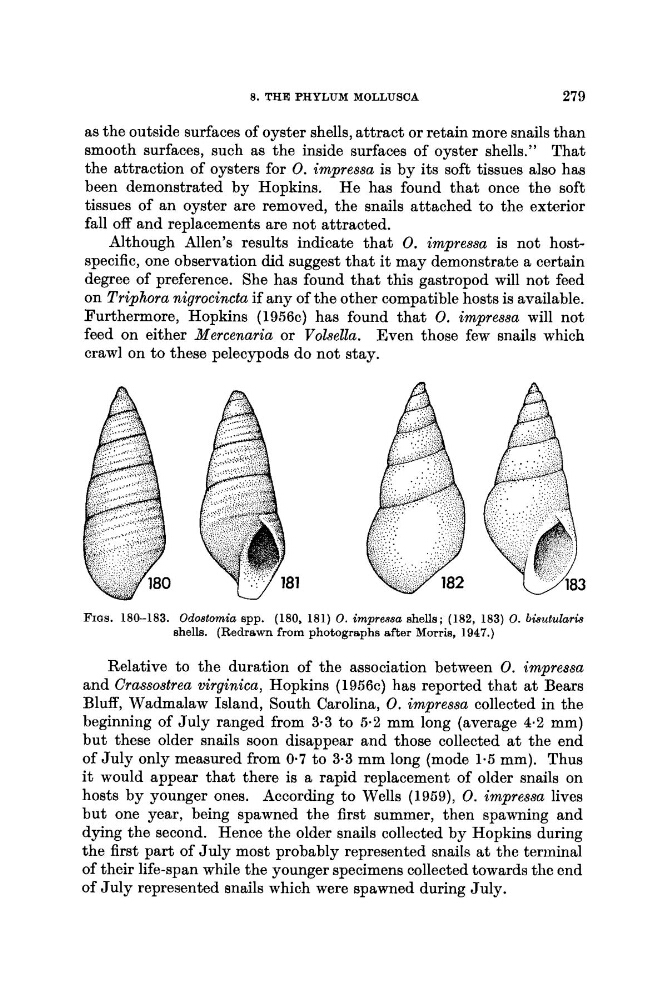
FIQS. 180-183. Odostomia spp. (180. 181) 0. impressa shells; (182, 183) 0. bkutulark
shells. (Redrewn from photographs after Morris, 1947.)
Relative to the duration of the association between 0. impressa
and Crassostrea virginica, Hopkins (1956~) has reported that at Bears
Bluff, Wadmalaw Island, South Carolina, 0. impressa collected in the
beginning of July ranged from 3.3 to 5.2 mm long (average 4.2 mm)
but these older snails soon disappear and those collected at the end
of July only measured from 0.7 to 3.3 mm long (mode 1.5 mm). Thus
it would appear that there is a rapid replacement of older snails on
hosts by younger ones. According to Wells (1959), 0. impressa lives
but one year, being spawned the first summer, then spawning and
dying the second. Hence the older snails collected by Hopkins during
the first part of July most probably represented snails at the terminal
of their life-span while the younger specimens collected towards the end
of July represented snails which were spawned during July.
279
as the outside surfaces of oyster shells, attract or retain more snails than
smooth surfaces, such as the inside surfaces of oyster shells.” That
the attraction of oysters for 0. impressa is by its soft tissues also has
been demonstrated by Hopkins. He has found that once the soft
tissues of an oyster are removed, the snails attached to the exterior
fall off and replacements are not attracted.
Although Allen’s results indicate that 0. impressa is not hostspecific, one observation did suggest that it may demonstrate a certain
degree of preference. She has found that this gastropod will not feed
on Triphora nigrocincta if any of the other compatible hosts is available.
Furthermore, Hopkins (1956~) has found that 0. impressa will not
feed on either Mercenaria or Volsella. Even those few snails which
crawl on to these pelecypods do not stay.
FIQS. 180-183. Odostomia spp. (180. 181) 0. impressa shells; (182, 183) 0. bkutulark
shells. (Redrewn from photographs after Morris, 1947.)
Relative to the duration of the association between 0. impressa
and Crassostrea virginica, Hopkins (1956~) has reported that at Bears
Bluff, Wadmalaw Island, South Carolina, 0. impressa collected in the
beginning of July ranged from 3.3 to 5.2 mm long (average 4.2 mm)
but these older snails soon disappear and those collected at the end
of July only measured from 0.7 to 3.3 mm long (mode 1.5 mm). Thus
it would appear that there is a rapid replacement of older snails on
hosts by younger ones. According to Wells (1959), 0. impressa lives
but one year, being spawned the first summer, then spawning and
dying the second. Hence the older snails collected by Hopkins during
the first part of July most probably represented snails at the terminal
of their life-span while the younger specimens collected towards the end
of July represented snails which were spawned during July.