

8. THE PHYLUM MOLLUSCA
277
Fretter and Graham (1949) have strongly emphasized that pyramidellids are host-specific. However, various subsequent investigators
(Cole, 1951b; Cole and Hancock, 1955; Allen, 1958; Ankel, 1959;
Wells and Wells, 1961 ; Ankel and Christensen, 1963), as the result of
finding widespread absence of host-specificity, have challenged this
concept. Indeed, the currently accepted opinion is that the pyramidellids are not as host-specific as believed by Fretter and Graham, although
both Odostomiu scalaris and 0. impressa, and perhaps others, do portray
a certain degree of host preference (Boss and Merrill, 1965).
All of the pyramidellids are ectoparasites since they are generally
attached on the exterior, near the edges of the valves of pelecypods,
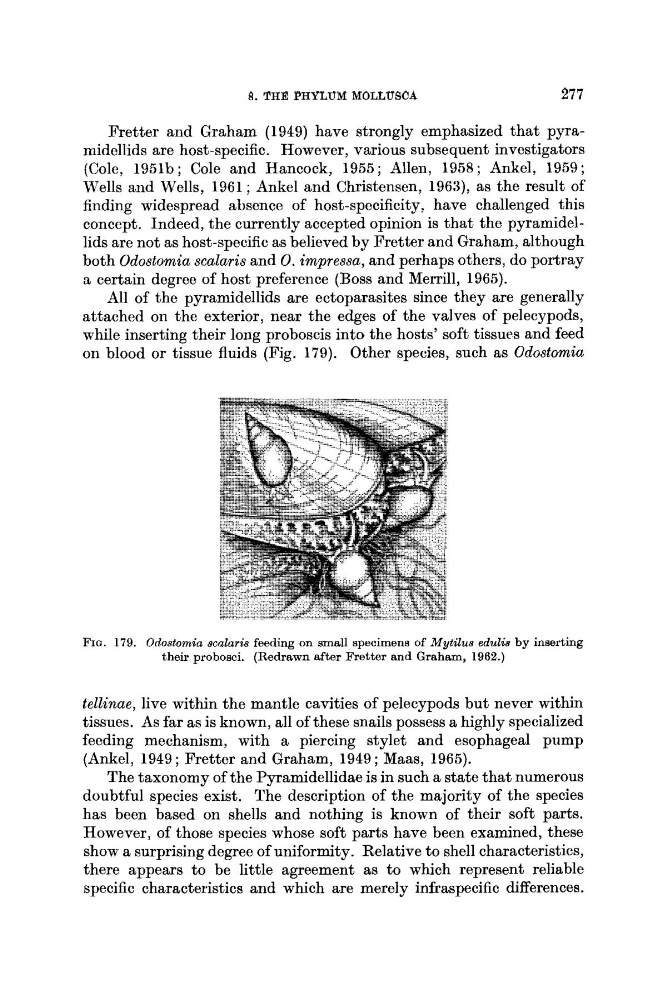
while inserting their long proboscis into the hosts’ soft tissues and feed
on blood or tissue fluids (Fig. 179). Other species, such as Udostomia
FIQ. 179. Odostomia scalaris feeding on small specimens of Mytilus edulis by inserting
their probosci. (Redrawn after Fretter and Graham, 1962.)
tellinae, live within the mantle cavities of pelecypods but never within
tissues. As far as is known, all of these snails possess a highly specialized
feeding mechanism, with a piercing stylet and esophageal pump
(Ankel, 1949 ; Fretter and Graham, 1949 ; Maas, 1965).
The taxonomy of the Pyramidellidae is in such a state that numerous
doubtful species exist. The description of the majority of the species
has been based on shells and nothing is known of their soft parts.
However, of those species whose soft parts have been examined, these
show a surprising degree of uniformity. Relative to shell characteristics,
there appears to be little agreement as to which represent reliable
specific characteristics and which are merely infraspecific differences.
277
Fretter and Graham (1949) have strongly emphasized that pyramidellids are host-specific. However, various subsequent investigators
(Cole, 1951b; Cole and Hancock, 1955; Allen, 1958; Ankel, 1959;
Wells and Wells, 1961 ; Ankel and Christensen, 1963), as the result of
finding widespread absence of host-specificity, have challenged this
concept. Indeed, the currently accepted opinion is that the pyramidellids are not as host-specific as believed by Fretter and Graham, although
both Odostomiu scalaris and 0. impressa, and perhaps others, do portray
a certain degree of host preference (Boss and Merrill, 1965).
All of the pyramidellids are ectoparasites since they are generally
attached on the exterior, near the edges of the valves of pelecypods,
while inserting their long proboscis into the hosts’ soft tissues and feed
on blood or tissue fluids (Fig. 179). Other species, such as Udostomia
FIQ. 179. Odostomia scalaris feeding on small specimens of Mytilus edulis by inserting
their probosci. (Redrawn after Fretter and Graham, 1962.)
tellinae, live within the mantle cavities of pelecypods but never within
tissues. As far as is known, all of these snails possess a highly specialized
feeding mechanism, with a piercing stylet and esophageal pump
(Ankel, 1949 ; Fretter and Graham, 1949 ; Maas, 1965).
The taxonomy of the Pyramidellidae is in such a state that numerous
doubtful species exist. The description of the majority of the species
has been based on shells and nothing is known of their soft parts.
However, of those species whose soft parts have been examined, these
show a surprising degree of uniformity. Relative to shell characteristics,
there appears to be little agreement as to which represent reliable
specific characteristics and which are merely infraspecific differences.