

I. THE PHYLA NEMERTINEA, ASCHELMINTHES AND ANNELIDA
269
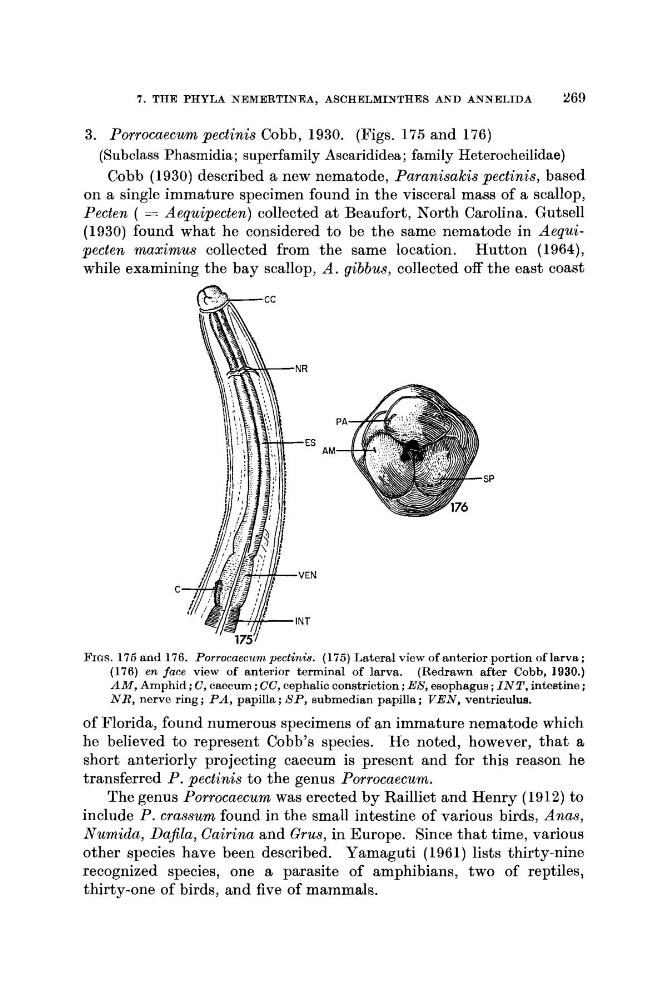
3. Porrocaecum pectinis Cobb, 1930. (Figs. 175 and 176)
(Subclass Phasmidia; superfamily Ascarididea; family Heterocheilidae)
Cobb (1930) described a new nematode, Paranisakis pectinis, based
on a single immature specimen found in the visceral mass of a scallop,
Pecten ( = Aepuipecten) collected a t Beaufort, North Carolina. Gutsell
(1930) found what he considered to be the same nematode in Aequipecten mazimus collected from the same location. Hutton (1964),
while examining the bay scallop, A . gibbus, collected off the east coast
FIGS. 176 and 176. Porrocaecum pectinis. (175) Lateral view of anterior portion of larva;
(176) en face view o f anterior terminal of larva. (Redrawn after Cobb, 1930.)
A M , Amphid ; C, caecum ; CC, cephalic constriction ; ES, esophagus ; I N T , intestine ;
N R , nerve ring; P A , papilla; SP, submedian papilla; V E N , ventriculus.
of Florida, found numerous specimens of an immature nematode which
he believed to represent Cobb’s species. He noted, however, that a
short anteriorly projecting caecum is present and for this reason he
transferred P. pectinis to the genus Porrocaecum.
The genus Porrocaecum was erected by Railliet and Henry (1912) to
include P. crassum found in the small intestine of various birds, Anas,
Numidn, DaJla, Cairina and Grus, in Europe. Since that time, various
other species have been described. Yamaguti (1961) lists thirty-nine
recognized species, one a parasite of amphibians, two of reptiles,
thirty-one of birds, and five of mammals.
269
3. Porrocaecum pectinis Cobb, 1930. (Figs. 175 and 176)
(Subclass Phasmidia; superfamily Ascarididea; family Heterocheilidae)
Cobb (1930) described a new nematode, Paranisakis pectinis, based
on a single immature specimen found in the visceral mass of a scallop,
Pecten ( = Aepuipecten) collected a t Beaufort, North Carolina. Gutsell
(1930) found what he considered to be the same nematode in Aequipecten mazimus collected from the same location. Hutton (1964),
while examining the bay scallop, A . gibbus, collected off the east coast
FIGS. 176 and 176. Porrocaecum pectinis. (175) Lateral view of anterior portion of larva;
(176) en face view o f anterior terminal of larva. (Redrawn after Cobb, 1930.)
A M , Amphid ; C, caecum ; CC, cephalic constriction ; ES, esophagus ; I N T , intestine ;
N R , nerve ring; P A , papilla; SP, submedian papilla; V E N , ventriculus.
of Florida, found numerous specimens of an immature nematode which
he believed to represent Cobb’s species. He noted, however, that a
short anteriorly projecting caecum is present and for this reason he
transferred P. pectinis to the genus Porrocaecum.
The genus Porrocaecum was erected by Railliet and Henry (1912) to
include P. crassum found in the small intestine of various birds, Anas,
Numidn, DaJla, Cairina and Grus, in Europe. Since that time, various
other species have been described. Yamaguti (1961) lists thirty-nine
recognized species, one a parasite of amphibians, two of reptiles,
thirty-one of birds, and five of mammals.