

I. THE m Y r A A NEMERTINEA, ASCITELMINTHES AND ANNELIDA
267
he reported its life cycle and included descriptions of the larval and
adul t stages.
Description of stage in mollusc. Millemann only found second-stage
larvae in Haliotis corrugata. Second stage larva, 18-21 mm (average
20 mm) long, 0.614-0.704 mm (average 0.651 mm) wide; with eight
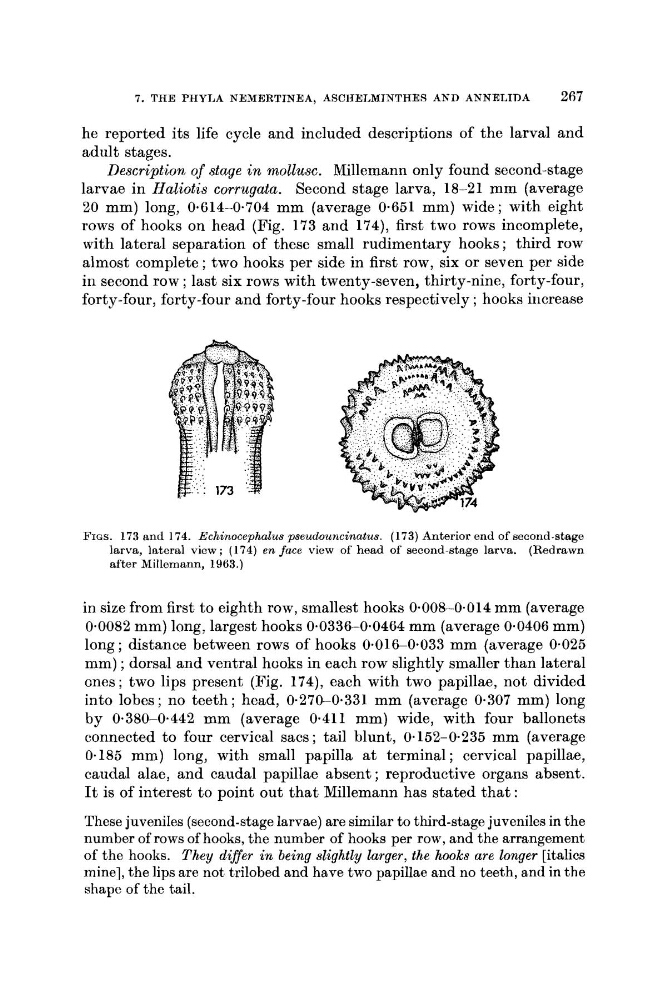
rows of hooks on head (Fig. 173 and 174), first two rows incomplete,
with lateral separation of these small rudimentary hooks ; third row
almost complete ; two hooks per side in first row, six or seven per side
in second row ; last six rows with twenty-seven, thirty-nine, forty-four,
forty-four, forty-four and forty-four hooks respectively ; hooks increase
FIGS. 173 and 174. Echinocephalus pseudouncimtus. (173) Anterior end of second-stage
(Redrawn
larva, lateral view ; (174) en face view o f head of second-stage larva.
after Millemann, 1963.)
in size from first to eighth row, smallest hooks 0.008-0.014 mm (average
0.0082 mm) long, largest hooks 0.0336-0.0464 mm (average 0.0406 mm)
long ; distance between rows of hooks 0.016-0.033 mm (average 0.025
mm) ; dorsal and ventral hooks in each row slightly smaller than lateral
ones ; two lips present (Fig. 174), each with two papillae, not divided
into lobes; no teeth; head, 0.270-0.331 mm (average 0.307 mm) long
by 0.380-0.442 mm (average 0.411 mm) wide, with four ballonets
connected to four cervical sacs; tail blunt, 0.152-0.235 mm (average
0.185 mm) long, with small papilla a t terminal ; cervical papillae,
caudal alae, and caudal papillae absent ; reproductive organs absent.
It is of interest to point out that Millemann has stated that :
These juveniles (second-stage larvae) are similar to third-stage juveniles in the
number of rows of hooks, the number of hooks per row, and the arrangement
of the hooks. They differ in being slightly larger, the hooks are longer [italics
mine], the lips are not trilobed and have two papillae and no teeth, and in the
shape of the tlail.
267
he reported its life cycle and included descriptions of the larval and
adul t stages.
Description of stage in mollusc. Millemann only found second-stage
larvae in Haliotis corrugata. Second stage larva, 18-21 mm (average
20 mm) long, 0.614-0.704 mm (average 0.651 mm) wide; with eight
rows of hooks on head (Fig. 173 and 174), first two rows incomplete,
with lateral separation of these small rudimentary hooks ; third row
almost complete ; two hooks per side in first row, six or seven per side
in second row ; last six rows with twenty-seven, thirty-nine, forty-four,
forty-four, forty-four and forty-four hooks respectively ; hooks increase
FIGS. 173 and 174. Echinocephalus pseudouncimtus. (173) Anterior end of second-stage
(Redrawn
larva, lateral view ; (174) en face view o f head of second-stage larva.
after Millemann, 1963.)
in size from first to eighth row, smallest hooks 0.008-0.014 mm (average
0.0082 mm) long, largest hooks 0.0336-0.0464 mm (average 0.0406 mm)
long ; distance between rows of hooks 0.016-0.033 mm (average 0.025
mm) ; dorsal and ventral hooks in each row slightly smaller than lateral
ones ; two lips present (Fig. 174), each with two papillae, not divided
into lobes; no teeth; head, 0.270-0.331 mm (average 0.307 mm) long
by 0.380-0.442 mm (average 0.411 mm) wide, with four ballonets
connected to four cervical sacs; tail blunt, 0.152-0.235 mm (average
0.185 mm) long, with small papilla a t terminal ; cervical papillae,
caudal alae, and caudal papillae absent ; reproductive organs absent.
It is of interest to point out that Millemann has stated that :
These juveniles (second-stage larvae) are similar to third-stage juveniles in the
number of rows of hooks, the number of hooks per row, and the arrangement
of the hooks. They differ in being slightly larger, the hooks are longer [italics
mine], the lips are not trilobed and have two papillae and no teeth, and in the
shape of the tlail.