

216
MARINE MOLLUSCS AS HOSTS FOR SYMBIOSES
Life cycle. The complete life cycle of Xetacercaria strigatu is not
known. Giard (1907), who found this parasite in the same second
intermediate hosts but did not name or describe it, has suggested that
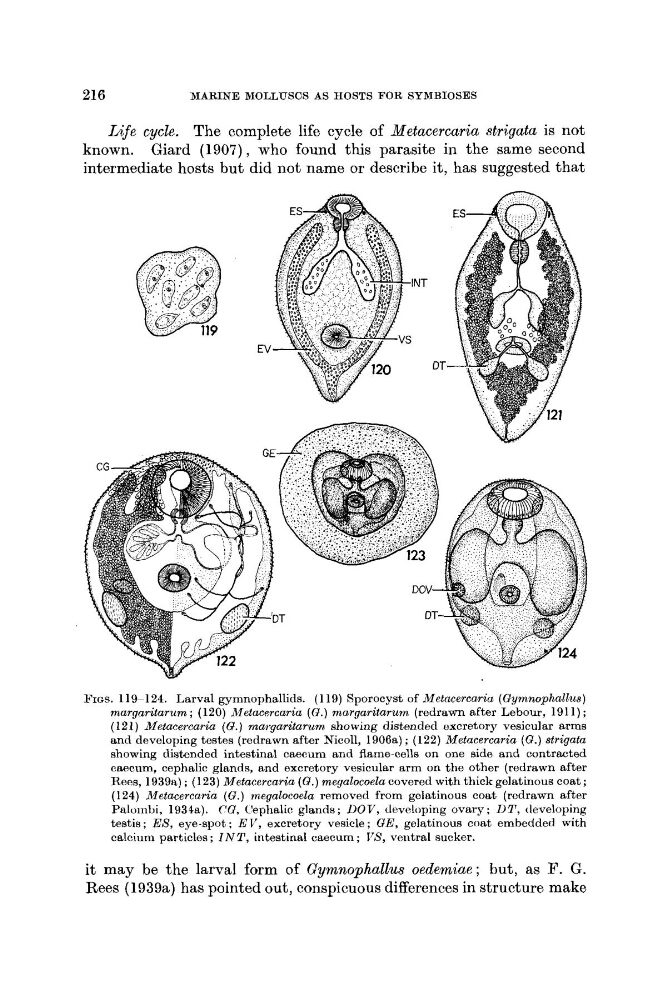
FIGS. 119-124. Larval gymnophallids. (1 19) Sporocyst of Metncercaria (GymnophnZZus)
margaritarum ; (120) Metacercaria (G.) margaritarum (redrawn after Lebour, 191 1) ;
(121) Metacercwia (C.) margaritarum showing distended excretory vesicular arms
and developing testes (redrawn after Nicoll, 1906a) ; (122) Metacercaria (C.) strigata
showing distended intestinal caecum and flame-cells on one side and contracted
caecum, cephalic glands, and excretory vesicular arm on the other (redrawn after
Rees, 1939a) ; (123) Metacercaria (G.) megalocoela covered with thick gelatinous coat;
(1 24) Metacercuria ( G . ) rnegalocoela removed from gelatinous coat (redrawn after
Paloinbi, 1934a). C’C, C‘ephalir glands ; DOV, developing (wary ; DT, (leveloping
testis ; ES, eye-spot ; El.’, excretory vesicle ; GE, gelatinous coat embedded with
calcium particles; I N T , intestinal caecum ; I’S, ventral sucker.
it may be the larval form of Gymnophallus oedemiue; but, as F. G.
Rees (1939a) has pointed out, conspicuous differences in structure make
MARINE MOLLUSCS AS HOSTS FOR SYMBIOSES
Life cycle. The complete life cycle of Xetacercaria strigatu is not
known. Giard (1907), who found this parasite in the same second
intermediate hosts but did not name or describe it, has suggested that
FIGS. 119-124. Larval gymnophallids. (1 19) Sporocyst of Metncercaria (GymnophnZZus)
margaritarum ; (120) Metacercaria (G.) margaritarum (redrawn after Lebour, 191 1) ;
(121) Metacercwia (C.) margaritarum showing distended excretory vesicular arms
and developing testes (redrawn after Nicoll, 1906a) ; (122) Metacercaria (C.) strigata
showing distended intestinal caecum and flame-cells on one side and contracted
caecum, cephalic glands, and excretory vesicular arm on the other (redrawn after
Rees, 1939a) ; (123) Metacercaria (G.) megalocoela covered with thick gelatinous coat;
(1 24) Metacercuria ( G . ) rnegalocoela removed from gelatinous coat (redrawn after
Paloinbi, 1934a). C’C, C‘ephalir glands ; DOV, developing (wary ; DT, (leveloping
testis ; ES, eye-spot ; El.’, excretory vesicle ; GE, gelatinous coat embedded with
calcium particles; I N T , intestinal caecum ; I’S, ventral sucker.
it may be the larval form of Gymnophallus oedemiue; but, as F. G.
Rees (1939a) has pointed out, conspicuous differences in structure make