

8
MARINE MOLLUSCS AS HOSTS FOR SYMBIOSES
other; however, there may also be a slight overlapping between
commensalism and parasitism. Cheng (1964b) has discussed the possible
origins of symbiotic relationships. It has been concluded that although
one type of association may evolve into another, and the occurrence
of overlaps suggest this, such need not always be the case. In certain
instances, the types of relationships may also have evolved independently, not involving a transitional stage which could be interpreted as
being one of the other established types of symbiosis.
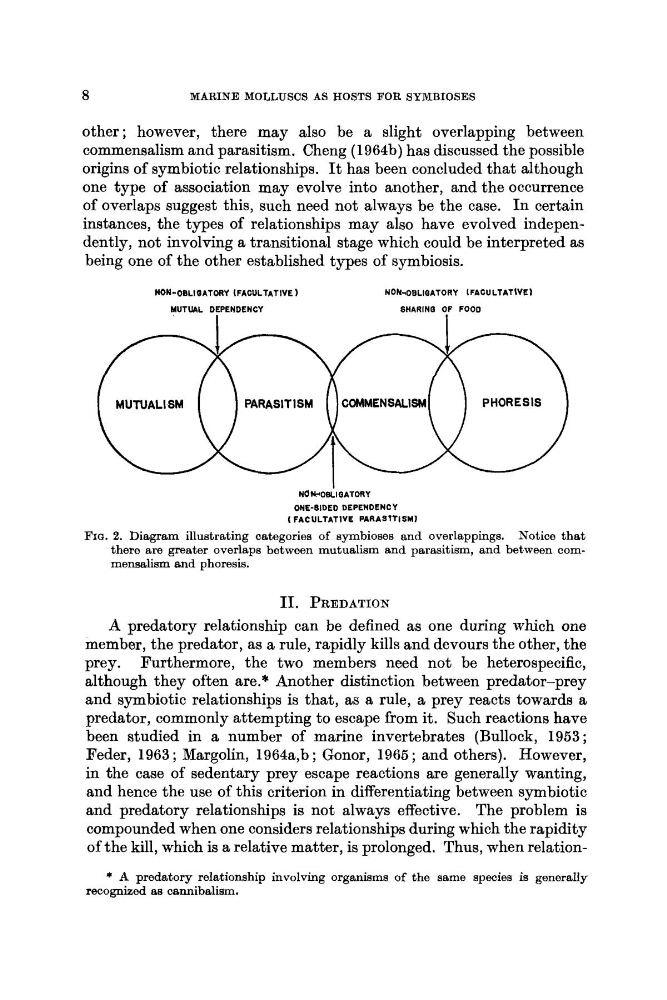
NON-OBLIOATORY IFACULTATIVE)
MUTUAL DEPENDENCY
NON-OBLICATORY IFADULTATWE)
SHARINO OF FOOD
N U M O ~ I Q A T O R Y
ONE-SIDED DEPENDENCY
I FACULTATlVE PARASTTISMI
FIQ. 2. Diagram illustrating categories of symbioses and overlappings. Notice that
there are greater overlaps between mutualism and parasitism, and between commensalism and phoresis.
11. PREDATION
A predatory relationship can be defined as one during which one
member, the predator, as a rule, rapidly kills and devours the other, the
prey. Furthermore, the two members need not be heterospecific,
although they often are.* Another distinction between predator-prey
and symbiotic relationships is that, as a rule, a prey reacts towards a
predator, commonly attempting to escape from it. Such reactions have
been studied in a number of marine invertebrates (Bullock, 1953;
Feder, 1963 ; Margolin, 1964a,b ; Gonor, 1965 ; and others). However,
in the case of sedentary prey escape reactions are generally wanting,
and hence the use of this criterion in differentiating between symbiotic
and predatory relationships is not always effective. The problem is
compounded when one considers relationships during which the rapidity
of the kill, which is a relative matter, is prolonged. Thus, when relation* A predatory relationship involving organisms of the same species is generally
recognized as cannibalism.
MARINE MOLLUSCS AS HOSTS FOR SYMBIOSES
other; however, there may also be a slight overlapping between
commensalism and parasitism. Cheng (1964b) has discussed the possible
origins of symbiotic relationships. It has been concluded that although
one type of association may evolve into another, and the occurrence
of overlaps suggest this, such need not always be the case. In certain
instances, the types of relationships may also have evolved independently, not involving a transitional stage which could be interpreted as
being one of the other established types of symbiosis.
NON-OBLIOATORY IFACULTATIVE)
MUTUAL DEPENDENCY
NON-OBLICATORY IFADULTATWE)
SHARINO OF FOOD
N U M O ~ I Q A T O R Y
ONE-SIDED DEPENDENCY
I FACULTATlVE PARASTTISMI
FIQ. 2. Diagram illustrating categories of symbioses and overlappings. Notice that
there are greater overlaps between mutualism and parasitism, and between commensalism and phoresis.
11. PREDATION
A predatory relationship can be defined as one during which one
member, the predator, as a rule, rapidly kills and devours the other, the
prey. Furthermore, the two members need not be heterospecific,
although they often are.* Another distinction between predator-prey
and symbiotic relationships is that, as a rule, a prey reacts towards a
predator, commonly attempting to escape from it. Such reactions have
been studied in a number of marine invertebrates (Bullock, 1953;
Feder, 1963 ; Margolin, 1964a,b ; Gonor, 1965 ; and others). However,
in the case of sedentary prey escape reactions are generally wanting,
and hence the use of this criterion in differentiating between symbiotic
and predatory relationships is not always effective. The problem is
compounded when one considers relationships during which the rapidity
of the kill, which is a relative matter, is prolonged. Thus, when relation* A predatory relationship involving organisms of the same species is generally
recognized as cannibalism.