

6. THE PHYLA PORIFERA, CNIDARIA AND PLATYHELMINTHES
205
the cod, Gadus callarias, and the whiting, G. merlangus, it is not known
with certainty that this is the metacercarial stage of B. haimeanus
although it may very well be. The adult is believed to be an intestinal
parasite of the angler, Lophius piscatorius, which feeds on gadoids.
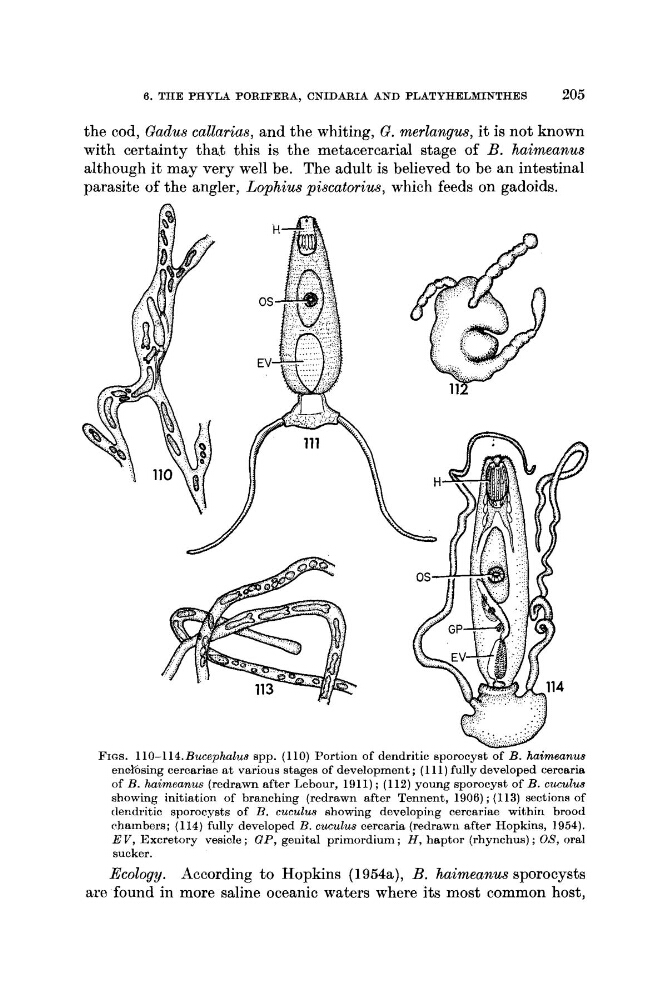
FIGS. 110-114.Bucephalus spp. (110) Portion of dendritic sporocyst of B. haimeanus
en&osing cercariae at various stages of development ; (1 11) fully developed cercaria,
of B. haimeanus (redrawn after Lebour, 1911) ; (112) young sporocyst of B. cuculus
showing initiation of branching (redrawn after Tennent, 1906) ; (1 13) sections of
tlendritic sporocysts of B. cuculus showing developing cercariae within brood
rhambers; (1 14) fully developed B. cuculus cercaria (redrawn after Hopkins, 1954).
E V , Excretory vesicle ; B P , genital primordium ; H , haptor (rhynchus) ; OS, oral
sucker.
Ecology. According t o Hopkins ( 1954a), B. haimeanus sporocysts
are found in more saline oceanic waters where its most common host,
205
the cod, Gadus callarias, and the whiting, G. merlangus, it is not known
with certainty that this is the metacercarial stage of B. haimeanus
although it may very well be. The adult is believed to be an intestinal
parasite of the angler, Lophius piscatorius, which feeds on gadoids.
FIGS. 110-114.Bucephalus spp. (110) Portion of dendritic sporocyst of B. haimeanus
en&osing cercariae at various stages of development ; (1 11) fully developed cercaria,
of B. haimeanus (redrawn after Lebour, 1911) ; (112) young sporocyst of B. cuculus
showing initiation of branching (redrawn after Tennent, 1906) ; (1 13) sections of
tlendritic sporocysts of B. cuculus showing developing cercariae within brood
rhambers; (1 14) fully developed B. cuculus cercaria (redrawn after Hopkins, 1954).
E V , Excretory vesicle ; B P , genital primordium ; H , haptor (rhynchus) ; OS, oral
sucker.
Ecology. According t o Hopkins ( 1954a), B. haimeanus sporocysts
are found in more saline oceanic waters where its most common host,