

5. THE PHYLUM PROTOZOA
195
(average 14-5 p) thick; cilia disposed for the most part on shallow
concavity occupying anterior three-fifths of central body surface ;
central ciliary complex of seven rows which are one-third to one-half
length of body and which become progressively longer towards left
side ; right complex of two rows, each about one-half body length ; left
MI
MA
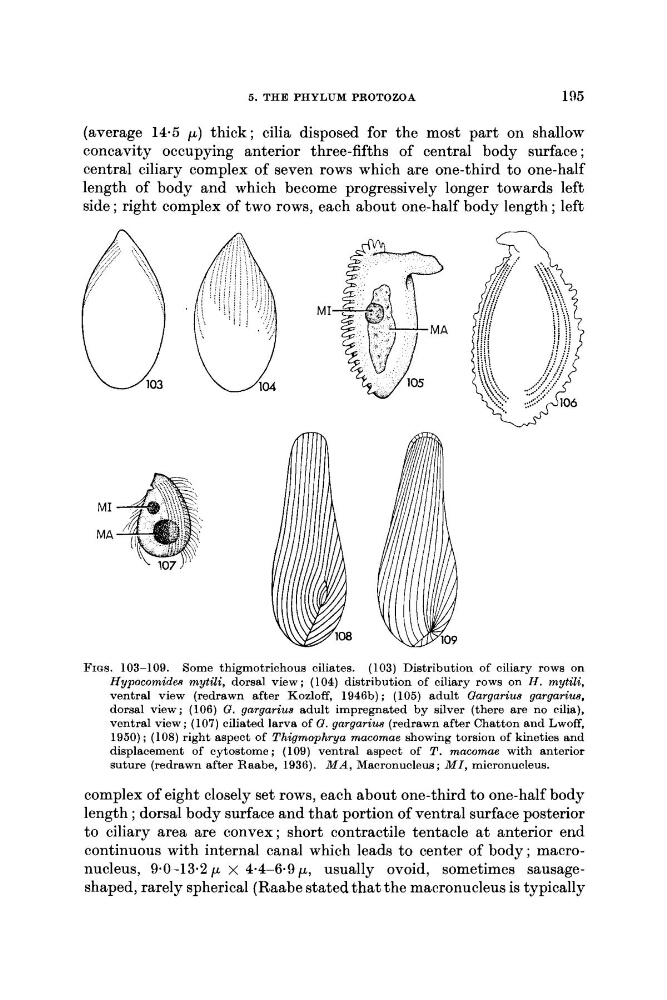
FIGS. 103-109. Some thigmotrichous ciliates. (103) Distribution of ciliary rows on
Hypocornides mytili, d'brsal view ; (104) distribution of ciliary rows on ' H . mytili,
ventral view (redrawn after Kozloff, 1946b) ; (105) adult Gargariua gargariua,
dorsal view; (106) a. gargariua adult impregnated by silver (there are no cilia),
ventral view ; (107) ciliated larva of B. gargarius (redrawn after Chatton and Lwoff,
1950) ; (108) right aspect of Thigrnophrya macomae showing torsion of kineties and
displacement of cytostome; (109) ventral aspect of T. macomae with anterior
suture (redrawn after Raabe, 1936). M A , Macronucleus ; M I , micronucleus.
complex of eight closely set rows, each about one-third to one-half body
length ; dorsal body surface and that portion of ventral surface posterior
to ciliary area are convex; short contractile tentacle a t anterior end
continuous with internal canal which leads to center of body ; macronucleus, 9.0-13.2 p x 4-4-6.9 p, usually ovoid, sometimes sausageshaped, rarely spherical (Raabe stated that the macronucleus is typically
195
(average 14-5 p) thick; cilia disposed for the most part on shallow
concavity occupying anterior three-fifths of central body surface ;
central ciliary complex of seven rows which are one-third to one-half
length of body and which become progressively longer towards left
side ; right complex of two rows, each about one-half body length ; left
MI
MA
FIGS. 103-109. Some thigmotrichous ciliates. (103) Distribution of ciliary rows on
Hypocornides mytili, d'brsal view ; (104) distribution of ciliary rows on ' H . mytili,
ventral view (redrawn after Kozloff, 1946b) ; (105) adult Gargariua gargariua,
dorsal view; (106) a. gargariua adult impregnated by silver (there are no cilia),
ventral view ; (107) ciliated larva of B. gargarius (redrawn after Chatton and Lwoff,
1950) ; (108) right aspect of Thigrnophrya macomae showing torsion of kineties and
displacement of cytostome; (109) ventral aspect of T. macomae with anterior
suture (redrawn after Raabe, 1936). M A , Macronucleus ; M I , micronucleus.
complex of eight closely set rows, each about one-third to one-half body
length ; dorsal body surface and that portion of ventral surface posterior
to ciliary area are convex; short contractile tentacle a t anterior end
continuous with internal canal which leads to center of body ; macronucleus, 9.0-13.2 p x 4-4-6.9 p, usually ovoid, sometimes sausageshaped, rarely spherical (Raabe stated that the macronucleus is typically