

6. THE PHYLUM PROTOZOA
191
12. Isocomides mytili Chatton and Lwoff, 1922. (Fig. 100)
(Subclass Holotrichia; order Thigmotrichida; family Ancistrocomidae)
This ciliate was originally described by Chatton and Lwoff (1922a)
as Hypocomides mytili. It was later (Chatton and Lwoff, 1950) transferred to the genus Isocomides. This ciliate is found on the ctenidia of
Mytilus edulis.
Description. Body oblong, 57-63 p x 20-22 p, tapering anteriorly
to a process which bears suctorial tentacle ; thigmotactic field longitudinally subdivided by a keel of cilia ; cytoplasm on each side of thigmotactic field devoid of cilia ; vestigial kinety, running transversely in
groove posterior to thigmotactic field, bears very long cilia.
Other information. Nothing else is known about this species.
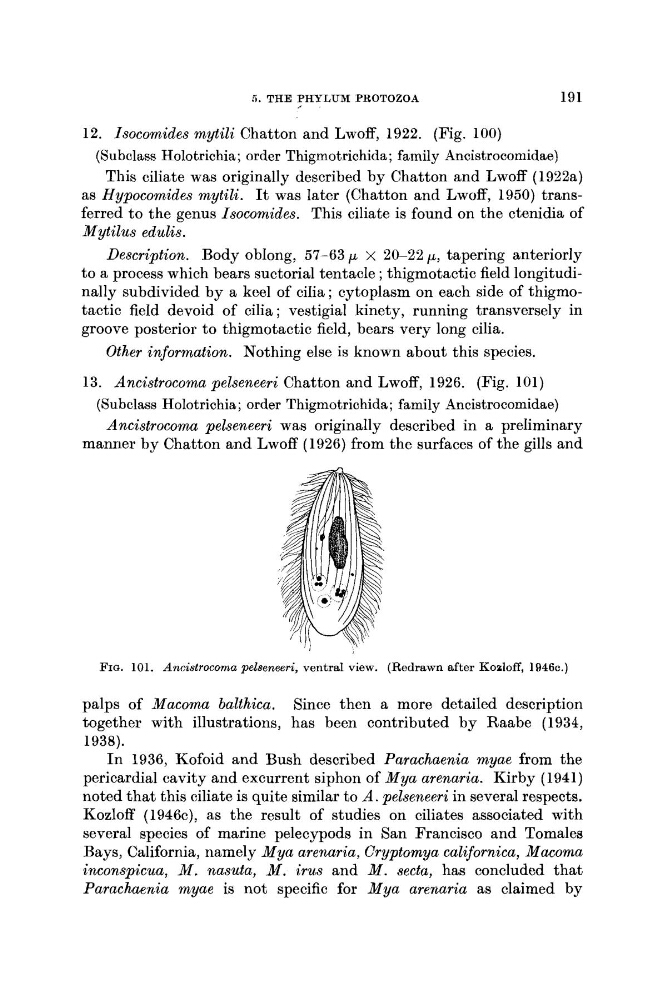
13. Ancistrocoma pelseneeri Chatton and Lwoff, 1926. (Fig. 101)
(Subclass Holotrichia; order Thigmotrichida; family Ancistrocomidae)
Ancistrocoma pelseneeri was originally described in a preliminary
manner by Chatton and Lwoff (1926) from the surfaces of the gills and
FIG. 101. Ancistrocoma pelseneeri, ventral view. (Redrawn after Kozloff, 1946c.)
palps of Macoma balthica. Since then a more detailed description
together with illustrations, has been contributed by Raabe (1934,
1938).
I n 1936, Kofoid and Bush described Parachaenia myae from the
pericardial cavity and excurrent siphon of Mya arenaria. Kirby (1941)
noted that this ciliate is quite similar to A. pelseneeri in several respects.
Kozloff (1946c), as the result of studies on ciliates associated with
several species of marine pelecypods in San Francisco and Tomales
Bays, California, namely Mya arenaria, Cryptomya californica, Macoma
inconspicua, M . nasuta, M . irus and M . secta, has concluded that
Parachaenia myae is not specific for Mya arenaria as claimed by
191
12. Isocomides mytili Chatton and Lwoff, 1922. (Fig. 100)
(Subclass Holotrichia; order Thigmotrichida; family Ancistrocomidae)
This ciliate was originally described by Chatton and Lwoff (1922a)
as Hypocomides mytili. It was later (Chatton and Lwoff, 1950) transferred to the genus Isocomides. This ciliate is found on the ctenidia of
Mytilus edulis.
Description. Body oblong, 57-63 p x 20-22 p, tapering anteriorly
to a process which bears suctorial tentacle ; thigmotactic field longitudinally subdivided by a keel of cilia ; cytoplasm on each side of thigmotactic field devoid of cilia ; vestigial kinety, running transversely in
groove posterior to thigmotactic field, bears very long cilia.
Other information. Nothing else is known about this species.
13. Ancistrocoma pelseneeri Chatton and Lwoff, 1926. (Fig. 101)
(Subclass Holotrichia; order Thigmotrichida; family Ancistrocomidae)
Ancistrocoma pelseneeri was originally described in a preliminary
manner by Chatton and Lwoff (1926) from the surfaces of the gills and
FIG. 101. Ancistrocoma pelseneeri, ventral view. (Redrawn after Kozloff, 1946c.)
palps of Macoma balthica. Since then a more detailed description
together with illustrations, has been contributed by Raabe (1934,
1938).
I n 1936, Kofoid and Bush described Parachaenia myae from the
pericardial cavity and excurrent siphon of Mya arenaria. Kirby (1941)
noted that this ciliate is quite similar to A. pelseneeri in several respects.
Kozloff (1946c), as the result of studies on ciliates associated with
several species of marine pelecypods in San Francisco and Tomales
Bays, California, namely Mya arenaria, Cryptomya californica, Macoma
inconspicua, M . nasuta, M . irus and M . secta, has concluded that
Parachaenia myae is not specific for Mya arenaria as claimed by