

2. DEFINITIONS OF TYPES OF SYMBIOSES
5
and Noble (1961) have expressed the view that because of the modern
trends in parasitology, parasitologists might be designated as
“ symbiontologists ”. I, however, prefer the term symbiology (Cheng,
196410) over “ symbiontology ”, since the latter implies that the
investigator and his discipline are only concerned with one member
of the association, the symbiont, and not with the host. As stated
earlier, if the study of relationships between heterospecific organisms
is to be comprehensive and unique, both the host and the symbiont,
plus the nature of the relationship, must be taken into consideration.
As stated, several subcategories of symbioses have long been in use
in the biological literature. These are redefined below, and are drawn
from what are considered to be the most appropriate aspects of previous
definitions, although the basic interpretations are those of Smyth
(1962).
A. Parasitism
Parasitism describes a heterospecific relationship, be it permanent
or temporary, during which there exists metabolic dependence of the
parasite, the smaller of the two species, on its host. This metabolic
dependency may be in the form of nutritional materials, digestive
enzymes, developmental stimuli, or control of maturation. With the
acceptance of this definition, Smyth (1962) has pointed out that it is
now possible “ t o draw up a list of parasitic species which show an
increasing degree of metabolic dependence on their hosts ”. Along this
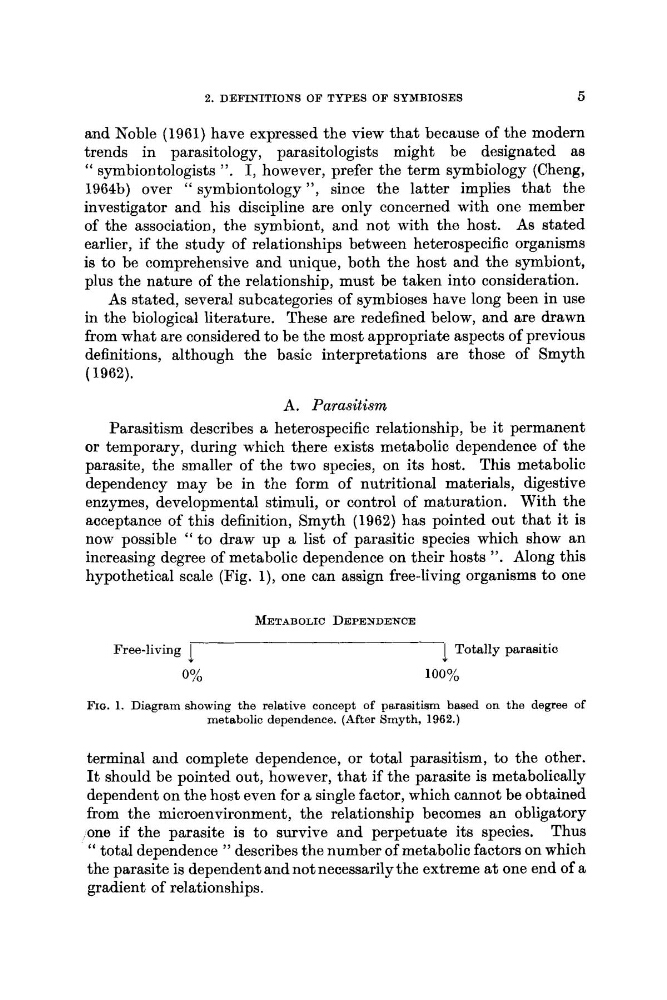
hypothetical scale (Fig. l), one can assign free-living organisms to one
METABOLIC DEPENDENCE
1 Totally parasitic
100%
1
Free-living
0%
FIG. 1. Diagram showing the relative concept of parasitism based on the degree of
metabolic dependence. (After Smyth, 1962.)
terminal and complete dependence, or total parasitism, to the other.
It should be pointed out, however, that if the parasite is metabolically
dependent on the host even for a single factor, which cannot be obtained
from the microenvironment, the relationship becomes an obligatory
one if the parasite is to survive and perpetuate its species. Thus
“ total dependence ” describes the number of metabolic factors on which
the parasite is dependent and not necessarily the extreme at one end of a
gradient of relationships.
5
and Noble (1961) have expressed the view that because of the modern
trends in parasitology, parasitologists might be designated as
“ symbiontologists ”. I, however, prefer the term symbiology (Cheng,
196410) over “ symbiontology ”, since the latter implies that the
investigator and his discipline are only concerned with one member
of the association, the symbiont, and not with the host. As stated
earlier, if the study of relationships between heterospecific organisms
is to be comprehensive and unique, both the host and the symbiont,
plus the nature of the relationship, must be taken into consideration.
As stated, several subcategories of symbioses have long been in use
in the biological literature. These are redefined below, and are drawn
from what are considered to be the most appropriate aspects of previous
definitions, although the basic interpretations are those of Smyth
(1962).
A. Parasitism
Parasitism describes a heterospecific relationship, be it permanent
or temporary, during which there exists metabolic dependence of the
parasite, the smaller of the two species, on its host. This metabolic
dependency may be in the form of nutritional materials, digestive
enzymes, developmental stimuli, or control of maturation. With the
acceptance of this definition, Smyth (1962) has pointed out that it is
now possible “ t o draw up a list of parasitic species which show an
increasing degree of metabolic dependence on their hosts ”. Along this
hypothetical scale (Fig. l), one can assign free-living organisms to one
METABOLIC DEPENDENCE
1 Totally parasitic
100%
1
Free-living
0%
FIG. 1. Diagram showing the relative concept of parasitism based on the degree of
metabolic dependence. (After Smyth, 1962.)
terminal and complete dependence, or total parasitism, to the other.
It should be pointed out, however, that if the parasite is metabolically
dependent on the host even for a single factor, which cannot be obtained
from the microenvironment, the relationship becomes an obligatory
one if the parasite is to survive and perpetuate its species. Thus
“ total dependence ” describes the number of metabolic factors on which
the parasite is dependent and not necessarily the extreme at one end of a
gradient of relationships.