

176
MARINE MOLLUSCS A S HOSTS FOR SYMBIOSES
the Haplosporida (Caullery, 1953 ; Caullery and Mesnil, 1905 ; Minchin,
1903). Sprague is of the opinion that this genus should be considered
as subordinate to the Microsporida since: ‘‘ The spores, having an
anterior ‘ vacuole ’, look essentially like those of certain Microsporida
which have an anterior ‘ vacuole ’ containing an unextruded polar
1
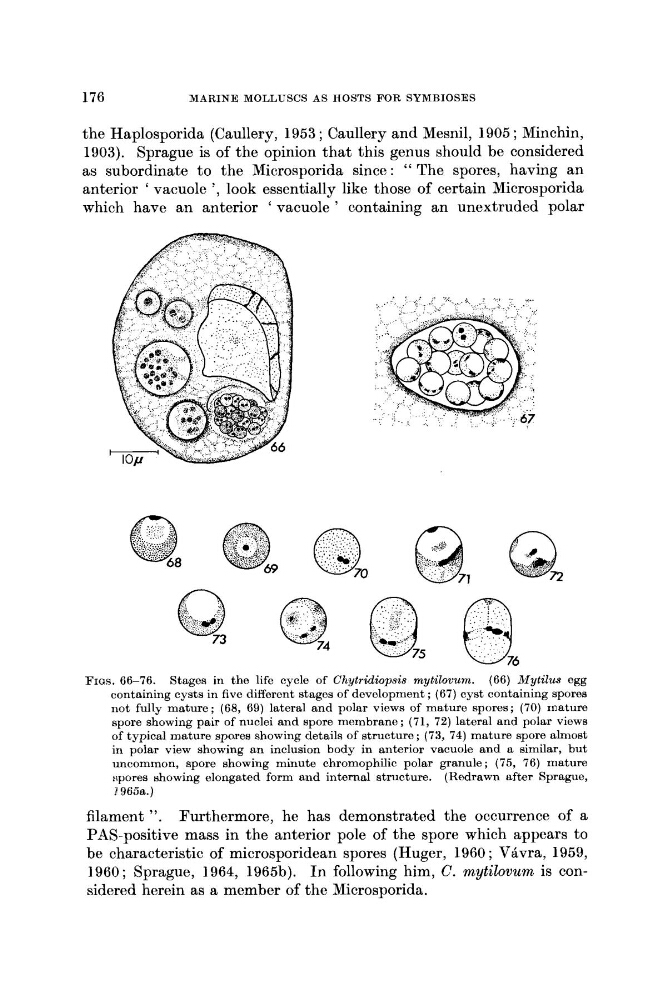
FIGS. 66-76. Stages in the life cycle of Chytridiopsis mytilowurn. (66) Mytilus egg
containing cysts in five different stages of development ; (67) cyst containing spores
not fully mature; (68, 69) lateral and polar views of mature spores; (70) mature
spore showing pair of nuclei and spore membrane; (71, 72) lateral and polar views
of typical mature spores showing details of structure; (73, 74) mature spore almost
in polar view showing a n inclusion body in anterior vacuole and a similar, but
uncommon, spore showing minute chromophilic polar granule ; (75, 76) mature
spores showing elongated form and internal structure. (Redrawn after Sprague,
1965a.)
filament ”. Furthermore, he has demonstrated the occurrence of a
PAS-positive mass in the anterior pole of the spore which appears to
be characteristic of microsporidean spores (Huger, 1960 ; VBvra, 1959,
1960 ; Sprague, 1964, 196513). I n following him, C. mytilowurn is considered herein as a member of the Microsporida.
MARINE MOLLUSCS A S HOSTS FOR SYMBIOSES
the Haplosporida (Caullery, 1953 ; Caullery and Mesnil, 1905 ; Minchin,
1903). Sprague is of the opinion that this genus should be considered
as subordinate to the Microsporida since: ‘‘ The spores, having an
anterior ‘ vacuole ’, look essentially like those of certain Microsporida
which have an anterior ‘ vacuole ’ containing an unextruded polar
1
FIGS. 66-76. Stages in the life cycle of Chytridiopsis mytilowurn. (66) Mytilus egg
containing cysts in five different stages of development ; (67) cyst containing spores
not fully mature; (68, 69) lateral and polar views of mature spores; (70) mature
spore showing pair of nuclei and spore membrane; (71, 72) lateral and polar views
of typical mature spores showing details of structure; (73, 74) mature spore almost
in polar view showing a n inclusion body in anterior vacuole and a similar, but
uncommon, spore showing minute chromophilic polar granule ; (75, 76) mature
spores showing elongated form and internal structure. (Redrawn after Sprague,
1965a.)
filament ”. Furthermore, he has demonstrated the occurrence of a
PAS-positive mass in the anterior pole of the spore which appears to
be characteristic of microsporidean spores (Huger, 1960 ; VBvra, 1959,
1960 ; Sprague, 1964, 196513). I n following him, C. mytilowurn is considered herein as a member of the Microsporida.