

5 . THE PHYLUM PROTOZOA
173
3. Haplosporidium tumefacientis Taylor, 1966. (Figs. 58-65)
(Class Haplosporea; order Haplosporida; family Haplosporiidae)
Since Sprague’s (1963) revision of the genus Haplosporidium during
which he transferred those species found in molluscs to the genus
Minchinia, only one species, H . tumefacientis, is now known to be a
parasite of a mollusc. This parasite was described by Taylor (1966)
from the digestive gland and nephridium of the California musscl,
Mytilus californianus, collected at Corona del Mar, California.
2
3
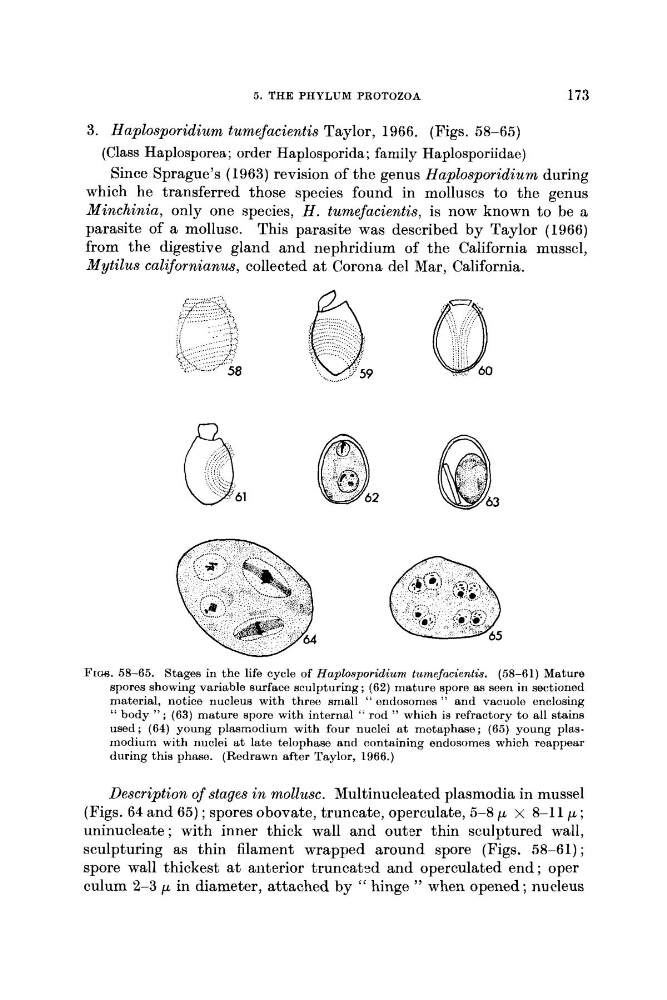
Frm. 58-65. Stages in the life cycle of Huplosporidium tumefacientis. (58-61) Mature
spores showing variable surface sculpturing ; (62) mature spore ES seen in sectioned
material, notice nucleus with three small ‘‘ endosomes ” and vacuole enclosing
‘‘ body ”; (63) mature spore with internal “ rod ” which is refractory to all stains
used; (64) young plasmodium with four nuclei a t metaphase; (65) young plasmodium with nuclei at late telophase and containing endosomes which reappear
during this phase. (Redrawn after Taylor, 1966.)
Description of stages in mollusc. Multinucleated plasmodia in mussel
(Figs. 64 and 65) ; spores obovate, truncate, operculate, 5-8 p x 8-1 1 p ;
minucleate ; with inner thick wall and outer thin sculptured wall,
sculpturing as thin filament wrapped around spore (Figs. 58-61) ;
spore wall thickest a t anterior truncatsd and operculated end ; oper
culum 2-3 p in diameter, attached by “ hinge ” when opened; nucleus
173
3. Haplosporidium tumefacientis Taylor, 1966. (Figs. 58-65)
(Class Haplosporea; order Haplosporida; family Haplosporiidae)
Since Sprague’s (1963) revision of the genus Haplosporidium during
which he transferred those species found in molluscs to the genus
Minchinia, only one species, H . tumefacientis, is now known to be a
parasite of a mollusc. This parasite was described by Taylor (1966)
from the digestive gland and nephridium of the California musscl,
Mytilus californianus, collected at Corona del Mar, California.
2
3
Frm. 58-65. Stages in the life cycle of Huplosporidium tumefacientis. (58-61) Mature
spores showing variable surface sculpturing ; (62) mature spore ES seen in sectioned
material, notice nucleus with three small ‘‘ endosomes ” and vacuole enclosing
‘‘ body ”; (63) mature spore with internal “ rod ” which is refractory to all stains
used; (64) young plasmodium with four nuclei a t metaphase; (65) young plasmodium with nuclei at late telophase and containing endosomes which reappear
during this phase. (Redrawn after Taylor, 1966.)
Description of stages in mollusc. Multinucleated plasmodia in mussel
(Figs. 64 and 65) ; spores obovate, truncate, operculate, 5-8 p x 8-1 1 p ;
minucleate ; with inner thick wall and outer thin sculptured wall,
sculpturing as thin filament wrapped around spore (Figs. 58-61) ;
spore wall thickest a t anterior truncatsd and operculated end ; oper
culum 2-3 p in diameter, attached by “ hinge ” when opened; nucleus