

160
MARINE MOLLUSCS AS HOSTS FOR SYMBIOSES
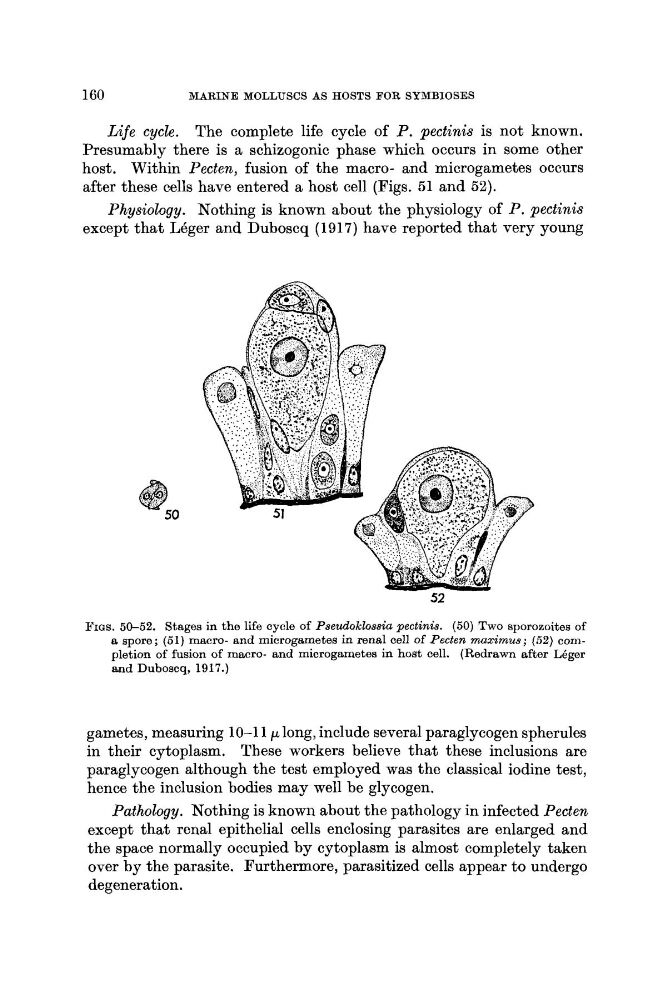
Life cycle. The complete life cycle of P . pectinis is not known.
Presumably there is a schizogonic phase which occurs in some other
host. Within Pecten, fusion of the macro- and microgametes occurs
after these cells have entered a host cell (Figs. 51 and 52).
Physiology. Nothing is known about the physiology of P. pectinis
except that LBger and Duboscq (1917) have reported that very young
PIGS. 50-52. Stages in the life cycle of Pseudoklossia pectinis. (50) Two sporozoites of
a spore; (51) macro- and microgametes in renal cell of Pecten nmximus; (52) completion of fusion of macro- and microgametes in host cell. (Redrawn after LBger
and Duboscq, 1917.)
gametes, measuring 10-1 1 p long, include several paraglycogen spherules
in their cytoplasm. These workers believe that these inclusions are
paraglycogen although the test employed was the classical iodine test,
hence the inclusion bodies may well be glycogen.
Pathology. Nothing is known about the pathology in infected Pecten
except that renal epithelial cells enclosing parasites are enlarged and
the space normally occupied by cytoplasm is almost completely taken
over by the parasite. Furthermore, parasitized cells appear to undergo
degeneration.
MARINE MOLLUSCS AS HOSTS FOR SYMBIOSES
Life cycle. The complete life cycle of P . pectinis is not known.
Presumably there is a schizogonic phase which occurs in some other
host. Within Pecten, fusion of the macro- and microgametes occurs
after these cells have entered a host cell (Figs. 51 and 52).
Physiology. Nothing is known about the physiology of P. pectinis
except that LBger and Duboscq (1917) have reported that very young
PIGS. 50-52. Stages in the life cycle of Pseudoklossia pectinis. (50) Two sporozoites of
a spore; (51) macro- and microgametes in renal cell of Pecten nmximus; (52) completion of fusion of macro- and microgametes in host cell. (Redrawn after LBger
and Duboscq, 1917.)
gametes, measuring 10-1 1 p long, include several paraglycogen spherules
in their cytoplasm. These workers believe that these inclusions are
paraglycogen although the test employed was the classical iodine test,
hence the inclusion bodies may well be glycogen.
Pathology. Nothing is known about the pathology in infected Pecten
except that renal epithelial cells enclosing parasites are enlarged and
the space normally occupied by cytoplasm is almost completely taken
over by the parasite. Furthermore, parasitized cells appear to undergo
degeneration.