

150
MARINE MOLLUSCS AS HOSTS FOR SYMBIOSES
endogenous budding (Sprague, 1954) resulting in numerous minute
gametes. The gametes resulting from one gametocyte are smaller and
C Y C LE
t
A = = = = = d R
\N
M U D C R A B
C Y C L E
O Y S T E R
"
.I
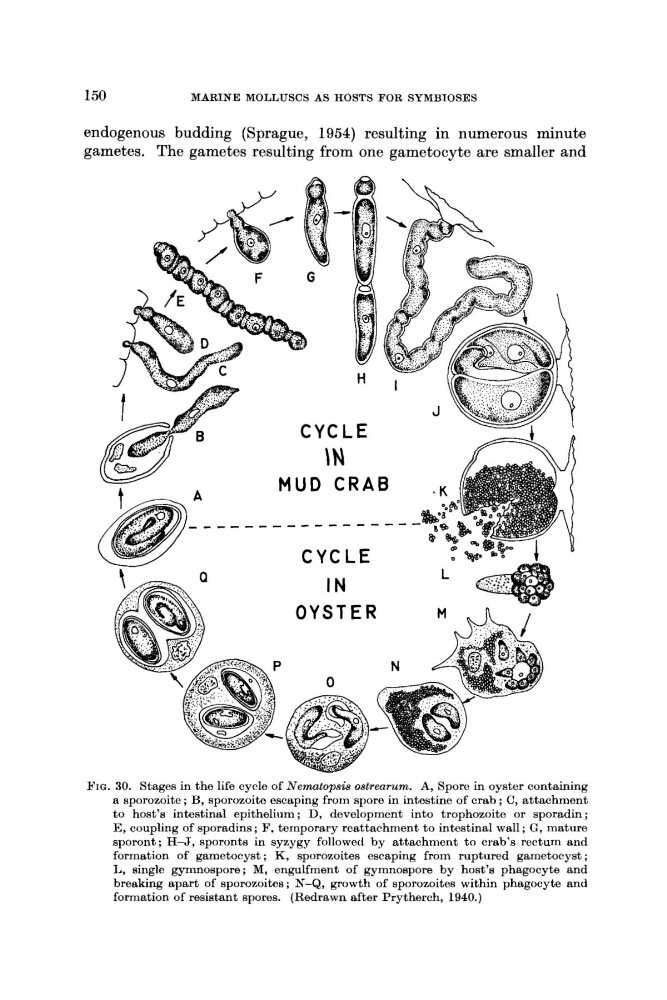
PIG. 30. Stages in the life cycle of Nematopsis ostrearum. A, Spore in oyster containing
a sporozoite ; B, sporozoite escaping from spore in intestine of crab ; C, attachment
to host's intestinal epithelium ; D, development into trophozoite or sporadin ;
E, coupling of sporadins; F, temporary reattachment to intestinal wall ; G, mature
sporont ; H-J, sporonts in syzygy followed by attachment to crab's rectum and
formation of gametocyst ; K, sporozoites escaping from ruptured gametocyst ;
L, single gymnospore; M, engulfment of gymnospore by host's phagocyte and
breaking apart of sporozoites ; N-Q, growth of sporozoites within phagocyte and
formation of resistant spores. (Redrawn after Prytherch, 1940.)
MARINE MOLLUSCS AS HOSTS FOR SYMBIOSES
endogenous budding (Sprague, 1954) resulting in numerous minute
gametes. The gametes resulting from one gametocyte are smaller and
C Y C LE
t
A = = = = = d R
\N
M U D C R A B
C Y C L E
O Y S T E R
"
.I
PIG. 30. Stages in the life cycle of Nematopsis ostrearum. A, Spore in oyster containing
a sporozoite ; B, sporozoite escaping from spore in intestine of crab ; C, attachment
to host's intestinal epithelium ; D, development into trophozoite or sporadin ;
E, coupling of sporadins; F, temporary reattachment to intestinal wall ; G, mature
sporont ; H-J, sporonts in syzygy followed by attachment to crab's rectum and
formation of gametocyst ; K, sporozoites escaping from ruptured gametocyst ;
L, single gymnospore; M, engulfment of gymnospore by host's phagocyte and
breaking apart of sporozoites ; N-Q, growth of sporozoites within phagocyte and
formation of resistant spores. (Redrawn after Prytherch, 1940.)