

5 . THE PHYLUM PROTOZOA
147
V . patuxent, according to Hogue, is also influenced by temperature.
When amoebae cultured on agar plates are maintained for 24 h at
35OC and later removed, numerous trophozoites encyst. Similarly,
trophozoites cultured in a hanging drop of sterile 0.7% NaCl solution
are influenced t o round up or encyst if maintained a t 35°C. At low
temperatures, 10-15"C, the amoebae multiply more slowly than if
maintained at 18-23°C.
Physiology. Physiological processes of V . patuxent in the modern
sense have not been studied. There is some information on the cultivation of this amoeba. Hogue (1921) has reported successful growth and
division in both solid and liquid media. One type of suitable solid
medium is composed of 1.5% agar in 0.7y0, 1.0% or 1.5% NaCl
solution. The amoebae grow equally well on all three. The second type
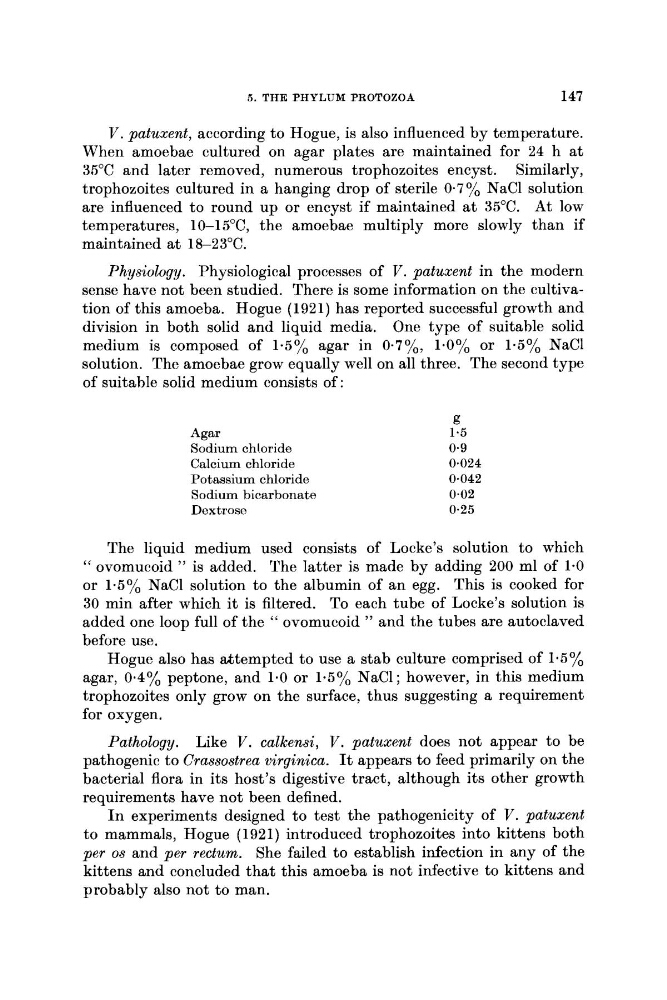
of suitable solid medium consists of:
Agar
Sodium chloride
Calcium chloride
Potassium chloride
Sodium bicarbonate
Dextrose
g
1.5
0.9
0.024
0.042
0.02
0.25
The liquid medium used consists of Locke's solution to which
" ovomucoid " is added. The latter is made by adding 200 ml of 1.0
or 1.5% NaCl solution to the albumin of an egg. This is cooked for
30 min after which it is filtered. To each tube of Locke's solution is
added one loop full of the " ovomucoid " and the tubes are autoclaved
before use.
Hogue also has attempted to use a stab culture comprised of 1.5%
agar, 0.4% peptone, and 1.0 or 1.5% NaCl ; however, in this medium
trophozoites only grow on the surface, thus suggesting a requirement
for oxygen.
Like V . calkensi, V . patuxent does not appear to be
pathogenic to Crassostrea virginica. It appears to feed primarily on the
bacterial flora in its host's digestive tract, although its other growth
requirements have not been defined.
I n experiments designed to test the pathogenicity of V . patuxent
to mammals, Hogue (1921) introduced trophozoites into kittens both
per 0s and per rectum. She failed to establish infection in any of the
kittens and concluded that this amoeba is not infective to kittens and
probably also not to man.
Pathology.
147
V . patuxent, according to Hogue, is also influenced by temperature.
When amoebae cultured on agar plates are maintained for 24 h at
35OC and later removed, numerous trophozoites encyst. Similarly,
trophozoites cultured in a hanging drop of sterile 0.7% NaCl solution
are influenced t o round up or encyst if maintained a t 35°C. At low
temperatures, 10-15"C, the amoebae multiply more slowly than if
maintained at 18-23°C.
Physiology. Physiological processes of V . patuxent in the modern
sense have not been studied. There is some information on the cultivation of this amoeba. Hogue (1921) has reported successful growth and
division in both solid and liquid media. One type of suitable solid
medium is composed of 1.5% agar in 0.7y0, 1.0% or 1.5% NaCl
solution. The amoebae grow equally well on all three. The second type
of suitable solid medium consists of:
Agar
Sodium chloride
Calcium chloride
Potassium chloride
Sodium bicarbonate
Dextrose
g
1.5
0.9
0.024
0.042
0.02
0.25
The liquid medium used consists of Locke's solution to which
" ovomucoid " is added. The latter is made by adding 200 ml of 1.0
or 1.5% NaCl solution to the albumin of an egg. This is cooked for
30 min after which it is filtered. To each tube of Locke's solution is
added one loop full of the " ovomucoid " and the tubes are autoclaved
before use.
Hogue also has attempted to use a stab culture comprised of 1.5%
agar, 0.4% peptone, and 1.0 or 1.5% NaCl ; however, in this medium
trophozoites only grow on the surface, thus suggesting a requirement
for oxygen.
Like V . calkensi, V . patuxent does not appear to be
pathogenic to Crassostrea virginica. It appears to feed primarily on the
bacterial flora in its host's digestive tract, although its other growth
requirements have not been defined.
I n experiments designed to test the pathogenicity of V . patuxent
to mammals, Hogue (1921) introduced trophozoites into kittens both
per 0s and per rectum. She failed to establish infection in any of the
kittens and concluded that this amoeba is not infective to kittens and
probably also not to man.
Pathology.