

5 . THE PHYLUM PROTOZOA
145
It is of interest t o note t h a t Kudo (1966) has speculated " that
Vahlkampjia, Hydramoeba, Schizamoeba and Endamoeba, are the different
stages of the course the intestinal amoebae might have taken during
their evolution ." Basing his definition of parasitism on the criterion
of infliction of injury t o the host, Kudo has proposed t h a t :
Obviously endocommensalism in the alimentary canal (as in the case of
Vahlkampjia) was the initial phase of endoparasitism. When these endocommensals began to consume an excessive amount of food or to feed on
the tissue cells of the host gut, they became the true endoparasites.
H e has further stated :
Destroying or penetrating through the intestinal wall, they became first
established in the body of organ cavities and then invaded tissues, cells or
even nuclei, t,hus developing into pathogenic Protozoa.
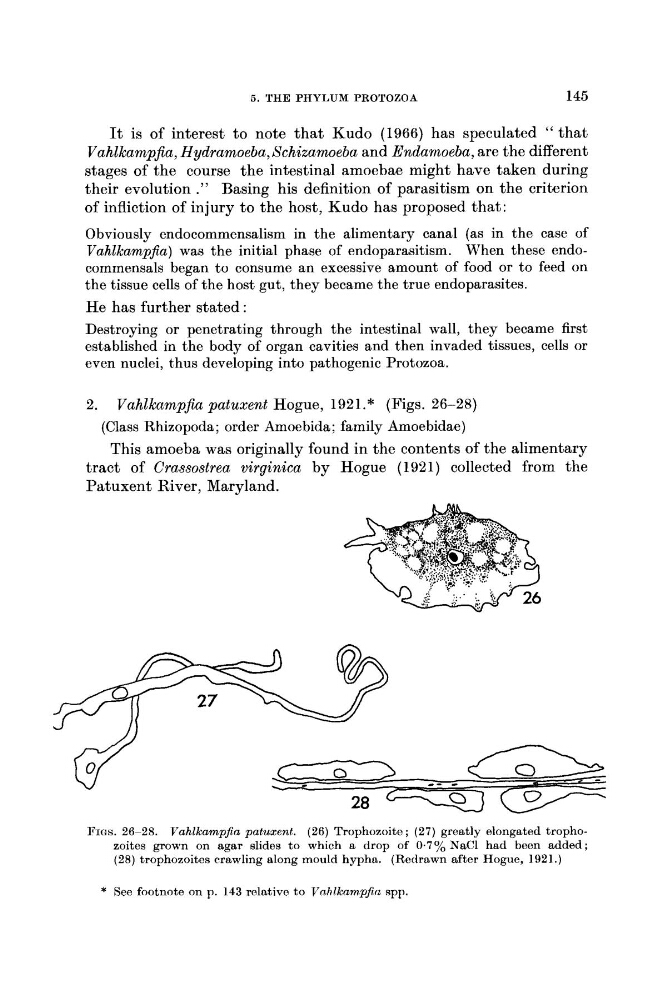
2. Vahlknmpjia patuxent Hogue, 1921." (Figs. 26-28)
(Class Rhizopoda; order Amoebida; family Amoebidae)
This amoeba was originally found in the contents of the alimentary
tract of Crassostrea virginica by Hogue (1921) collected from the
Patuxent River, Maryland.
FIGS. 26-28. Vahlkampjn patuxent. (26) Trophozoite ; (27) greatly elongated trophozoites grown on agar slides to which a drop of 0.7% NaCl had been added;
(28) trophozoitos crawling along mould hypha. (Redrawn after Hogue, 1921 .)
* See footnote on p. 143 relative t o Vnhlkampja spp,
145
It is of interest t o note t h a t Kudo (1966) has speculated " that
Vahlkampjia, Hydramoeba, Schizamoeba and Endamoeba, are the different
stages of the course the intestinal amoebae might have taken during
their evolution ." Basing his definition of parasitism on the criterion
of infliction of injury t o the host, Kudo has proposed t h a t :
Obviously endocommensalism in the alimentary canal (as in the case of
Vahlkampjia) was the initial phase of endoparasitism. When these endocommensals began to consume an excessive amount of food or to feed on
the tissue cells of the host gut, they became the true endoparasites.
H e has further stated :
Destroying or penetrating through the intestinal wall, they became first
established in the body of organ cavities and then invaded tissues, cells or
even nuclei, t,hus developing into pathogenic Protozoa.
2. Vahlknmpjia patuxent Hogue, 1921." (Figs. 26-28)
(Class Rhizopoda; order Amoebida; family Amoebidae)
This amoeba was originally found in the contents of the alimentary
tract of Crassostrea virginica by Hogue (1921) collected from the
Patuxent River, Maryland.
FIGS. 26-28. Vahlkampjn patuxent. (26) Trophozoite ; (27) greatly elongated trophozoites grown on agar slides to which a drop of 0.7% NaCl had been added;
(28) trophozoitos crawling along mould hypha. (Redrawn after Hogue, 1921 .)
* See footnote on p. 143 relative t o Vnhlkampja spp,