

140
MARINE MOLLUSCS AS HOSTS FOR SYMBIOSES
Ecology. It is known from studies along the Atlantic coast of North
America that the occurrence of Hexamita in Crassostreu virginicu
fluctuates with the season and hence with the environmental temperature. Scheltema (1962), in one of the few published reports, although
ample evidence has been collected by Dr. H. H. Haskin of Rutgers
University, has demonstrated that in oysters dredged from Delaware
U
20 30r
160
. \.
\
\
-30 ou
Y
5
-20 5
2
I
2
IL1:
Y
6
n
Is
6MAY JUN
JUL A U G SEP O C T N O V DEC JAN FEB M A R A P R
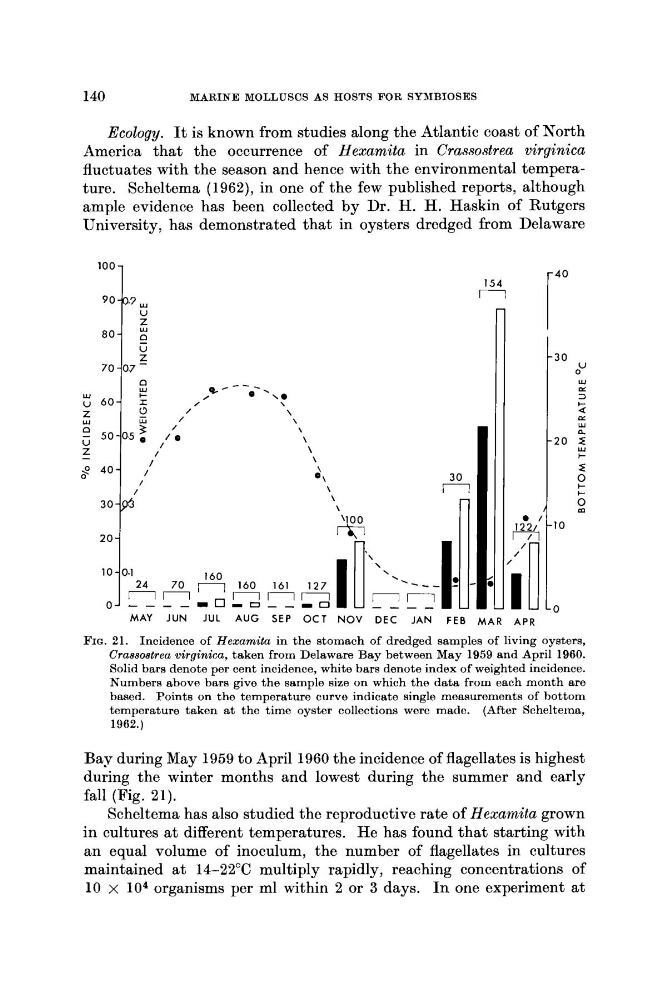
FIG. 21. Incidence of Hexarnita in the stomach of dredged samples of living oysters,
Crassoatrea virginica, taken from Delaware Bay between May 1959 and April 1960.
Solid bars denote per cent incidence, white bars denote index of weighted incidence.
Numbers above bars give the sample size on which the data from each month are
based. Points on the temperature curve indicate single measurements of bottom
temperature taken at the time oyster collections were made. (After Scheltema,
1962.)
Bay during May 1959 to April 1960 the incidence of flagellates is highest
during the winter months and lowest during the summer and early
fall (Fig. 21).
Scheltema has also studied the reproductive rate of Hexamita grown
in cultures a t different temperatures. He has found that starting with
an equal volume of inoculum, the number of flagellates in cultures
maintained at 14-22°C multiply rapidly, reaching concentrations of
10 x 104 organisms per ml within 2 or 3 days. I n one experiment at
MARINE MOLLUSCS AS HOSTS FOR SYMBIOSES
Ecology. It is known from studies along the Atlantic coast of North
America that the occurrence of Hexamita in Crassostreu virginicu
fluctuates with the season and hence with the environmental temperature. Scheltema (1962), in one of the few published reports, although
ample evidence has been collected by Dr. H. H. Haskin of Rutgers
University, has demonstrated that in oysters dredged from Delaware
U
20 30r
160
. \.
\
\
-30 ou
Y
5
-20 5
2
I
2
IL1:
Y
6
n
Is
6MAY JUN
JUL A U G SEP O C T N O V DEC JAN FEB M A R A P R
FIG. 21. Incidence of Hexarnita in the stomach of dredged samples of living oysters,
Crassoatrea virginica, taken from Delaware Bay between May 1959 and April 1960.
Solid bars denote per cent incidence, white bars denote index of weighted incidence.
Numbers above bars give the sample size on which the data from each month are
based. Points on the temperature curve indicate single measurements of bottom
temperature taken at the time oyster collections were made. (After Scheltema,
1962.)
Bay during May 1959 to April 1960 the incidence of flagellates is highest
during the winter months and lowest during the summer and early
fall (Fig. 21).
Scheltema has also studied the reproductive rate of Hexamita grown
in cultures a t different temperatures. He has found that starting with
an equal volume of inoculum, the number of flagellates in cultures
maintained at 14-22°C multiply rapidly, reaching concentrations of
10 x 104 organisms per ml within 2 or 3 days. I n one experiment at