

138
MARINE MOLLUSCS AS HOSTS FOR SYMBIOSES
found in large numbers in the stomach and around the crystalline style
of oysters. The present concensus of opinion is that Certes’s “ Trypanosoma balbianii ” and Ryder’s ‘‘ Spirillum ostrearum ” represent the
same or closely related spirochaetes. It should be noted that Ryder has
stated ‘‘ Yet, upon eating these same individuals (oysters) known to
be infested with parasites, no inconvenience was experienced, showing
that these organisms, whatever they may be, are probably harmless t o
man.”
Hexamita injlata is considered herein as the only known zooflagellate
parasite of oysters.
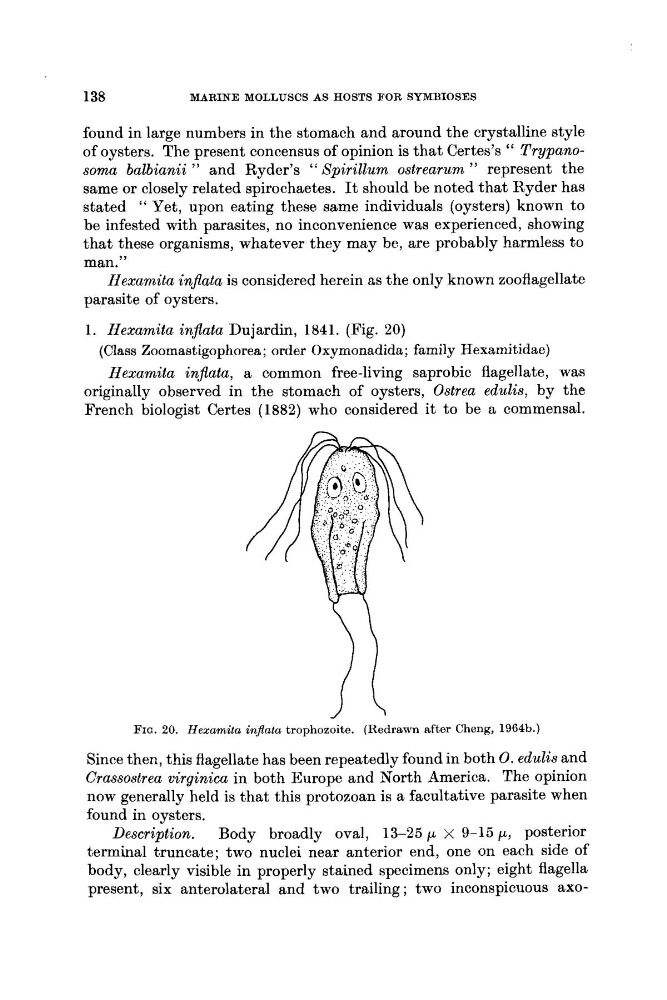
1. Hexamita injlata Dujardin, 1841. (Fig. 20)
Hexamita in$ata, a common free-living saprobic flagellate, was
originally observed in the stomach of oysters, Ostrea edulis, by the
French biologist Certes (1882) who considered it to be a commensal.
(Class Zoomastigophorea; order Oxymonadida; family Hexamitidae)
FIG. 20. Hexamita inJlatu trophozoite. (Redrawn after Cheng, 1964b.)
Since then, this flagellate has been repeatedly found in both 0. edulis and
Crassostrea virginica in both Europe and North America. The opinion
now generally held is that this protozoan is a facultative parasite when
found in oysters.
Description. Body broadly oval, 13-25 p x 9-15 p, posterior
terminal truncate; two nuclei near anterior end, one on each side of
body, clearly visible in properly stained specimens only; eight flagella
present, six anterolateral and two trailing ; two inconspicuous axo-
MARINE MOLLUSCS AS HOSTS FOR SYMBIOSES
found in large numbers in the stomach and around the crystalline style
of oysters. The present concensus of opinion is that Certes’s “ Trypanosoma balbianii ” and Ryder’s ‘‘ Spirillum ostrearum ” represent the
same or closely related spirochaetes. It should be noted that Ryder has
stated ‘‘ Yet, upon eating these same individuals (oysters) known to
be infested with parasites, no inconvenience was experienced, showing
that these organisms, whatever they may be, are probably harmless t o
man.”
Hexamita injlata is considered herein as the only known zooflagellate
parasite of oysters.
1. Hexamita injlata Dujardin, 1841. (Fig. 20)
Hexamita in$ata, a common free-living saprobic flagellate, was
originally observed in the stomach of oysters, Ostrea edulis, by the
French biologist Certes (1882) who considered it to be a commensal.
(Class Zoomastigophorea; order Oxymonadida; family Hexamitidae)
FIG. 20. Hexamita inJlatu trophozoite. (Redrawn after Cheng, 1964b.)
Since then, this flagellate has been repeatedly found in both 0. edulis and
Crassostrea virginica in both Europe and North America. The opinion
now generally held is that this protozoan is a facultative parasite when
found in oysters.
Description. Body broadly oval, 13-25 p x 9-15 p, posterior
terminal truncate; two nuclei near anterior end, one on each side of
body, clearly visible in properly stained specimens only; eight flagella
present, six anterolateral and two trailing ; two inconspicuous axo-