

128
MARINE MOLLUSCS AS HOSTS FOR SYMBIOSES
many populations of the Australian mud whelk, Velacumantus australis,
which occurs in large numbers along the eastern and southern coasts
of Australia, possess banded shells. Each band is white, about 1-2 mm
wide, and is present at the lower part of each whorl. Examination of
25 155 snails of all ages has revealed that 3.92% are banded. Upon
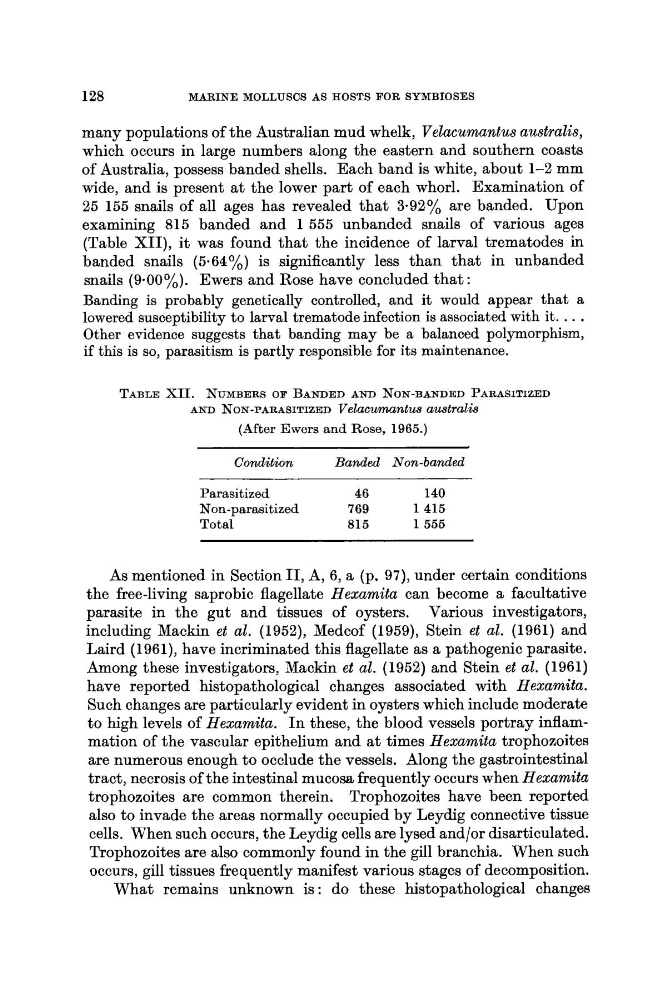
examining 815 banded and 1 5 5 5 unbanded snails of various ages
(Table XII), it was found that the incidence of larval trematodes in
banded snails (5.64%) is significantly less than that in unbanded
snails (9.00%). Ewers and Rose have concluded that :
Banding is probably genetically controlled, and it would appear that a
lowered susceptibility to larval trematode infection is associated with it. . . .
Other evidence suggests that banding may be a balanced polymorphism,
if this is so, parasitism is partly responsible for its maintenance.
TABLE XII. NUMBERS OF BANDED AND NON-BANDED PARASITIZED
AND NON-PARASITIZED Velacumantus australis
(After Ewers and Rose, 1965.)
Condition
Banded Non-banded
Parasitized
46
140
Non-parasitized
769
1 4 1 5
Total
815
1 5 5 5
As mentioned in Section 11, A, 6, a (p. 97), under certain conditions
the free-living saprobic flagellate Hexamita can become a facultative
parasite in the gut and tissues of oysters. Various investigators,
including M a c h et al. (1952), Medcof (1959), Stein et ab. (1961) and
Laird (1961), have incriminated this flagellate as a pathogenic parasite.
Among these investigators, Mackin et al. (1952) and Stein et al. (1961)
have reported histopathological changes associated with Hexamita.
Such changes are particularly evident in oysters which include moderate
to high levels of Hexamita. In these, the blood vessels portray inflammation of the vascular epithelium and at times Hexamita trophozoites
are numerous enough to occlude the vessels. Along the gastrointestinal
tract, necrosis of the intestinal mucosa frequently occurs when Hexamita
trophozoites are common therein. Trophozoites have been reported
also to invade the areas normally occupied by Leydig connective tissue
cells. When such occurs, the Leydig cells are lysed and/or disarticulated.
Trophozoites are also commonly found in the gill branchia. When such
occurs, gill tissues frequently manifest various stages of decomposition.
What remains unknown is : do these histopathological changes
MARINE MOLLUSCS AS HOSTS FOR SYMBIOSES
many populations of the Australian mud whelk, Velacumantus australis,
which occurs in large numbers along the eastern and southern coasts
of Australia, possess banded shells. Each band is white, about 1-2 mm
wide, and is present at the lower part of each whorl. Examination of
25 155 snails of all ages has revealed that 3.92% are banded. Upon
examining 815 banded and 1 5 5 5 unbanded snails of various ages
(Table XII), it was found that the incidence of larval trematodes in
banded snails (5.64%) is significantly less than that in unbanded
snails (9.00%). Ewers and Rose have concluded that :
Banding is probably genetically controlled, and it would appear that a
lowered susceptibility to larval trematode infection is associated with it. . . .
Other evidence suggests that banding may be a balanced polymorphism,
if this is so, parasitism is partly responsible for its maintenance.
TABLE XII. NUMBERS OF BANDED AND NON-BANDED PARASITIZED
AND NON-PARASITIZED Velacumantus australis
(After Ewers and Rose, 1965.)
Condition
Banded Non-banded
Parasitized
46
140
Non-parasitized
769
1 4 1 5
Total
815
1 5 5 5
As mentioned in Section 11, A, 6, a (p. 97), under certain conditions
the free-living saprobic flagellate Hexamita can become a facultative
parasite in the gut and tissues of oysters. Various investigators,
including M a c h et al. (1952), Medcof (1959), Stein et ab. (1961) and
Laird (1961), have incriminated this flagellate as a pathogenic parasite.
Among these investigators, Mackin et al. (1952) and Stein et al. (1961)
have reported histopathological changes associated with Hexamita.
Such changes are particularly evident in oysters which include moderate
to high levels of Hexamita. In these, the blood vessels portray inflammation of the vascular epithelium and at times Hexamita trophozoites
are numerous enough to occlude the vessels. Along the gastrointestinal
tract, necrosis of the intestinal mucosa frequently occurs when Hexamita
trophozoites are common therein. Trophozoites have been reported
also to invade the areas normally occupied by Leydig connective tissue
cells. When such occurs, the Leydig cells are lysed and/or disarticulated.
Trophozoites are also commonly found in the gill branchia. When such
occurs, gill tissues frequently manifest various stages of decomposition.
What remains unknown is : do these histopathological changes