

4. ANALYSIS OF FACTORS INVOLVED IN SYMBIOSIS
121
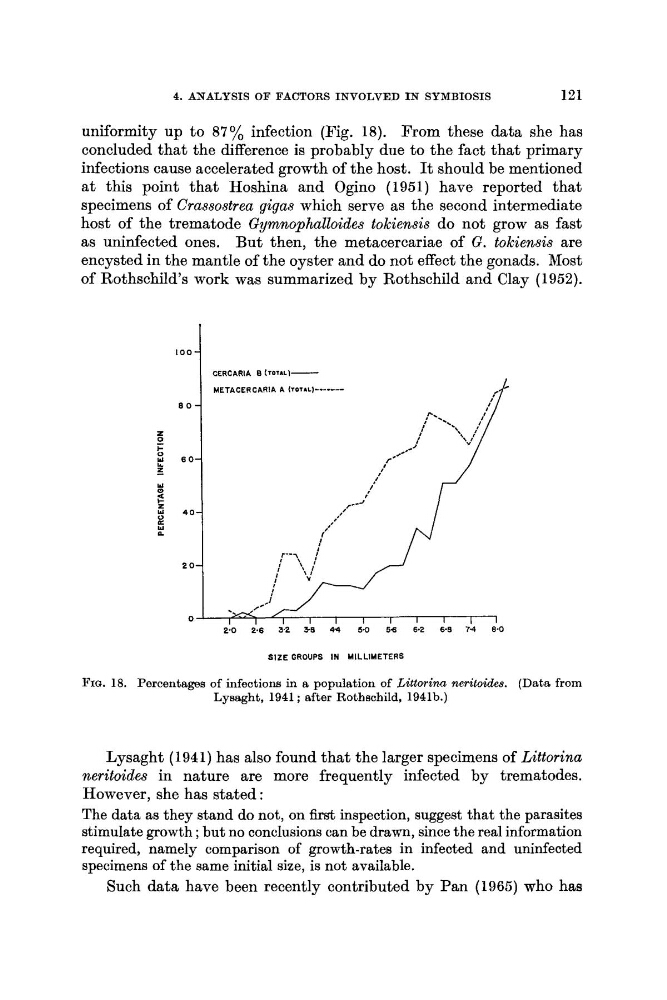
100uniformity up to 87% infection (Fig. 18). From these data she has
concluded that the difference is probably due to the fact that primary
infections cause accelerated growth of the host. It should be mentioned
at this point that Hoshina and Ogino (1951) have reported that
specimens of Crassostrea gigas which serve as the second intermediate
host of the trematode Gymnophalloides tokiensis do not grow as fast
as uninfected ones. But then, the metacercariae of G . tokiensis are
encysted in the mantle of the oyster and do not effect the gonads. Most
of Rothschild’s work was summarized by Rothschild and Clay (1952).
CERCARIA B ~T0r~LlSIZE GROUPS IN MILLIMETERS
FIG. 18. Percentages of infections in a population of Littorina neritoides. (Data from
Lysaght, 1941 ; after Rothschild, 1941b.)
Lysaght (1941) has also found that the larger specimens of Littorina
neritoides in nature are more frequently infected by trematodes.
However, she has stated:
The data as they stand do not, on first inspection, suggest that the parasites
stimulate growth ; but no conclusions can be drawn, since the real information
required, namely comparison of growth-rates in infected and uninfected
specimens of the same initial size, is not available.
Such data have been recently contributed by Pan (1965) who has
121
100uniformity up to 87% infection (Fig. 18). From these data she has
concluded that the difference is probably due to the fact that primary
infections cause accelerated growth of the host. It should be mentioned
at this point that Hoshina and Ogino (1951) have reported that
specimens of Crassostrea gigas which serve as the second intermediate
host of the trematode Gymnophalloides tokiensis do not grow as fast
as uninfected ones. But then, the metacercariae of G . tokiensis are
encysted in the mantle of the oyster and do not effect the gonads. Most
of Rothschild’s work was summarized by Rothschild and Clay (1952).
CERCARIA B ~T0r~LlSIZE GROUPS IN MILLIMETERS
FIG. 18. Percentages of infections in a population of Littorina neritoides. (Data from
Lysaght, 1941 ; after Rothschild, 1941b.)
Lysaght (1941) has also found that the larger specimens of Littorina
neritoides in nature are more frequently infected by trematodes.
However, she has stated:
The data as they stand do not, on first inspection, suggest that the parasites
stimulate growth ; but no conclusions can be drawn, since the real information
required, namely comparison of growth-rates in infected and uninfected
specimens of the same initial size, is not available.
Such data have been recently contributed by Pan (1965) who has