

4. ANALYSIS OF FACTORS INVOLVED IN SYMBIOSIS
115
would cause the destruction of the cells distad to the site of blockage.
James, however, as noted earlier, disagrees with W. J. Rees who has
claimed that the destruction of these cells results from the effects of
accumulated parasite waste products. James is of the opinion that it is
primarily due to starvation autolysis. Among the five species of
trematodes compared, only C . roscovita forms a “ blocking layer.”
James’s hypothesis on physiological resistance is of considerable
interest and differs from any of the factors discussed earlier (Section
11, A, 2), although up to a point it is similar to the finding of Heyneman
(1966). This hypothesis is briefly mentioned here. C. ubiquita will
parasitize three species of Littorina 1 L. saxatilis, L. littoralis and L.
littorea (Lebour, 1911; Stunkard, 1932; W. J. Rees, 193613). James
has established the incidence of infection of C. ubiquita in all three
species of Littorina on College Rocks, Aberystwyth, Wales, during
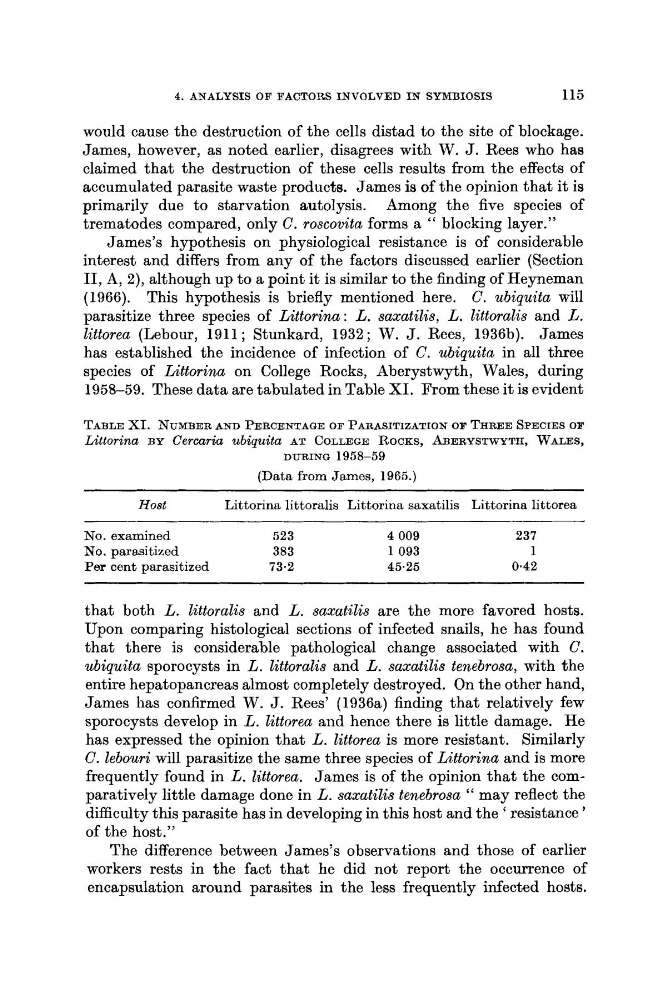
1958-59. These data are tabulated in Table XI. From these it is evident
TABLE XI. NUMBER AND PERCENTAGE OF PARASITIZATION OF THREE SPECIES OF
Littorina BY Cercaritc ubiquita AT COLLEGE ROCKS, ABERYSTWYTH, WALES,
DURING 1958-59
(Data from James, 1965.)
Host
Littorina littoralis Littorina saxatilis Littorina littorea
~
~
~
~~
~
~~
~
No. examined
523
4 009
237
Per cent parasitized
73.2
45.25
0.42
No. parasitized
383
1093
1
that both L. littorulis and L. saxatilis are the more favored hosts.
Upon comparing histological sections of infected snails, he has found
that there is considerable pathological change associated with C.
ubiquita sporocysts in L. littoralis and L. saxatilis tenebrosa, with the
entire hepatopancreas almost completely destroyed. On the other hand,
James has confirmed W. J. Rees’ (1936a) finding that relatively few
sporocysts develop in L. littorea and hence there is little damage. He
has expressed the opinion that L. littorea is more resistant. Similarly
C. lebouri will parasitize the same three species of Littorina and is more
frequently found in L. littorea. James is of the opinion that the comparatively little damage done in L. saxatilis tenebrosa “ may reflect the
difficulty this parasite has in developing in this host and the ‘ resistance ’
of the host.”
The difference between James’s observations and those of earlier
workers rests in the fact that he did not report the occurrence of
encapsulation around parasites in the less frequently infected hosts.
115
would cause the destruction of the cells distad to the site of blockage.
James, however, as noted earlier, disagrees with W. J. Rees who has
claimed that the destruction of these cells results from the effects of
accumulated parasite waste products. James is of the opinion that it is
primarily due to starvation autolysis. Among the five species of
trematodes compared, only C . roscovita forms a “ blocking layer.”
James’s hypothesis on physiological resistance is of considerable
interest and differs from any of the factors discussed earlier (Section
11, A, 2), although up to a point it is similar to the finding of Heyneman
(1966). This hypothesis is briefly mentioned here. C. ubiquita will
parasitize three species of Littorina 1 L. saxatilis, L. littoralis and L.
littorea (Lebour, 1911; Stunkard, 1932; W. J. Rees, 193613). James
has established the incidence of infection of C. ubiquita in all three
species of Littorina on College Rocks, Aberystwyth, Wales, during
1958-59. These data are tabulated in Table XI. From these it is evident
TABLE XI. NUMBER AND PERCENTAGE OF PARASITIZATION OF THREE SPECIES OF
Littorina BY Cercaritc ubiquita AT COLLEGE ROCKS, ABERYSTWYTH, WALES,
DURING 1958-59
(Data from James, 1965.)
Host
Littorina littoralis Littorina saxatilis Littorina littorea
~
~
~
~~
~
~~
~
No. examined
523
4 009
237
Per cent parasitized
73.2
45.25
0.42
No. parasitized
383
1093
1
that both L. littorulis and L. saxatilis are the more favored hosts.
Upon comparing histological sections of infected snails, he has found
that there is considerable pathological change associated with C.
ubiquita sporocysts in L. littoralis and L. saxatilis tenebrosa, with the
entire hepatopancreas almost completely destroyed. On the other hand,
James has confirmed W. J. Rees’ (1936a) finding that relatively few
sporocysts develop in L. littorea and hence there is little damage. He
has expressed the opinion that L. littorea is more resistant. Similarly
C. lebouri will parasitize the same three species of Littorina and is more
frequently found in L. littorea. James is of the opinion that the comparatively little damage done in L. saxatilis tenebrosa “ may reflect the
difficulty this parasite has in developing in this host and the ‘ resistance ’
of the host.”
The difference between James’s observations and those of earlier
workers rests in the fact that he did not report the occurrence of
encapsulation around parasites in the less frequently infected hosts.