

4. ANALYSIS O F FACTORS INVOLVED IN SYMBIOSIS
107
pancreatic tubules, they grew rapidly, both in size and number, thus
causing the lumina of the hepatopancreatic tubules to be completely
obliterated and a t the same time stretching the tunica propria which
covers the entire gland. The excretory wastes of the parasites greatly
tax the absorptive cells of the hepatopancreatic tubules. Although
some of these wastes may have initially become dissolved in the host’s
plasma (hemolymph) and are passed back to the kidneys, as the
infection progresses the intertubular spaces become blocked (Fig. 17)
and the metabolic wastes of both the host and parasites must then be
eliminated via the absorptive cells which comprise each tubule. Rees
has stated : “ If they (the waste products) cannot be removed sufficiently
rapidly the accumulation of acids brings about histological alterations
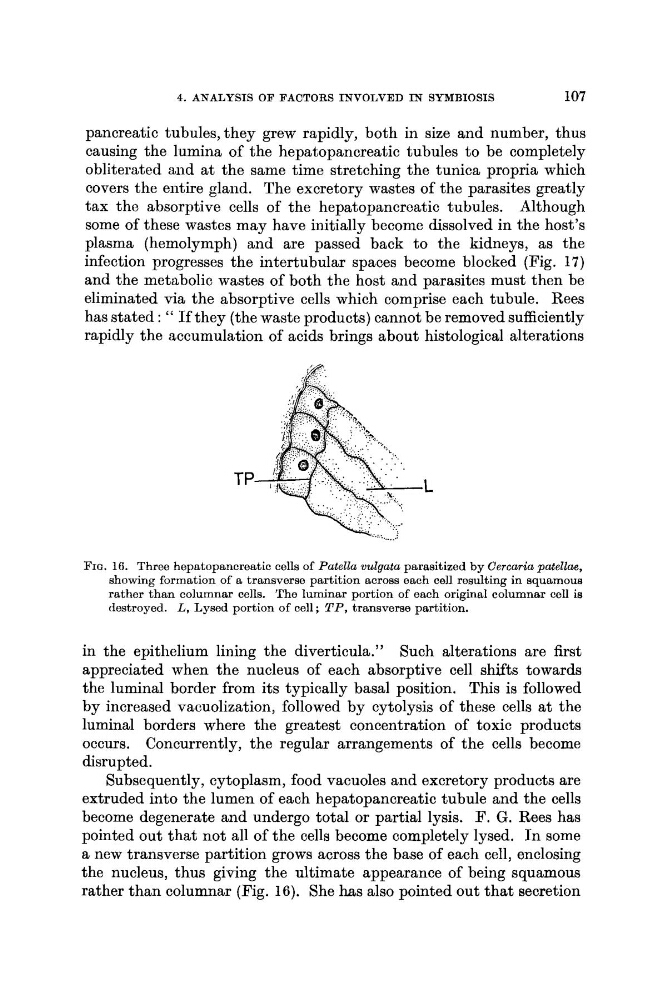
Fro. 16. Three hepatopancreatic cells of Patella wulgata parasitized by Cercaria patellae,
showing formation of a transverse partition across each cell resulting in squamous
rather than columnar cells. The luminar portion of each original columnar cell is
destroyed. L , Lysed portion of cell; T P , transverse partition.
in the epithelium lining the diverticula.” Such alterations are first
appreciated when the nucleus of each absorptive cell shifts towards
the luminal border from its typically basal position. This is followed
by increased vacuolization, followed by cytolysis of these cells a t the
luminal borders where the greatest concentration of toxic products
occurs. Concurrently, the regular arrangements of the cells become
disrupted.
Subsequently, cytoplasm, food vacuoles and excretory products are
extruded into the lumen of each hepatopancreatic tubule and the cells
become degenerate and undergo total or partial lysis. F. G. Rees has
pointed out that not all of the cells become completely lysed. In some
a new transverse partition grows across the base of each cell, enclosing
the nucleus, thus giving the ultimate appearance of being squamous
rather than columnar (Fig. 16). She has also pointed out that secretion
107
pancreatic tubules, they grew rapidly, both in size and number, thus
causing the lumina of the hepatopancreatic tubules to be completely
obliterated and a t the same time stretching the tunica propria which
covers the entire gland. The excretory wastes of the parasites greatly
tax the absorptive cells of the hepatopancreatic tubules. Although
some of these wastes may have initially become dissolved in the host’s
plasma (hemolymph) and are passed back to the kidneys, as the
infection progresses the intertubular spaces become blocked (Fig. 17)
and the metabolic wastes of both the host and parasites must then be
eliminated via the absorptive cells which comprise each tubule. Rees
has stated : “ If they (the waste products) cannot be removed sufficiently
rapidly the accumulation of acids brings about histological alterations
Fro. 16. Three hepatopancreatic cells of Patella wulgata parasitized by Cercaria patellae,
showing formation of a transverse partition across each cell resulting in squamous
rather than columnar cells. The luminar portion of each original columnar cell is
destroyed. L , Lysed portion of cell; T P , transverse partition.
in the epithelium lining the diverticula.” Such alterations are first
appreciated when the nucleus of each absorptive cell shifts towards
the luminal border from its typically basal position. This is followed
by increased vacuolization, followed by cytolysis of these cells a t the
luminal borders where the greatest concentration of toxic products
occurs. Concurrently, the regular arrangements of the cells become
disrupted.
Subsequently, cytoplasm, food vacuoles and excretory products are
extruded into the lumen of each hepatopancreatic tubule and the cells
become degenerate and undergo total or partial lysis. F. G. Rees has
pointed out that not all of the cells become completely lysed. In some
a new transverse partition grows across the base of each cell, enclosing
the nucleus, thus giving the ultimate appearance of being squamous
rather than columnar (Fig. 16). She has also pointed out that secretion