

58
CARL J. SINDERMANN
ocellatum on the gills and occasionally the external surfaces of 28
species. The parasite appears to be nonspecific in host selection.
Laird (1956) reported it as a cause of major mortalities in a Singapore
aquarium. Primarily a gill parasite, it caused hemorrhages and
adhesions of gill filaments and interfered with host respiration. I n
heavy infections it spread over skin and fins, giving the appearance
of powdery or velvety patches. Nigrelli (1936) also reported this
parasitic dinoflagellate as common on skin and gills of many species
in marine aquaria.
A ciliate parasite, Cryptocaryon irritans Brown, is the marine
counterpart of the ubiquitous fresh-water Ichthyophthirius multiJiliis
Fouquet. The parasite, only briefly described by Brown (1951), causes
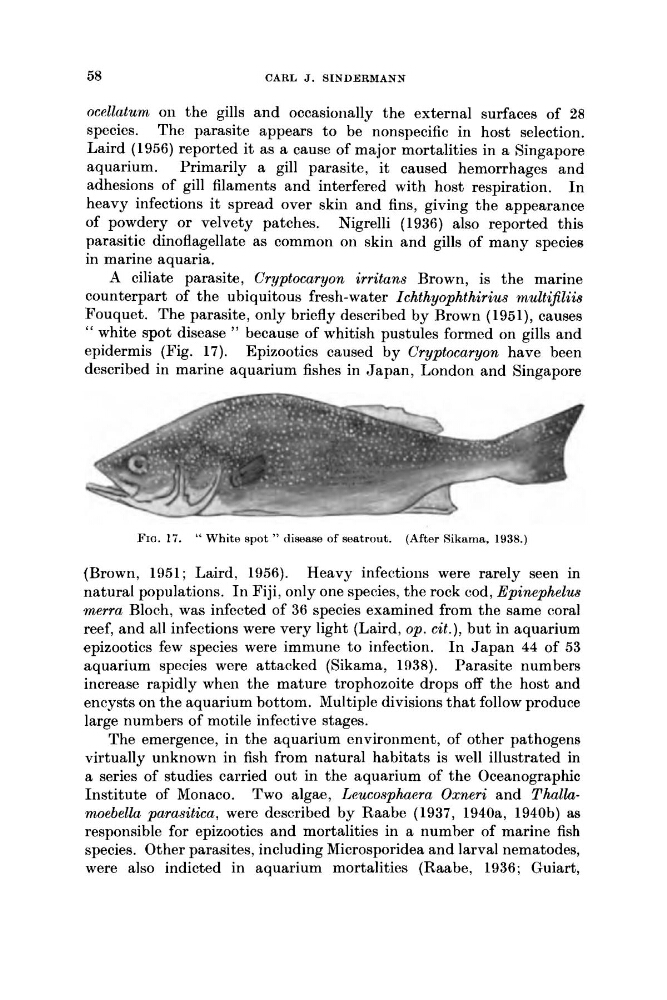
“ white spot disease ” because of whitish pustules formed on gills and
epidermis (Fig. 17). Epizootics caused by Cryptocaryon have been
described in marine aquarium fishes in Japan, London and Singapore
FIG. 17. “White spot ” disease of seatrout. (After Sikama, 1938.)
(Brown, 1951; Laird, 1956). Heavy infections were rarely seen in
natural populations. I n Fiji, only one species, the rock cod, Epinephelus
merra Bloch, was infected of 36 species examined from the same coral
reef, and all infections were very light (Laird, op. cit.), but in aquarium
epizootics few species were immune to infection. I n Japan 44 of 53
aquarium species were attacked (Sikama, 1938). Parasite numbers
increase rapidly when the mature trophozoite drops off the host and
encysts on the aquarium bottom. Multiple divisions that follow produce
large numbers of motile infective stages.
The emergence, in the aquarium environment, of other pathogens
virtually unknown in fish from natural habitats is well illustrated in
a series of studies carried out in the aquarium of the Oceanographic
Institute of Monaco. Two algae, Leucosphaera Oxneri and Thallumoebella parasitica, were described by Raabe (1937, 1940a, 1940b) as
responsible for epizootics and mortalities in a number of marine fish
species. Other parasites, including Microsporidea and larval nematodes,
were also indicted in aquarium mortalities (Raabe, 1936; Guiart,
CARL J. SINDERMANN
ocellatum on the gills and occasionally the external surfaces of 28
species. The parasite appears to be nonspecific in host selection.
Laird (1956) reported it as a cause of major mortalities in a Singapore
aquarium. Primarily a gill parasite, it caused hemorrhages and
adhesions of gill filaments and interfered with host respiration. I n
heavy infections it spread over skin and fins, giving the appearance
of powdery or velvety patches. Nigrelli (1936) also reported this
parasitic dinoflagellate as common on skin and gills of many species
in marine aquaria.
A ciliate parasite, Cryptocaryon irritans Brown, is the marine
counterpart of the ubiquitous fresh-water Ichthyophthirius multiJiliis
Fouquet. The parasite, only briefly described by Brown (1951), causes
“ white spot disease ” because of whitish pustules formed on gills and
epidermis (Fig. 17). Epizootics caused by Cryptocaryon have been
described in marine aquarium fishes in Japan, London and Singapore
FIG. 17. “White spot ” disease of seatrout. (After Sikama, 1938.)
(Brown, 1951; Laird, 1956). Heavy infections were rarely seen in
natural populations. I n Fiji, only one species, the rock cod, Epinephelus
merra Bloch, was infected of 36 species examined from the same coral
reef, and all infections were very light (Laird, op. cit.), but in aquarium
epizootics few species were immune to infection. I n Japan 44 of 53
aquarium species were attacked (Sikama, 1938). Parasite numbers
increase rapidly when the mature trophozoite drops off the host and
encysts on the aquarium bottom. Multiple divisions that follow produce
large numbers of motile infective stages.
The emergence, in the aquarium environment, of other pathogens
virtually unknown in fish from natural habitats is well illustrated in
a series of studies carried out in the aquarium of the Oceanographic
Institute of Monaco. Two algae, Leucosphaera Oxneri and Thallumoebella parasitica, were described by Raabe (1937, 1940a, 1940b) as
responsible for epizootics and mortalities in a number of marine fish
species. Other parasites, including Microsporidea and larval nematodes,
were also indicted in aquarium mortalities (Raabe, 1936; Guiart,