

DISEASES O F MAFUXE FISHES
49
(1955) reported E. sardinae but not E. clupearum in Barents Sea
herring. Kabata (1963a) found both species in North Sea herring,
while Shulman (1959) found E. sardinae in the Gulf of Riga but not
in the Gulf of Finland. Changes associated with salinity have been
observed in the occurrence of other parasites of White and Baltic Sea
herring (Shulman and Shulman-Albova, 1953 ; Dogie1 et d , 1958).
Several stages in the transition from strictly marine to fresh-water
parasites were noted in the surveys involved.
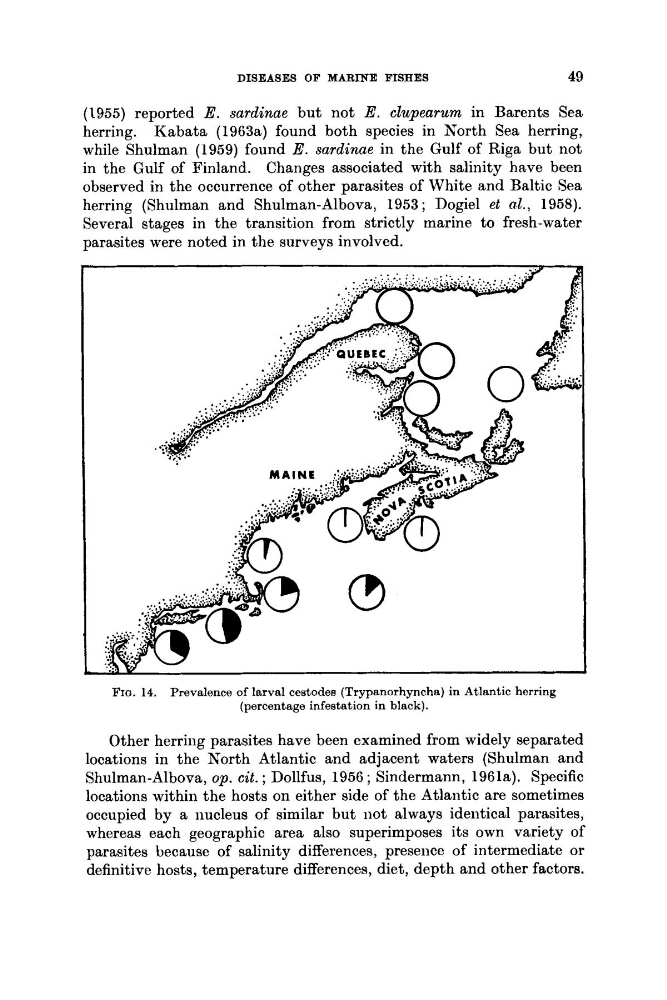
Fro. 14. Prevalence of larval cestodes (Trypanorhyncha) in Atlantic herring
(percentage infestation in black).
Other herring parasites have been examined from widely separated
locations in the North Atlantic and adjacent waters (Shulman and
Shulman-Albova, op. cit. ; Dollfus, 1956 ; Sindermann, 1961a). Specific
locations within the hosts on either side of the Atlantic are sometimes
occupied by a nucleus of similar but not always identical parasites,
whereas each geographic area also superimposes its own variety of
parasites because of salinity differences, presence of intermediate or
definitive hosts, temperature differences, diet, depth and other factors.
49
(1955) reported E. sardinae but not E. clupearum in Barents Sea
herring. Kabata (1963a) found both species in North Sea herring,
while Shulman (1959) found E. sardinae in the Gulf of Riga but not
in the Gulf of Finland. Changes associated with salinity have been
observed in the occurrence of other parasites of White and Baltic Sea
herring (Shulman and Shulman-Albova, 1953 ; Dogie1 et d , 1958).
Several stages in the transition from strictly marine to fresh-water
parasites were noted in the surveys involved.
Fro. 14. Prevalence of larval cestodes (Trypanorhyncha) in Atlantic herring
(percentage infestation in black).
Other herring parasites have been examined from widely separated
locations in the North Atlantic and adjacent waters (Shulman and
Shulman-Albova, op. cit. ; Dollfus, 1956 ; Sindermann, 1961a). Specific
locations within the hosts on either side of the Atlantic are sometimes
occupied by a nucleus of similar but not always identical parasites,
whereas each geographic area also superimposes its own variety of
parasites because of salinity differences, presence of intermediate or
definitive hosts, temperature differences, diet, depth and other factors.