

38
CARL J. SINDERMANN
Mexico. Large spotted scatrout. C p o s c i o ~ nebulosus (Cuvier), harbored
up to 1 0 0 larval ori ins, a i d as niucli as 44% of a sample wcre infcstcd
(Chandler, 1935a. 1935b). Many food fishes, such as herring, hake and
mackerel, have becn reported t o harbor othcr trypanorhyiicli larvae
(Johnstone, 1912b ; Liiitoii, 1923 ; Ruszkowski, 1931 ; Iiahl, 1937 ;
Young. 1955 ; Rae, 1958). As an example, Grillofiu erinciceus (van
Beneden) is so common iii iiiaiiy North Atlantic teleosts t h a t ail
extensive literature on its occurrence existed in the iiiiieteeiith century.
Pleroceroids of the cestode were described by Johiistoiie (1912b) as
among the most abundant helminth parasites of Irish Sra fish ; they
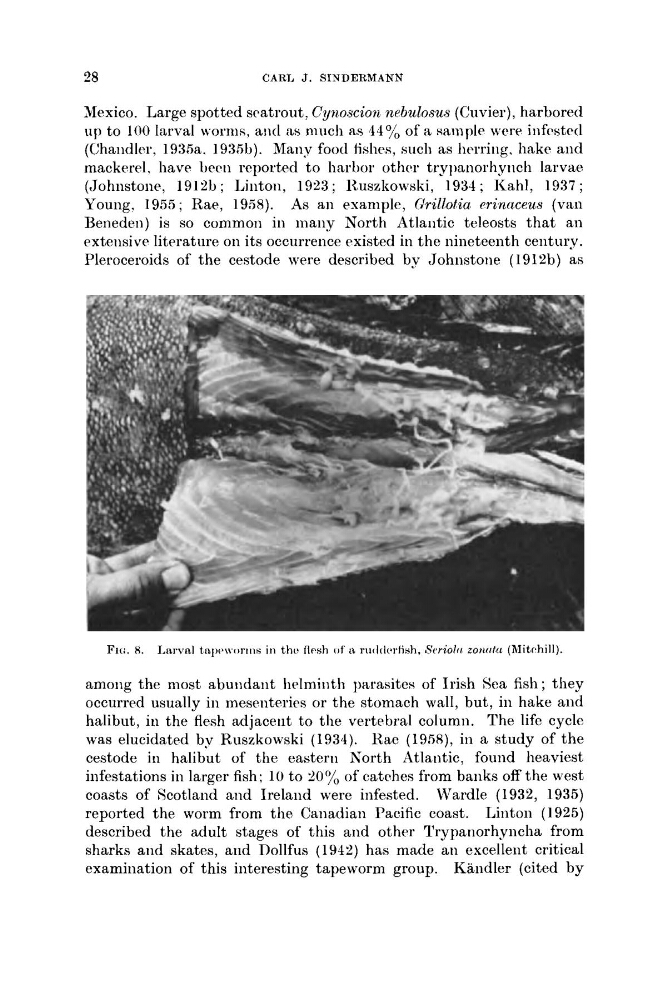
occurred usually in mesenteries or the stomach wall, but, in hake and
halibut, in the flesh adjacent to the vertebral column. The life cycle
was elucidated by Ruszkowski (1934). Rae (1958), in a study of the
cestode in halibut of the eastern North Atlantic, found heaviest
infestations in larger fish: 10 to 20% of catches from banks off the west
coasts of Scotland and Ireland were infested. Wardle (1932, 1935)
reported the worm from the Canadian Pacific coast. Liiitoii (1925)
described the adult stages of this and other Trypanorhyncha from
sharks and skates, and Dollfus (1912) has made a n excellent critical
examination of this interesting tapeworm group. Kandler (cited by
CARL J. SINDERMANN
Mexico. Large spotted scatrout. C p o s c i o ~ nebulosus (Cuvier), harbored
up to 1 0 0 larval ori ins, a i d as niucli as 44% of a sample wcre infcstcd
(Chandler, 1935a. 1935b). Many food fishes, such as herring, hake and
mackerel, have becn reported t o harbor othcr trypanorhyiicli larvae
(Johnstone, 1912b ; Liiitoii, 1923 ; Ruszkowski, 1931 ; Iiahl, 1937 ;
Young. 1955 ; Rae, 1958). As an example, Grillofiu erinciceus (van
Beneden) is so common iii iiiaiiy North Atlantic teleosts t h a t ail
extensive literature on its occurrence existed in the iiiiieteeiith century.
Pleroceroids of the cestode were described by Johiistoiie (1912b) as
among the most abundant helminth parasites of Irish Sra fish ; they
occurred usually in mesenteries or the stomach wall, but, in hake and
halibut, in the flesh adjacent to the vertebral column. The life cycle
was elucidated by Ruszkowski (1934). Rae (1958), in a study of the
cestode in halibut of the eastern North Atlantic, found heaviest
infestations in larger fish: 10 to 20% of catches from banks off the west
coasts of Scotland and Ireland were infested. Wardle (1932, 1935)
reported the worm from the Canadian Pacific coast. Liiitoii (1925)
described the adult stages of this and other Trypanorhyncha from
sharks and skates, and Dollfus (1912) has made a n excellent critical
examination of this interesting tapeworm group. Kandler (cited by