

210
MALCOLM R. CLARKE
13. Mastigoteuthis talismani (Fischer and Joubin, 1906)
Chiroteuthopsis Talismani Fischer and Joubin, 1906
This species is only known from the type which was taken at 34’46“
36’11‘W in the North Atlantic (Fischer and Joubin, 1906, 1907) with
an open net fished in 3 176 m (? sounding). The mantle length is 6-1 cm.
H. Larval chiroteuthids
Relationships between the named larval chiroteuthids, other than
those referred to Chiroteuthis veranyi may be best seen if they are
grouped according to their proportions and arranged to show any
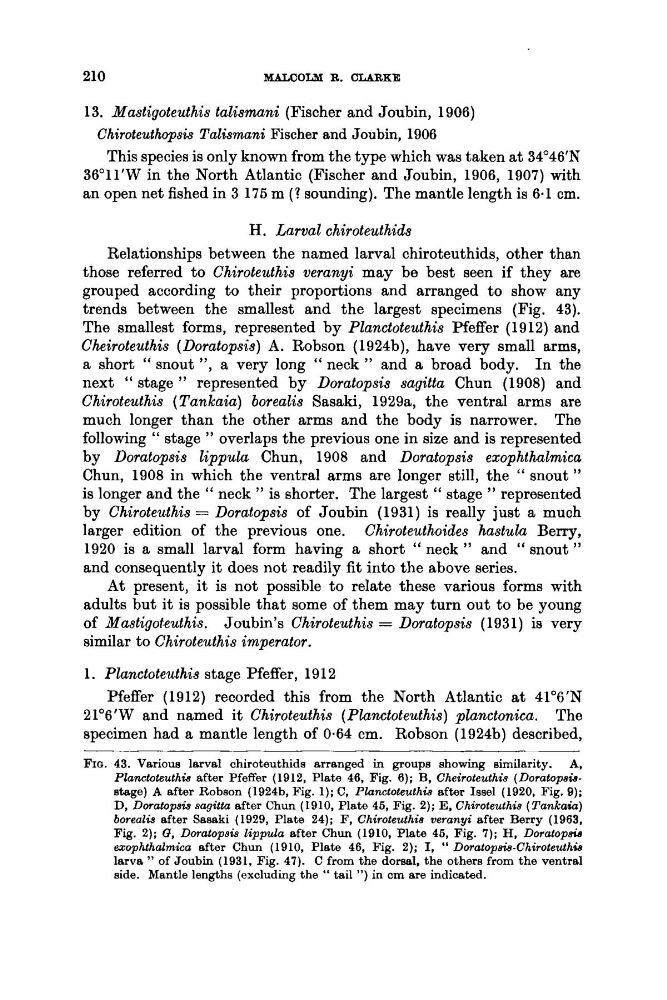
trends between the smallest and the largest specimens (Fig. 43).
The smallest forms, represented by Planctoteuthis Pfeffer (1912) and
Cheiroteuthis (Doratopsis) A. Robson (1924b), have very small arms,
a short “ snout ”, a very long
In the
next ‘( stage ” represented by Doratopsis sagitta Chun (1908) and
Chiroteuthis (Tankaia) borealis Sasaki, 1929a, the ventral arms are
much longer than the other arms and the body is narrower. The
following ‘ I stage ” overlaps the previous one in size and is represented
by Doratopsis lippula Chun, 1908 and Doratopsis exophthalmica
Chun, 1908 in which the ventral arms are longer still, the (‘ snout ”
is longer and the (‘ neck ” is shorter. The largest “ stage ” represented
by Chiroteuthis = Doratopsis of Joubin (1931) is really just a much
larger edition of the previous one. Chiroteuthoides hastula Berry,
1920 is a small larval form having a short neck ” and ‘ I snout ”
and consequently it does not readily fit into the above series.
At present, it is not possible to relate these various forms with
adults but it is possible that some of them may turn out to be young
of Mastigoteuthis. Joubin’s Chiroteuthis = Doratopsis (1931) is very
similar to Chiroteuthis imperator.
1. Planctoteuthis stage Pfeffer, 1912
Pfeffer (1912) recorded this from the North Atlantic at 41’6“
2 l”6’W and named it Chiroteuthis (Planctoteuthis) planctonica. The
specimen had a mantle length of 0-64 cm. Robson (1924b) described,
neck ” and a broad body.
FIQ. 43. Various larval chiroteuthids arranged in groups showing similarity. A,
Planctoteuthia after Pfeffer (1912, Plate 46, Fig. 6); B, Cheiroteuthis (Doratopaisstage) A after Robson (1924b, Fig. 1); C, Planctoteuthis after Issel (1920, Fig. 9);
D, Doratopsis sagitta after Chun (1910, Plate 46, Fig. 2); E, Chiroteuthis (Tankaiu)
borealis after Sasaki (1929, Plate 24); F, Chiroteuthia veranyi after Berry (1963,
Fig. 2); 0 , Doratopsia Zippula after Chun (1910, Plate 46, Fig. 7); H, Doratopais
ezophthalmica after Chun (1910, Plate 46, Fig. 2); I, “ Doratopsis-Chiroteuthia
larva ” of Joubin (1931, Fig. 47). C from the dored, the others from the ventral
side. Mantle lengths (excluding the “ tail ”) in cm are indicated.
MALCOLM R. CLARKE
13. Mastigoteuthis talismani (Fischer and Joubin, 1906)
Chiroteuthopsis Talismani Fischer and Joubin, 1906
This species is only known from the type which was taken at 34’46“
36’11‘W in the North Atlantic (Fischer and Joubin, 1906, 1907) with
an open net fished in 3 176 m (? sounding). The mantle length is 6-1 cm.
H. Larval chiroteuthids
Relationships between the named larval chiroteuthids, other than
those referred to Chiroteuthis veranyi may be best seen if they are
grouped according to their proportions and arranged to show any
trends between the smallest and the largest specimens (Fig. 43).
The smallest forms, represented by Planctoteuthis Pfeffer (1912) and
Cheiroteuthis (Doratopsis) A. Robson (1924b), have very small arms,
a short “ snout ”, a very long
In the
next ‘( stage ” represented by Doratopsis sagitta Chun (1908) and
Chiroteuthis (Tankaia) borealis Sasaki, 1929a, the ventral arms are
much longer than the other arms and the body is narrower. The
following ‘ I stage ” overlaps the previous one in size and is represented
by Doratopsis lippula Chun, 1908 and Doratopsis exophthalmica
Chun, 1908 in which the ventral arms are longer still, the (‘ snout ”
is longer and the (‘ neck ” is shorter. The largest “ stage ” represented
by Chiroteuthis = Doratopsis of Joubin (1931) is really just a much
larger edition of the previous one. Chiroteuthoides hastula Berry,
1920 is a small larval form having a short neck ” and ‘ I snout ”
and consequently it does not readily fit into the above series.
At present, it is not possible to relate these various forms with
adults but it is possible that some of them may turn out to be young
of Mastigoteuthis. Joubin’s Chiroteuthis = Doratopsis (1931) is very
similar to Chiroteuthis imperator.
1. Planctoteuthis stage Pfeffer, 1912
Pfeffer (1912) recorded this from the North Atlantic at 41’6“
2 l”6’W and named it Chiroteuthis (Planctoteuthis) planctonica. The
specimen had a mantle length of 0-64 cm. Robson (1924b) described,
neck ” and a broad body.
FIQ. 43. Various larval chiroteuthids arranged in groups showing similarity. A,
Planctoteuthia after Pfeffer (1912, Plate 46, Fig. 6); B, Cheiroteuthis (Doratopaisstage) A after Robson (1924b, Fig. 1); C, Planctoteuthis after Issel (1920, Fig. 9);
D, Doratopsis sagitta after Chun (1910, Plate 46, Fig. 2); E, Chiroteuthis (Tankaiu)
borealis after Sasaki (1929, Plate 24); F, Chiroteuthia veranyi after Berry (1963,
Fig. 2); 0 , Doratopsia Zippula after Chun (1910, Plate 46, Fig. 7); H, Doratopais
ezophthalmica after Chun (1910, Plate 46, Fig. 2); I, “ Doratopsis-Chiroteuthia
larva ” of Joubin (1931, Fig. 47). C from the dored, the others from the ventral
side. Mantle lengths (excluding the “ tail ”) in cm are indicated.