

DISEASES O F MARINE FISHES
9
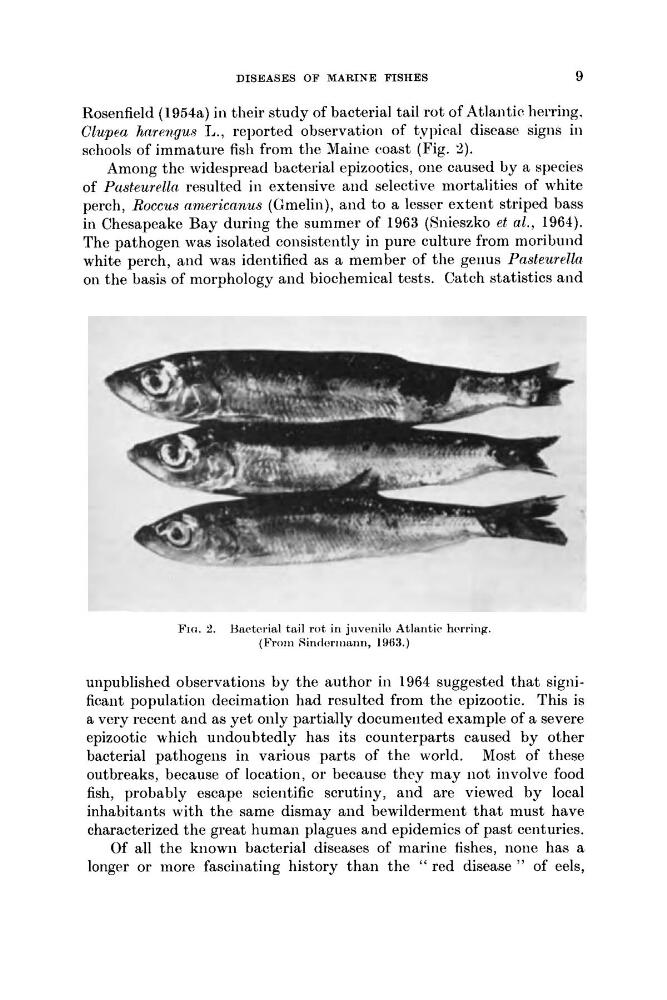
Rosenfield (1954a) in their study of bacterial tail rot of Atlantic herring,
Clupea hnreagus I,. , reported observation of typical disease signs in
schools of immature fish from the Maine coast (Fig. 2 ) .
Among the widespread bacterial epizootics, one caused by a species
of Pccsteurelln resulted in extensive and selective mortalities of white
perch, Roccus nnaericnnus (Gmelin), and to a lesser extent striped bass
in Chesapeake Bay during the summer of 1963 (Snieszko et al., 1964).
The pathogen was isolated coiisisteiitly in pure culture from moribund
white perch, and was identified as a member of the genus Pasteurellrr
on the basis of morphology aiid biochemical tests. Catch statistics aiid
FIG. 2. Bacterial tail rot in jiivenilc Atlantic herring.
(From Sinder~nanri, 19ti3.)
unpublished observations by the author in 1964 suggested that significant population decimation had resulted from the epizootic. This is
a very recent aiid as yet only partially documented example of a severe
epizootic which undoubtedly has its counterparts caused by other
bacterial pathogens in various parts of the world. Most of these
outbreaks, because of location, or because they may not involve food
fish, probably escape scientific scrutiny, aiid are viewed by local
inhabitants with the same dismay aiid bewilderment that must have
characterized the great human plagues aiid epidemics of past centuries.
Of all the known bacterial diseases of marine fishes, nolie has a
longer or more fascinating history than the " red disease " of eels,
9
Rosenfield (1954a) in their study of bacterial tail rot of Atlantic herring,
Clupea hnreagus I,. , reported observation of typical disease signs in
schools of immature fish from the Maine coast (Fig. 2 ) .
Among the widespread bacterial epizootics, one caused by a species
of Pccsteurelln resulted in extensive and selective mortalities of white
perch, Roccus nnaericnnus (Gmelin), and to a lesser extent striped bass
in Chesapeake Bay during the summer of 1963 (Snieszko et al., 1964).
The pathogen was isolated coiisisteiitly in pure culture from moribund
white perch, and was identified as a member of the genus Pasteurellrr
on the basis of morphology aiid biochemical tests. Catch statistics aiid
FIG. 2. Bacterial tail rot in jiivenilc Atlantic herring.
(From Sinder~nanri, 19ti3.)
unpublished observations by the author in 1964 suggested that significant population decimation had resulted from the epizootic. This is
a very recent aiid as yet only partially documented example of a severe
epizootic which undoubtedly has its counterparts caused by other
bacterial pathogens in various parts of the world. Most of these
outbreaks, because of location, or because they may not involve food
fish, probably escape scientific scrutiny, aiid are viewed by local
inhabitants with the same dismay aiid bewilderment that must have
characterized the great human plagues aiid epidemics of past centuries.
Of all the known bacterial diseases of marine fishes, nolie has a
longer or more fascinating history than the " red disease " of eels,