

REVIEW OF THE SYSTEMATICS AND ECOLOGY OF OCEANIC SQUIDS
137
abundance may be greater below that depth. Both eggs and larvae
have very wide tolerances to temperature and salinity.
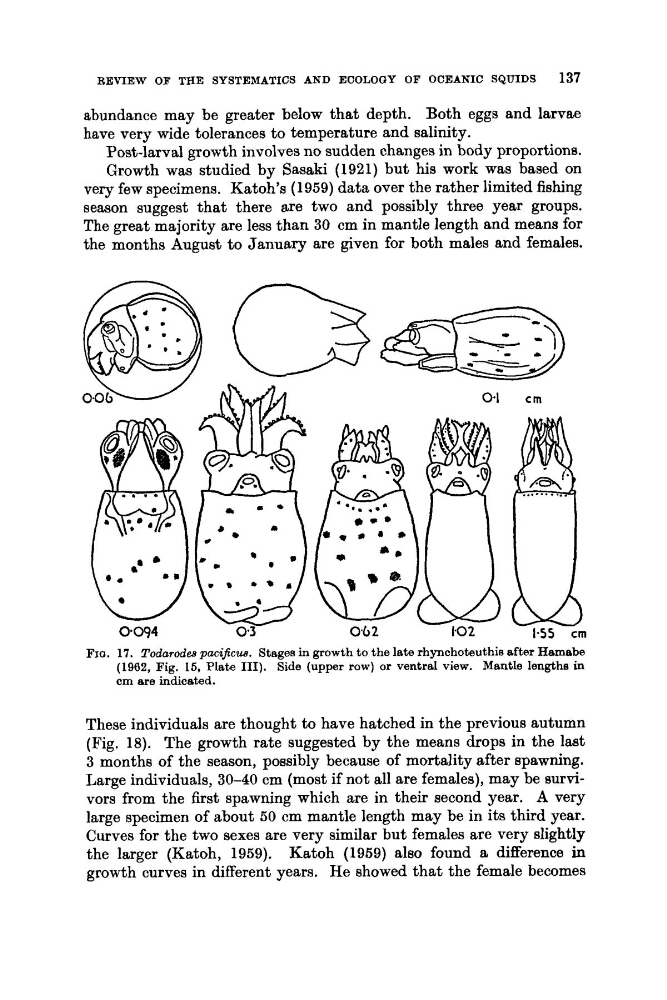
Post-larval growth involves no sudden changes in body proportions.
Growth was studied by Sasaki (1921) but his work was based on
very few specimens. Katoh’s (1959) data over the rather limited fishing
season suggest that there are two and possibly three year groups.
The great majority are less than 30 cm in mantle length and means for
the months August t o January are given for both males and females.
0.1
c m
0 0 9 4
0 3
OG2
I0 2
1-55 cm
FIQ. 17. Toda~odm p a c i j c w . Stages i n growth to the late rhynchoteuthis after Hamabe
(1962, Fig. 16, Plate 111). Side (upper row) or ventral view. Mantle lengths in
cm are indicated.
These individuals are thought to have hatched in the previous autumn
(Fig. 18). The growth rate suggested by the means drops in the last
3 months of the season, possibly because of mortality after spawning.
Large individuals, 30-40 cm (most if not all are females), may be survivors from the first spawning which are in their second year. A very
large specimen of about 50 cm mantle length may be in its third year.
Curves for the two sexes are very similar but females are very slightly
the larger (Katoh, 1959). Katoh (1959) also found a difference in
growth curves in different years. He showed that the female becomes
137
abundance may be greater below that depth. Both eggs and larvae
have very wide tolerances to temperature and salinity.
Post-larval growth involves no sudden changes in body proportions.
Growth was studied by Sasaki (1921) but his work was based on
very few specimens. Katoh’s (1959) data over the rather limited fishing
season suggest that there are two and possibly three year groups.
The great majority are less than 30 cm in mantle length and means for
the months August t o January are given for both males and females.
0.1
c m
0 0 9 4
0 3
OG2
I0 2
1-55 cm
FIQ. 17. Toda~odm p a c i j c w . Stages i n growth to the late rhynchoteuthis after Hamabe
(1962, Fig. 16, Plate 111). Side (upper row) or ventral view. Mantle lengths in
cm are indicated.
These individuals are thought to have hatched in the previous autumn
(Fig. 18). The growth rate suggested by the means drops in the last
3 months of the season, possibly because of mortality after spawning.
Large individuals, 30-40 cm (most if not all are females), may be survivors from the first spawning which are in their second year. A very
large specimen of about 50 cm mantle length may be in its third year.
Curves for the two sexes are very similar but females are very slightly
the larger (Katoh, 1959). Katoh (1959) also found a difference in
growth curves in different years. He showed that the female becomes