

REVIEW OF THE SYSTEMATICS AND ECOLOGY OF OCEANIC SQUIDS
lo!)
so earning the name of "flying squid'' (Verrill, 188%; Berry, 1912d;
Aratara 1954). The author has seen this behaviour by 0. caroli which
were about 30 cm in total length and some degree of control in a
fresh breeze was once witnessed. It is more often observed prior to
the appearance of larger squid and can be interpreted as a panic,
escape reaction.
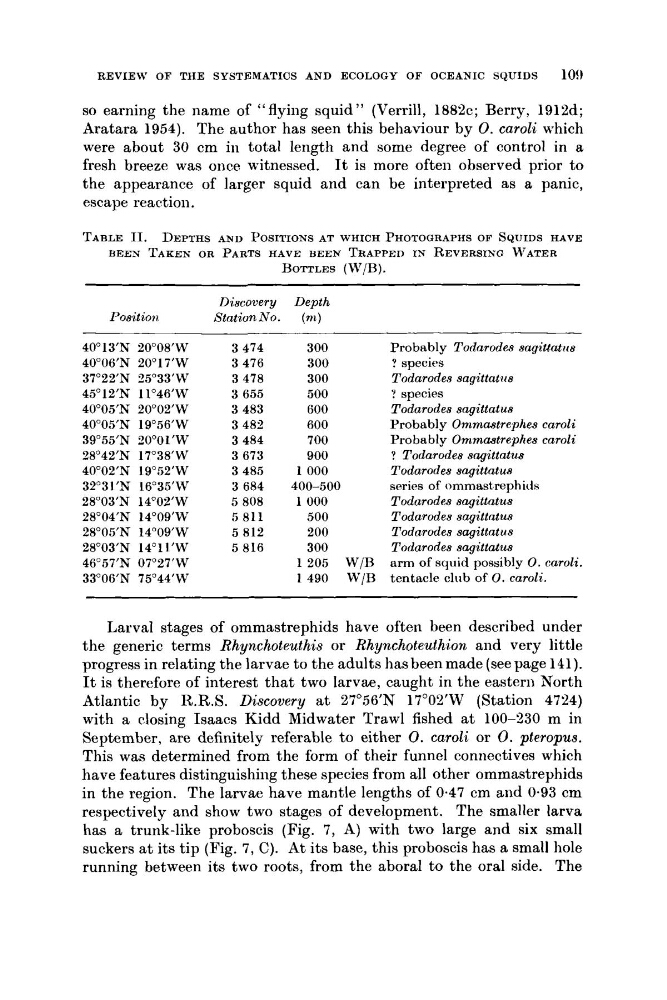
TABLE 11. DEPTHS AND POSITIONS AT WHICH PHOTOGRAPHS OF SQUIDS HAVE
BOTTLES (W/B).
BEEN TAKEN OR PARTS HAVE BEEN TRAPPED IN REVERSING WATER
Discovery Depth
Position
Station N o .
( m )
40'13"
2O"OS'W
40"06'N 20'17'W
37'22"
25"33'W
45'12"
11'46'W
40'05"
20'02'W
40"05'N 1Y56'W
39"55'N 20"Ol'W
28'42"
17"38'W
40"02'N 19"52'W
32"31'N 16"35'W
28"03'N 14'02'W
28"04'N 14'09'W
28'05"
14"09'W
28'03"
14'1 1'W
46"57'N 07"27'W
33'06"
75"44'W
3 474
3 476
3 478
3 655
3 483
3 482
3 484
3 673
3 485
3 684
5 808
5 811
5 812
5 816
300
300
300
500
GOO
600
700
900
1000
400-500
1 000
500
200
300
1205 W/B
1490 W / B
Probably Todarodes sagittatus
? species
Todarodes sagittal 11s
? species
Todarodes sagittatus
Probably Ommastrephes caroli
Probably Ommastrephes caroli
? Todarodes sagittatus
Todarodes sagittatus
series of ommastrephids
Todarodes sagittatus
Todarodes sagittatus
Todarodes sagittatus
Todarodes sagittalus
arm of squid possibly 0 . caroli.
tentacle club of 0 . caroli.
Larval stages of ommastrephids have often been described under
the generic terms Rhynchoteuthis or Rhynchoteuthion and very little
progress in relating the larvae to the adults has been made (see page 141).
It is therefore of interest that two larvae, caught in the eastern North
Atlantic by R.R.S. Discovery at 27'56"
17'02'W (Station 4724)
with a closing Isaacs Kidd Midwater Trawl fished at 100-230 m in
September, are definitely referable to either 0. caroli or 0 . pteropus.
This was determined from the form of their funnel connectives which
have features distinguishing these species from all other ommastreyhids
in the region. The larvae have mantle lengths of 0.47 cm and 0.93 cm
respectively and show two stages of development. The smaller larva
has a trunk-like proboscis (Fig. 7, A) with two large and six small
suckers a t its tip (Fig. 7 , C). At its base, this proboscis has a small hole
running between its two roots, from the aboral to the oral side. The
lo!)
so earning the name of "flying squid'' (Verrill, 188%; Berry, 1912d;
Aratara 1954). The author has seen this behaviour by 0. caroli which
were about 30 cm in total length and some degree of control in a
fresh breeze was once witnessed. It is more often observed prior to
the appearance of larger squid and can be interpreted as a panic,
escape reaction.
TABLE 11. DEPTHS AND POSITIONS AT WHICH PHOTOGRAPHS OF SQUIDS HAVE
BOTTLES (W/B).
BEEN TAKEN OR PARTS HAVE BEEN TRAPPED IN REVERSING WATER
Discovery Depth
Position
Station N o .
( m )
40'13"
2O"OS'W
40"06'N 20'17'W
37'22"
25"33'W
45'12"
11'46'W
40'05"
20'02'W
40"05'N 1Y56'W
39"55'N 20"Ol'W
28'42"
17"38'W
40"02'N 19"52'W
32"31'N 16"35'W
28"03'N 14'02'W
28"04'N 14'09'W
28'05"
14"09'W
28'03"
14'1 1'W
46"57'N 07"27'W
33'06"
75"44'W
3 474
3 476
3 478
3 655
3 483
3 482
3 484
3 673
3 485
3 684
5 808
5 811
5 812
5 816
300
300
300
500
GOO
600
700
900
1000
400-500
1 000
500
200
300
1205 W/B
1490 W / B
Probably Todarodes sagittatus
? species
Todarodes sagittal 11s
? species
Todarodes sagittatus
Probably Ommastrephes caroli
Probably Ommastrephes caroli
? Todarodes sagittatus
Todarodes sagittatus
series of ommastrephids
Todarodes sagittatus
Todarodes sagittatus
Todarodes sagittatus
Todarodes sagittalus
arm of squid possibly 0 . caroli.
tentacle club of 0 . caroli.
Larval stages of ommastrephids have often been described under
the generic terms Rhynchoteuthis or Rhynchoteuthion and very little
progress in relating the larvae to the adults has been made (see page 141).
It is therefore of interest that two larvae, caught in the eastern North
Atlantic by R.R.S. Discovery at 27'56"
17'02'W (Station 4724)
with a closing Isaacs Kidd Midwater Trawl fished at 100-230 m in
September, are definitely referable to either 0. caroli or 0 . pteropus.
This was determined from the form of their funnel connectives which
have features distinguishing these species from all other ommastreyhids
in the region. The larvae have mantle lengths of 0.47 cm and 0.93 cm
respectively and show two stages of development. The smaller larva
has a trunk-like proboscis (Fig. 7, A) with two large and six small
suckers a t its tip (Fig. 7 , C). At its base, this proboscis has a small hole
running between its two roots, from the aboral to the oral side. The