

78
E. NAYLOR
indicators of temperature-depth variations, the presence of sewage
may be a more limiting factor for calcareous species than high temperatures. Industrial outfalls of mixed pollutants including heat are
also reported to bring about the elimination of species by Reish (1960).
Enclosed areas, such as docks used as cooling ponds for power
stations, might be expected to provide particularly striking examples
of the elimination of native species. Thus though Markowski (1959,
J F M A M J J A S O N D
.___. . ,-~_.
- -- . - .- ._ . . .
r6. omphitrite
r6. omphitrite
.-.----....
30
20 C"
1 0
0
- 30
-20 C"
- 1 0
-0
30
_._.... --..-.--.--.120 C"
6. omphitrite
6. crenotus
1 0
0
..
...-.-..-...
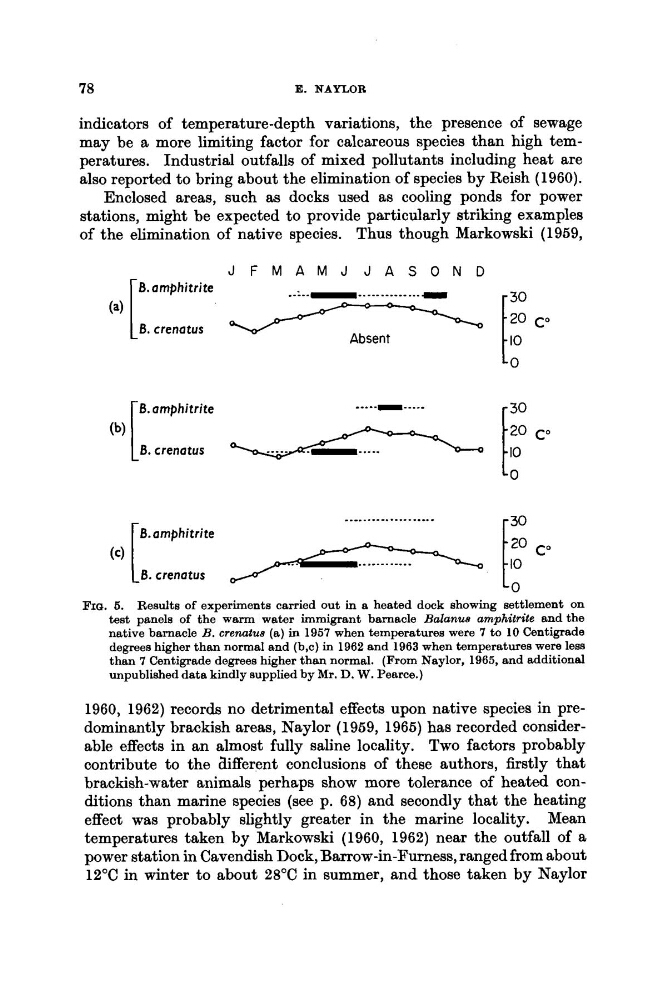
FIO. 6. Results of experiments carried out in a heated dock showing settlement on
test panels of the warm water immigrant barnacle Balanus amphitrite and the
native barnacle B. crenatw, (a) in 1957 when temperatures were 7 to 10 Centigrade
degrees higher than normal and (b,c) in 1962 and 1963 when temperatures were less
than 7 Centigrade degrees higher than normal. (From Naylor, 1965, and additional
unpublished data kindly supplied by Mr. D. W. Pearce.)
1960, 1962) records no detrimental effects upon native species in predominantly brackish areas, Naylor (1969, 1965) has recorded considerable effects in an almost fully saline locality. Two factors probably
contribute to the aifferent conclusions of these authors, firstly that
brackish-water animals perhaps show more tolerance of heated conditions than marine species (see p. 68) and secondly that the heating
effect was probably slightly greater in the marine locality. Mean
temperatures taken by Markowski (1960, 1962) near the outfall of a
power station in Cavendish Dock, Barrow-in-Furness, ranged from about
12°C in winter to about 28°C in summer, and those taken by Naylor
E. NAYLOR
indicators of temperature-depth variations, the presence of sewage
may be a more limiting factor for calcareous species than high temperatures. Industrial outfalls of mixed pollutants including heat are
also reported to bring about the elimination of species by Reish (1960).
Enclosed areas, such as docks used as cooling ponds for power
stations, might be expected to provide particularly striking examples
of the elimination of native species. Thus though Markowski (1959,
J F M A M J J A S O N D
.___. . ,-~_.
- -- . - .- ._ . . .
r6. omphitrite
r6. omphitrite
.-.----....
30
20 C"
1 0
0
- 30
-20 C"
- 1 0
-0
30
_._.... --..-.--.--.120 C"
6. omphitrite
6. crenotus
1 0
0
..
...-.-..-...
FIO. 6. Results of experiments carried out in a heated dock showing settlement on
test panels of the warm water immigrant barnacle Balanus amphitrite and the
native barnacle B. crenatw, (a) in 1957 when temperatures were 7 to 10 Centigrade
degrees higher than normal and (b,c) in 1962 and 1963 when temperatures were less
than 7 Centigrade degrees higher than normal. (From Naylor, 1965, and additional
unpublished data kindly supplied by Mr. D. W. Pearce.)
1960, 1962) records no detrimental effects upon native species in predominantly brackish areas, Naylor (1969, 1965) has recorded considerable effects in an almost fully saline locality. Two factors probably
contribute to the aifferent conclusions of these authors, firstly that
brackish-water animals perhaps show more tolerance of heated conditions than marine species (see p. 68) and secondly that the heating
effect was probably slightly greater in the marine locality. Mean
temperatures taken by Markowski (1960, 1962) near the outfall of a
power station in Cavendish Dock, Barrow-in-Furness, ranged from about
12°C in winter to about 28°C in summer, and those taken by Naylor