

EFFECTS OIF HEATED EFFLUENTS
71
1921 ; Fish and Johnson, 1937) and in areas affected by the Gulf
Stream and North Atlantic Drift (Bigelow, 1926 ; Naylor, 1957a,d).
A further a priori consideration of the effects of temperature upon
breeding concerns temperate regions where sub-polar and sub-tropical
species may occur together. I n such regions there is considerable evidence to show that high-latitude species breed in winter and lowlatitude species breed in summer (Apellof, 1912; Orton, 1920; Runnstrdm, 1928; Thorson, 1946; Crisp, 1954; Qasim, 1956), so heated
effluents might be expected to have differential effects upon these two
groups of animals. Thus heating might raise temperatures sufficiently
70 -
$ 6 0 -
e
' 5 0 -
c
B
40 -
32 -
10 -
lot
1
2
3
4
Age(years)
I
I
t
I
8
I
l
l
1
1
I
Egg-HolSh-Em~rp(-M,g~ot~
- Yaorling
- Gfilam - Morunnp adult - Spowning Slage
Fall WN. SP. SU. FA. WN. Sp. SU. FA. WN. SP. SU. FA. WN. SR SU: FA WN.
SeaSon
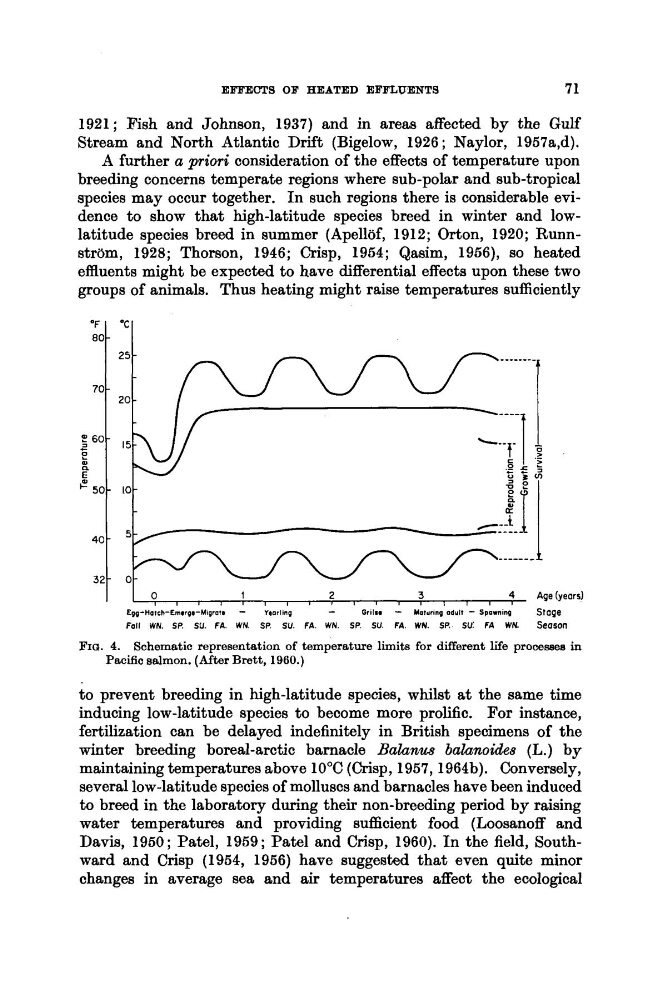
FIQ. 4. Schematic representation of temperature limits for different 1Xe processes i n
Pacific salmon. (After Brett, 1960.)
to prevent breeding in high-latitude species, whilst at the same time
inducing low-latitude species to become more prolific. For instance,
fertilization can be delayed indefinitely in British specimens of the
winter breeding boreal-arctic barnacle Balanus balanoides (L.) by
maintaining temperatures above 10°C (Crisp, 1957,1964b). Conversely,
several low-latitude species of molluscs and barnacles have been induced
to breed in the laboratory during their non-breeding period by raising
water temperatures and providing sufficient food (Loosanoff and
Davis, 1950 ; Patel, 1959 ; Patel and Crisp, 1960). I n the field, Southward and Crisp (1954, 1956) have suggested that even quite minor
changes in average sea and air temperatures affect the ecoIogica1
71
1921 ; Fish and Johnson, 1937) and in areas affected by the Gulf
Stream and North Atlantic Drift (Bigelow, 1926 ; Naylor, 1957a,d).
A further a priori consideration of the effects of temperature upon
breeding concerns temperate regions where sub-polar and sub-tropical
species may occur together. I n such regions there is considerable evidence to show that high-latitude species breed in winter and lowlatitude species breed in summer (Apellof, 1912; Orton, 1920; Runnstrdm, 1928; Thorson, 1946; Crisp, 1954; Qasim, 1956), so heated
effluents might be expected to have differential effects upon these two
groups of animals. Thus heating might raise temperatures sufficiently
70 -
$ 6 0 -
e
' 5 0 -
c
B
40 -
32 -
10 -
lot
1
2
3
4
Age(years)
I
I
t
I
8
I
l
l
1
1
I
Egg-HolSh-Em~rp(-M,g~ot~
- Yaorling
- Gfilam - Morunnp adult - Spowning Slage
Fall WN. SP. SU. FA. WN. Sp. SU. FA. WN. SP. SU. FA. WN. SR SU: FA WN.
SeaSon
FIQ. 4. Schematic representation of temperature limits for different 1Xe processes i n
Pacific salmon. (After Brett, 1960.)
to prevent breeding in high-latitude species, whilst at the same time
inducing low-latitude species to become more prolific. For instance,
fertilization can be delayed indefinitely in British specimens of the
winter breeding boreal-arctic barnacle Balanus balanoides (L.) by
maintaining temperatures above 10°C (Crisp, 1957,1964b). Conversely,
several low-latitude species of molluscs and barnacles have been induced
to breed in the laboratory during their non-breeding period by raising
water temperatures and providing sufficient food (Loosanoff and
Davis, 1950 ; Patel, 1959 ; Patel and Crisp, 1960). I n the field, Southward and Crisp (1954, 1956) have suggested that even quite minor
changes in average sea and air temperatures affect the ecoIogica1