

46
M. J. WELLS
function of the time spent in the aquarium. Secondly, it is stated
(though no data are given) that performance improved during days
when several trials were given. Thirdly, it was noticed that the animals,
escaping off their test board onto the floor of their aquarium, soon
ceased to pause at the edge of the board. All imply that the animals
were actually learning something about the test situation. A more
convincing proof comes from tests made with the three successful
starfish at the end of their training experiments. These three, trained
not to use arms 1 and 2 on either side of the madreporite, were afterAstropecten
Astropecten
Dark+/lightv h -
-
-: 2
;0
c u)
0
40
c
In1
Ls
c
E . : j h w i
h8 2
$ 1
0
E
5
20
40
5
2 0
40
Triols
Trials
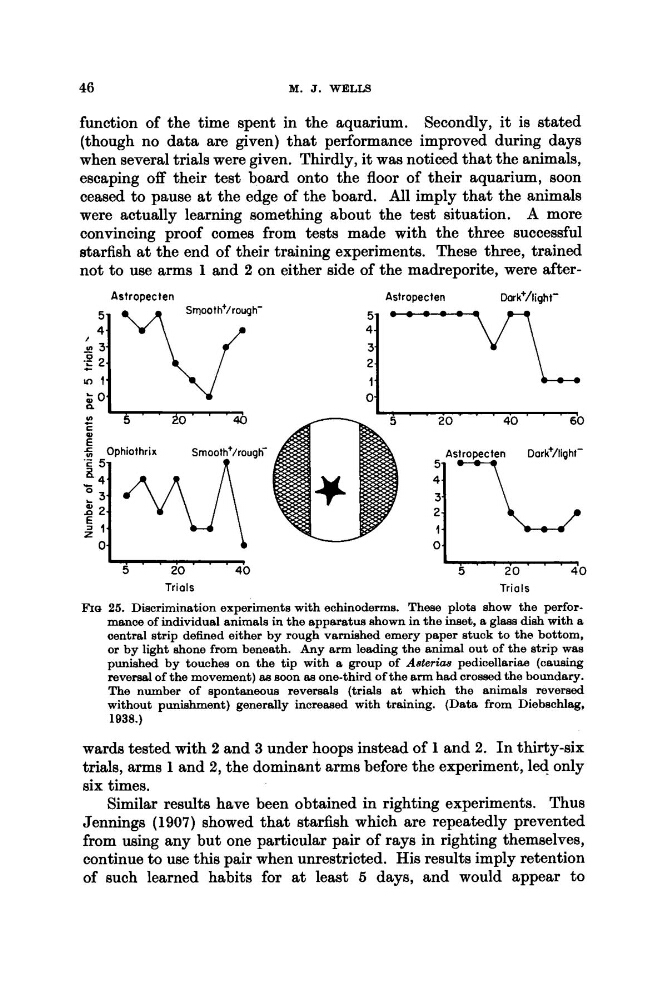
Fro 26. Discrimination experiments with echinoderms. These plots show the performance of individual animals in the apparatus shown in the inset, a glass dish with a
central strip defined either by rough varnished emery paper stuck to the bottom,
or by light shone from beneath. Any arm leading the animal out of the strip was
punished by touches on the tip with a group of Asterias pedicellariae (causing
reversal of the movement) &B soon as one-third of the arm had crossed the boundary.
The number of spontaneous reversals (trials a t which the animals reversed
without punishment) generally increased with training. (Data from Diebschlag,
1938.)
wards tested with 2 and 3 under hoops instead of 1 and 2. In thirty-six
trials, arms 1 and 2, the dominant arms before the experiment, led only
six times.
Similar results have been obtained in righting experiments. Thus
Jennings (1907) showed that starfish which are repeatedly prevented
from using any but one particular pair of rays in righting themselves,
continue to use this pair when unrestricted. His results imply retention
of such learned habits for at least 6 days, and would appear to
M. J. WELLS
function of the time spent in the aquarium. Secondly, it is stated
(though no data are given) that performance improved during days
when several trials were given. Thirdly, it was noticed that the animals,
escaping off their test board onto the floor of their aquarium, soon
ceased to pause at the edge of the board. All imply that the animals
were actually learning something about the test situation. A more
convincing proof comes from tests made with the three successful
starfish at the end of their training experiments. These three, trained
not to use arms 1 and 2 on either side of the madreporite, were afterAstropecten
Astropecten
Dark+/lightv h -
-
-: 2
;0
c u)
0
40
c
In1
Ls
c
E . : j h w i
h8 2
$ 1
0
E
5
20
40
5
2 0
40
Triols
Trials
Fro 26. Discrimination experiments with echinoderms. These plots show the performance of individual animals in the apparatus shown in the inset, a glass dish with a
central strip defined either by rough varnished emery paper stuck to the bottom,
or by light shone from beneath. Any arm leading the animal out of the strip was
punished by touches on the tip with a group of Asterias pedicellariae (causing
reversal of the movement) &B soon as one-third of the arm had crossed the boundary.
The number of spontaneous reversals (trials a t which the animals reversed
without punishment) generally increased with training. (Data from Diebschlag,
1938.)
wards tested with 2 and 3 under hoops instead of 1 and 2. In thirty-six
trials, arms 1 and 2, the dominant arms before the experiment, led only
six times.
Similar results have been obtained in righting experiments. Thus
Jennings (1907) showed that starfish which are repeatedly prevented
from using any but one particular pair of rays in righting themselves,
continue to use this pair when unrestricted. His results imply retention
of such learned habits for at least 6 days, and would appear to