

LEARNING BY MARINE INVERTEBRATES
37
C . Learning by Limulus polyphemus
An isolated classical conditioning experiment has been done with
this arachnid. The animals ( n = 18) were clamped in aquaria with
seawater covering the gills but not the eyes. Kymographic records of
tail movements were kept. The animals were first checked to see if they
made tail movements in response to light alone (200 W at 8 in) ; two
that moved more than twelve times in twenty trials were discarded.
Eight experimental animals were then subjected to trials in which the
light was switched on for 10 secondsevery 100-260 sec (the interval was
varied a t random) ; in the last lit second a 9 volt D.C. shock was given.
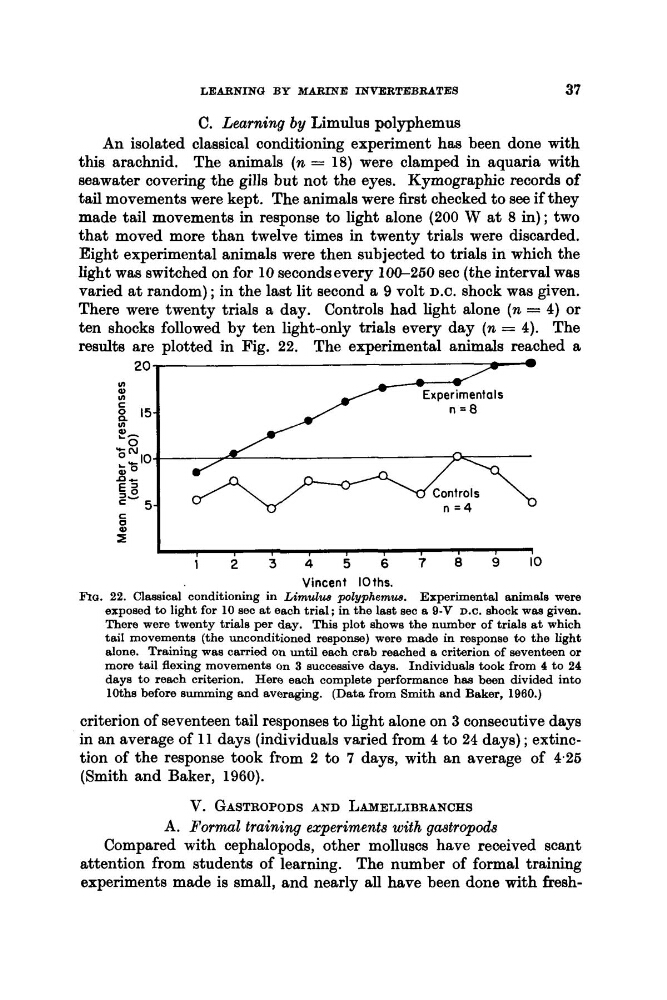
There were twenty trials a day. Controls had light alone ( n = 4) or
ten shocks followed by ten light-only trials every day (n = 4). The
resulta are plotted in Fig. 22. The experimental animals reached a
20 -7
ul
0) ul
c
P
"
1
2
3
4
5
6
7
6
9
1
0
Vincent IOths.
Experimental animals were
exposed to light for 10 sec at each trial ; in the last sec a 9-V D.C. shock was given.
There were twenty trials per day. This plot shows the number of trials a t which
tail movements (the unconditioned response) were made in response to the light
alone. Training was carried on until each crab reached a criterion of seventeen or
more tail flexing movements on 3 successive days. Individuals took from 4 to 24
days to reach criterion. Here each complete performance haa been divided into
lOths before summing and averaging. (Data from Smith and Baker, 1960.)
Fro. 22. Classical conditioning in Limulwr polyphemwr.
criterion of seventeen tail responses to light alone on 3 consecutive days
in an average of 11 days (individuals varied from 4 to 24 days) ; extinction of the response took from 2 to 7 days, with an average of 4.26
(Smith and Baker, 1960).
V. GASTROPODS AND LAMELLIBRANCHS
A. Formal training experiments with gastropods
Compared with cephalopods, other molluscs have received scant
attention from students of learning. The number of formal training
experiments made is small, and nearly all have been done with fresh-
37
C . Learning by Limulus polyphemus
An isolated classical conditioning experiment has been done with
this arachnid. The animals ( n = 18) were clamped in aquaria with
seawater covering the gills but not the eyes. Kymographic records of
tail movements were kept. The animals were first checked to see if they
made tail movements in response to light alone (200 W at 8 in) ; two
that moved more than twelve times in twenty trials were discarded.
Eight experimental animals were then subjected to trials in which the
light was switched on for 10 secondsevery 100-260 sec (the interval was
varied a t random) ; in the last lit second a 9 volt D.C. shock was given.
There were twenty trials a day. Controls had light alone ( n = 4) or
ten shocks followed by ten light-only trials every day (n = 4). The
resulta are plotted in Fig. 22. The experimental animals reached a
20 -7
ul
0) ul
c
P
"
1
2
3
4
5
6
7
6
9
1
0
Vincent IOths.
Experimental animals were
exposed to light for 10 sec at each trial ; in the last sec a 9-V D.C. shock was given.
There were twenty trials per day. This plot shows the number of trials a t which
tail movements (the unconditioned response) were made in response to the light
alone. Training was carried on until each crab reached a criterion of seventeen or
more tail flexing movements on 3 successive days. Individuals took from 4 to 24
days to reach criterion. Here each complete performance haa been divided into
lOths before summing and averaging. (Data from Smith and Baker, 1960.)
Fro. 22. Classical conditioning in Limulwr polyphemwr.
criterion of seventeen tail responses to light alone on 3 consecutive days
in an average of 11 days (individuals varied from 4 to 24 days) ; extinction of the response took from 2 to 7 days, with an average of 4.26
(Smith and Baker, 1960).
V. GASTROPODS AND LAMELLIBRANCHS
A. Formal training experiments with gastropods
Compared with cephalopods, other molluscs have received scant
attention from students of learning. The number of formal training
experiments made is small, and nearly all have been done with fresh-