

LEARNINU BY MARINE INVERTEBRATES
35
Home tub'
sequently recovered from the catch area. Creaser and Travis (1960)
reporting on a similar experiment, recaptured about 20% of their
Panulirus following similar displacements from a reef area a quarter of
a mile square. Clearly any proper assessment of these results depends
on the chances of individuals turning up as a result of random move0 0 0
N
NE
(b)
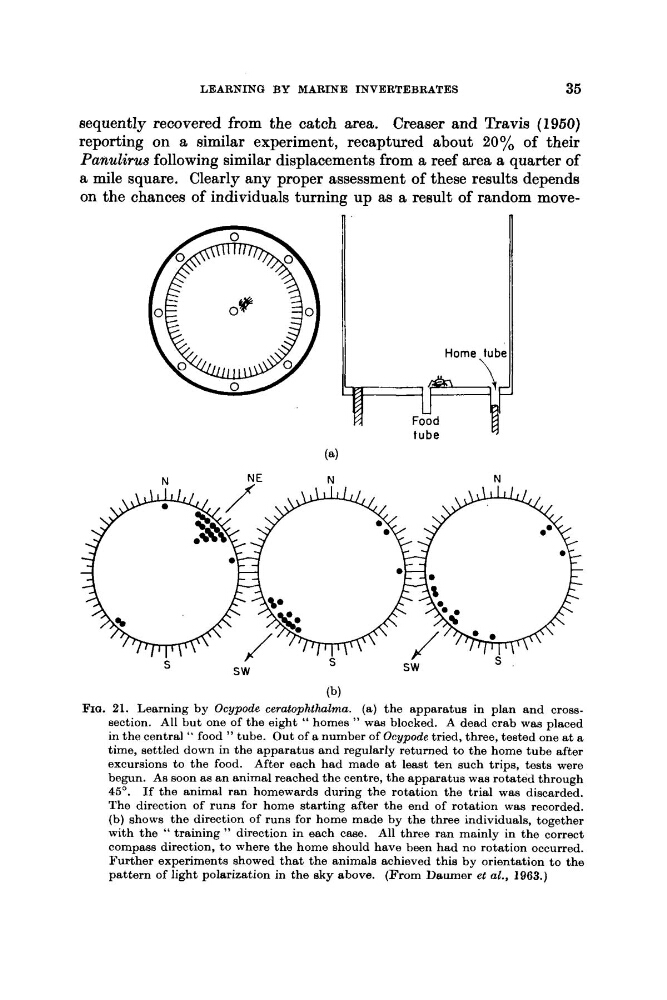
FIQ. 21. Learning by Ocypode ceratophthalma. (a) the apparatus in plan and crosssection. All but one of the eight '' homes " was blocked. A dead crab was placed
in the central " food " tube. Out of a number of Ocypode tried, three, tested one a t a
time, settled down in the apparatus and regularly returned to the home tube after
excursions to the food. After each had made at least ten such trips, tests were
begun. As soon as an animal reached the centre, the apparatus was rotated through
45'. If the animal ran homewards during the rotation the trial was discarded.
The direction of runs for home starting after the end of rotation was recorded.
(b) shows the direction of runs for home made by the three individuals, together
with the '' training " direction in each case. All three ran mainly in the correct
compaas direction, to where the home should have been had no rotation occurred.
Further experiments showed that the animals achieved this by orientation to the
pattern of light polarization in the sky above. (From Daumer e.! al., 1963.)
35
Home tub'
sequently recovered from the catch area. Creaser and Travis (1960)
reporting on a similar experiment, recaptured about 20% of their
Panulirus following similar displacements from a reef area a quarter of
a mile square. Clearly any proper assessment of these results depends
on the chances of individuals turning up as a result of random move0 0 0
N
NE
(b)
FIQ. 21. Learning by Ocypode ceratophthalma. (a) the apparatus in plan and crosssection. All but one of the eight '' homes " was blocked. A dead crab was placed
in the central " food " tube. Out of a number of Ocypode tried, three, tested one a t a
time, settled down in the apparatus and regularly returned to the home tube after
excursions to the food. After each had made at least ten such trips, tests were
begun. As soon as an animal reached the centre, the apparatus was rotated through
45'. If the animal ran homewards during the rotation the trial was discarded.
The direction of runs for home starting after the end of rotation was recorded.
(b) shows the direction of runs for home made by the three individuals, together
with the '' training " direction in each case. All three ran mainly in the correct
compaas direction, to where the home should have been had no rotation occurred.
Further experiments showed that the animals achieved this by orientation to the
pattern of light polarization in the sky above. (From Daumer e.! al., 1963.)