

MARINE TOXINS AND VENOMOUS AND POISONOUS MARINE A N I M U S
339
his hand, m e and shoulder, we all with much sorrow concluded his funerall,
mid prepared his grave in an Island by, aa himselfe directed : yet it pleased God
by a precious oyle Doctor Russell a t the first applyed to it when he sounded it
with probe, (ere night) his tormenting paine waa so well asswaged that he eate
of the fish to his supper, which gave no lesse joy and content to us than ease to
himselfe. For which we called the island Stingray Isle after the name of the fish.”
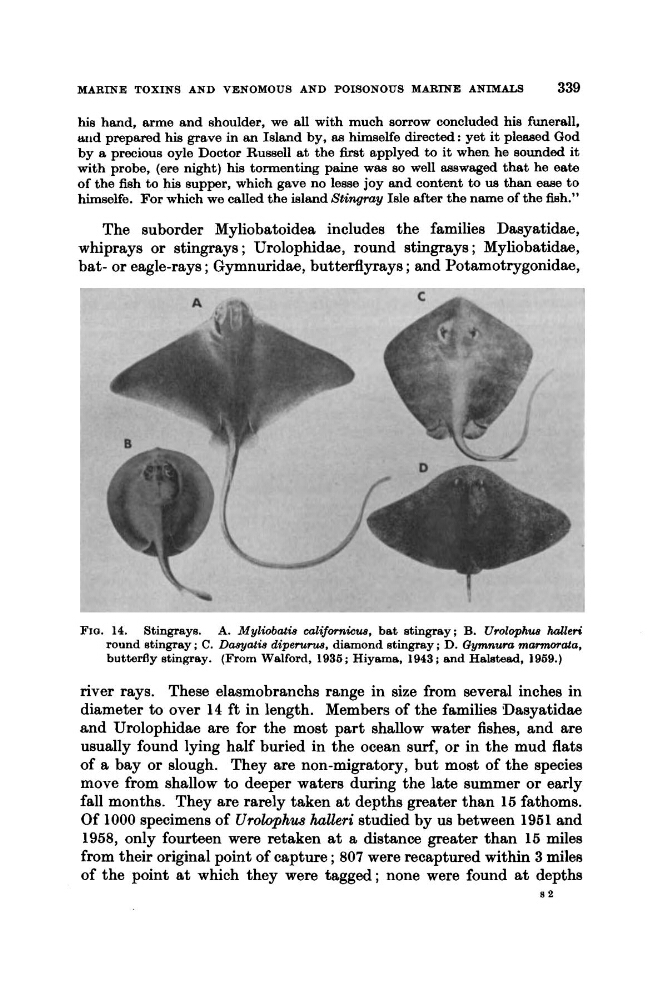
The suborder Myliobatoidea includes the families Dasyatidae,
whiprays or stingrays ; Urolophidae, round stingrays ; Myliobatidae,
bat- or eagle-rays ; Gymnuridae, butterflyrays ; and Potamotrygonidae,
Fro. 14. Stingrays. A. Myliobatia califwnicus, bat stingray; B. Urolophus hdlen’
round stingray ; C. Daqatis d i p e r u m , diamond stingray ; D. aymnura mamnwata,
butterfly stingray. (From Walforcl, 1936; Hiyama, 1943; and Halstead, 1969.)
river rays. These elasmobranchs range in size from several inches in
diameter to over 14 ft in length. Members of the families ’Dasyatidae
and Urolophidae are for the most part shallow water fishes, and are
usually found lying half buried in the ocean surf, or in the mud flats
of a bay or slough. They are non-migratory, but most of the species
move from shallow to deeper waters during the late summer or early
fall months. They are rarely taken at depths greater than 15 fathoms.
Of 1000 specimens of Urohphus halleri studied by us between 1951 and
1958, only fourteen were retaken at a distance greater than 15 miles
from their original point of capture ; 807 were recaptured within 3 miles
of the point at which they were tagged; none were found at depths
5 2
339
his hand, m e and shoulder, we all with much sorrow concluded his funerall,
mid prepared his grave in an Island by, aa himselfe directed : yet it pleased God
by a precious oyle Doctor Russell a t the first applyed to it when he sounded it
with probe, (ere night) his tormenting paine waa so well asswaged that he eate
of the fish to his supper, which gave no lesse joy and content to us than ease to
himselfe. For which we called the island Stingray Isle after the name of the fish.”
The suborder Myliobatoidea includes the families Dasyatidae,
whiprays or stingrays ; Urolophidae, round stingrays ; Myliobatidae,
bat- or eagle-rays ; Gymnuridae, butterflyrays ; and Potamotrygonidae,
Fro. 14. Stingrays. A. Myliobatia califwnicus, bat stingray; B. Urolophus hdlen’
round stingray ; C. Daqatis d i p e r u m , diamond stingray ; D. aymnura mamnwata,
butterfly stingray. (From Walforcl, 1936; Hiyama, 1943; and Halstead, 1969.)
river rays. These elasmobranchs range in size from several inches in
diameter to over 14 ft in length. Members of the families ’Dasyatidae
and Urolophidae are for the most part shallow water fishes, and are
usually found lying half buried in the ocean surf, or in the mud flats
of a bay or slough. They are non-migratory, but most of the species
move from shallow to deeper waters during the late summer or early
fall months. They are rarely taken at depths greater than 15 fathoms.
Of 1000 specimens of Urohphus halleri studied by us between 1951 and
1958, only fourteen were retaken at a distance greater than 15 miles
from their original point of capture ; 807 were recaptured within 3 miles
of the point at which they were tagged; none were found at depths
5 2