

116. J. WELLS
24
101
7 '
._
73
0
0
z
b
I 5'
g
L
01
rn 0
c
*
2
n" 2!
C
I
I
I
I
,
,
,
I
I
5
10
15
20 25 30 35
Trials
( 0 1
\ , m m
,
,
I
,
T
I
I
1
5
1 0
15
20 25
30
( b l
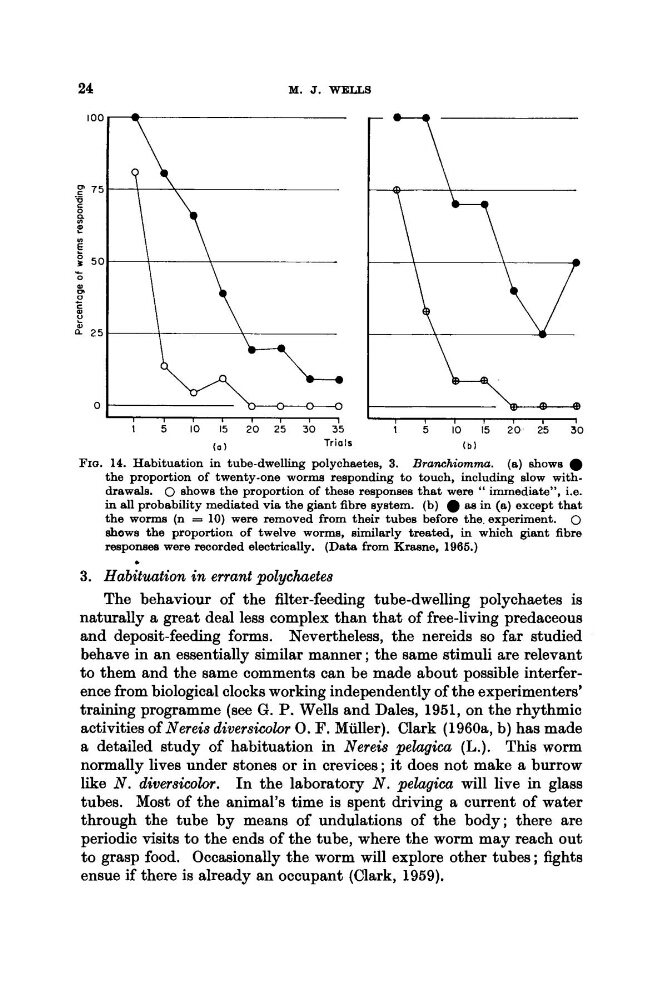
FIG. 14. Habituation in tube-dwelling polychaetes, 3. Branchiomma. (a) shows
the proportion of twenty-one worms responding to touch, including slow withdrawals. 0 shows the proportion of these responses that were " immediate", i.e.
in all probability mediated via the giant fibre system. (b)
aa in (a) except that
the worms (n = 10) were removed from their tubes before the.experiment. 0
shows the proportion of twelve worms, similarly treated, in which giant fibre
responses were recorded electrically. (Data from Kraane, 1966.)
.
3. Habituation in errant polychaetes
The behaviour of the filter-feeding tube-dwelling polychaetes is
naturally a great deal less complex than that of free-living predaceous
and deposit-feeding forms. Nevertheless, the nereids so far studied
behave in an essentially similar manner ; the same stimuli are relevant
to them and the same comments can be made about possible interference from biological clocks working independently of the experimenters'
training programme (see G. P. Wells and Dales, 1951, on the rhythmic
activities of Nereis diversicoh 0. F. Muller). Clark (1960a, b) has made
a detailed study of habituation in Nereis pelagica (L.). This worm
normally lives under stones or in crevices ; it does not make a burrow
like N . diversicoh. In the laboratory N . pelagica will live in glass
tubes. Most of the animal's time is spent driving a current of water
through the tube by means of undulations of the body; there are
periodic visits to the ends of the tube, where the worm may reach out
to grasp food. Occasionally the worm will explore other tubes ; fights
ensue if there is already an occupant (Clark, 1959).
24
101
7 '
._
73
0
0
z
b
I 5'
g
L
01
rn 0
c
*
2
n" 2!
C
I
I
I
I
,
,
,
I
I
5
10
15
20 25 30 35
Trials
( 0 1
\ , m m
,
,
I
,
T
I
I
1
5
1 0
15
20 25
30
( b l
FIG. 14. Habituation in tube-dwelling polychaetes, 3. Branchiomma. (a) shows
the proportion of twenty-one worms responding to touch, including slow withdrawals. 0 shows the proportion of these responses that were " immediate", i.e.
in all probability mediated via the giant fibre system. (b)
aa in (a) except that
the worms (n = 10) were removed from their tubes before the.experiment. 0
shows the proportion of twelve worms, similarly treated, in which giant fibre
responses were recorded electrically. (Data from Kraane, 1966.)
.
3. Habituation in errant polychaetes
The behaviour of the filter-feeding tube-dwelling polychaetes is
naturally a great deal less complex than that of free-living predaceous
and deposit-feeding forms. Nevertheless, the nereids so far studied
behave in an essentially similar manner ; the same stimuli are relevant
to them and the same comments can be made about possible interference from biological clocks working independently of the experimenters'
training programme (see G. P. Wells and Dales, 1951, on the rhythmic
activities of Nereis diversicoh 0. F. Muller). Clark (1960a, b) has made
a detailed study of habituation in Nereis pelagica (L.). This worm
normally lives under stones or in crevices ; it does not make a burrow
like N . diversicoh. In the laboratory N . pelagica will live in glass
tubes. Most of the animal's time is spent driving a current of water
through the tube by means of undulations of the body; there are
periodic visits to the ends of the tube, where the worm may reach out
to grasp food. Occasionally the worm will explore other tubes ; fights
ensue if there is already an occupant (Clark, 1959).